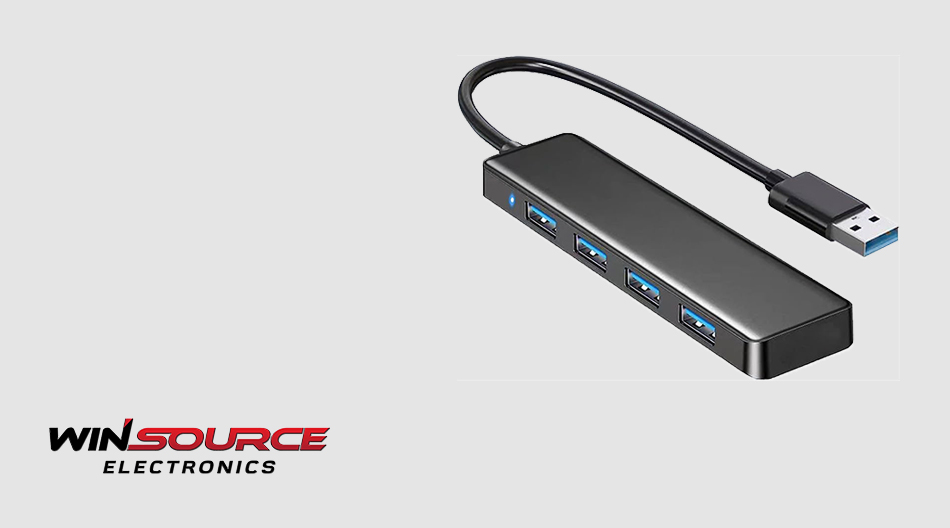
In embedded systems, industrial equipment, and various computing platforms, USB remains one of the most widely used and mature interfaces for peripheral connectivity. When a system needs to support both high-speed and low-speed devices simultaneously, a 4-port USB 3.0 hub often becomes an essential functional module.
However, in practical design, selecting a USB hub controller is far more complex than simply choosing one that “supports USB 3.0 and has enough ports.” Taking the TUSB8041RGCR, a common four-port USB 3.0 hub controller, as an example, its internal architecture, power supply strategy, stability, and long-term reliability all directly impact the overall system performance.
1. System Architecture: How the Hub Integrates into the Overall Platform
At the early stage of device selection, engineering teams should first evaluate how well a USB hub controller fits into the overall system architecture. Different platforms—such as x86 industrial PCs, ARM-based SoCs, or custom-designed boards—depend on USB subsystems in different ways, and the role of the hub may vary accordingly.
Besides considering whether it supports USB 3.0 backward compatibility with USB 2.0, the architecture design of the controller itself should also be evaluated. Taking four-port hub controllers like the TUSB8041RGCR as an example, their internal scheduling mechanisms and port architecture design often directly affect system performance when multiple devices are operating simultaneously at different speeds. Furthermore, the flexibility of the upstream and downstream port configurations will also impact the system’s future expansion capabilities.
Viewing the hub’s role from a system-level perspective often helps identify potential integration issues early, rather than discovering them during later development stages.
2. Power Management and Power Consumption Control: An Often Overlooked Design Priority
Power-related issues in a USB 3.0 hub become particularly prominent in multi-port, high-speed data transfer scenarios. A mature hub controller typically needs a well-defined power management framework—rather than merely being able to “provide power.”
When designing or selecting a controller, key points to focus on include:
- Whether each downstream port supports independent power control
- Whether the controller provides protection against overcurrent, overvoltage, and abnormal power interruptions
- Whether low-power or port-level suspend modes are supported when ports are idle or not in use
Well-implemented power management not only helps reduce overall system power consumption, but also significantly improves reliability in industrial or long-running equipment.
3. Signal Integrity and Real-World Stability: High Speed Does Not Always Mean Reliable
The high-speed nature of USB 3.0 places much stricter demands on signal integrity. Even when PCB routing fully complies with design guidelines, systems may still experience issues such as disconnections, re-enumeration, or unstable data rates during real-world operation.
In these cases, the signal processing capability of the USB hub controller itself becomes a key factor. Features such as integrated signal equalization and pre-emphasis can improve tolerance to signal loss and complex routing conditions. The ability to maintain stable data transmission when multiple ports operate concurrently is equally important.
Rather than relying solely on theoretical specifications, proven mass-production deployment is often a stronger indicator of a controller’s reliability—especially for industrial, medical, and machine vision applications where stability is more critical than peak bandwidth.
4. Product Lifecycle and Supply Stability: Practical Considerations for Long-Term Projects
In non-consumer applications, product lifecycles are typically measured in years. As a result, long-term availability, manufacturer support policies, and supply chain stability should be considered as carefully as technical specifications.
Engineering teams should evaluate whether a USB hub controller has a clearly defined lifecycle roadmap and whether there is any risk of short-term discontinuation or forced redesign. Access to stable documentation, reference designs, and ongoing technical support can also significantly reduce long-term maintenance and upgrade costs.
From a long-term perspective, component selection is not only a technical decision, but also a strategic supply chain choice.
Choosing a suitable 4-Port USB 3.0 Hub Controller is essentially a system-level trade-off. Whether it’s a mature model like the TUSB8041RGCR or other similar devices, a comprehensive evaluation of architecture, power consumption, stability, and lifecycle is necessary to truly meet long-term application requirements.
Throughout this process, electronic component distributors with broad product access and industry experience can provide valuable insights for both engineering and procurement teams. As a long-term global distributor serving the electronics industry, WIN SOURCE continues to focus on USB, embedded, and industrial applications, helping customers make more robust and sustainable decisions during both the design and sourcing stages.
© 2025 Win Source Electronics. All rights reserved. This content is protected by copyright and may not be reproduced, distributed, transmitted, cached or otherwise used, except with the prior written permission of Win Source Electronics.