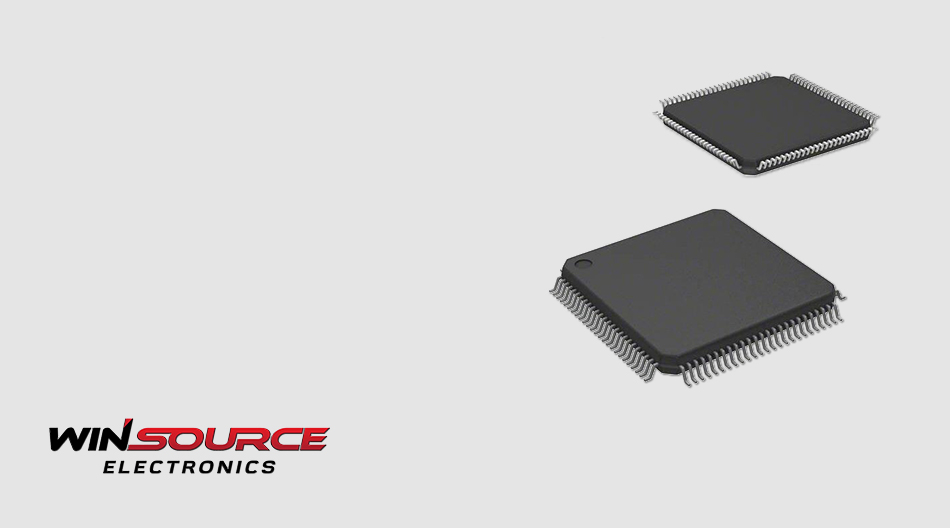
In the embedded systems field, new generations of MCUs continue to emerge. However, in industrial control, long-lifecycle products, and platform-continuation projects, selectionpriorities are often not about pursuing the latest architecture, but about controlling risk, shortening validation cycles, and ensuring long-term maintainability. Based on the ARM Cortex-M3 core, NXP’s LPC1768FBD100K is not a new architecture, yet it continues to be used in many industrial and continuation-type projects. Its value lies in the engineering certainty provided by a mature platform rather than headline performance specifications.
1. Engineering Certainty First: Keeping Risk Within a Controllable Range
From a systems engineering perspective, MCU “maturity” typically implies two key attributes: predictable behavior and reproducible issues. With a maximum operating frequency of 100 MHz, the LPC1768FBD100K achieves a stable balance between real-time responsiveness, instruction efficiency, and power consumption, sufficient for many control- and communication-oriented applications. More importantly, it has accumulated years of usage experience across multiple engineering applications, making exception handling behavior, peripheral response boundaries, and common timing characteristics easier for engineering teams to understand and manage.
This predictability translates directly into engineering benefits:
- Shorter debugging paths: In common scenarios such as interrupt handling, peripheral interaction, and low-power mode transitions, teams can establish clear and repeatable validation methods.
- Higher system consistency: For volume production and long-term maintenance, stable platform behavior helps reduce uncertain field issues.
- More controllable validation costs: As projects enter pilot production, certification, or delivery phases, mature platforms are often more conducive to executing regression testing and reliability validation as planned.
In other words, while it may not offer the highest raw performance, the LPC1768FBD100K functions as a reliable system foundation, well suited to engineering projects that prioritize predictable delivery.
2. System-Level Matching of Interfaces and Resources: Covering More Scenarios with Less Complexity
From a system architecture perspective, the peripheral configuration of the LPC1768FBD100K reflects a typical “engineering-practical” combination. Multiple UART, SPI, and I²C interfaces support sensor integration and peripheral expansion; CAN targets industrial field networks; Ethernet and USB capabilities allow the device to be used in communication gateways, data acquisition nodes, and network-connected terminals. Its on-chip Flash and SRAM are also well suited to hosting medium-scale firmware and commonly used protocol stacks.
The value of this configuration lies not in feature accumulation, but in reducing external system dependencies:
- Comprehensive interfaces mean many applications can avoid additional bridge devices, lowering BOM cost and driver integration effort.
- Parallel multi-protocol operation is easier to implement, allowing the MCU to handle communication and data processing alongside control tasks.
- Clearer architectural planning enables functional separation of control, communication, and management layers, improving long-term maintainability.
For industrial control units, communication gateways, and multi-interface embedded nodes, platforms that are functionally complete without excessive complexity often align more closely with real-world requirements.
3. Practical Lifecycle Trade-offs: Migration Costs Are Often Higher Than Upgrade Gains
When product lifecycles extend to ten years or longer, MCU selection tends to shift from performance comparison toward lifecycle management. In this context, the advantages of the LPC1768FBD100K become more evident. A mature toolchain, well-established reference designs, comprehensive application documentation, and reusable engineering experience allow teams to maintain and iterate on existing designs rather than repeatedly migrating to new platforms. Platform migration costs are frequently underestimated. Driver rewrites are only the beginning—differences in timing behavior, peripheral characteristics, toolchains, and library dependencies, along with renewed certification and regression testing, can significantly increase risk and development timelines. For many projects, a more rational approach is not aggressive upgrading, but continuing with a mature platform under clearly defined requirements and controlled risk, while allocating resources to more critical engineering objectives such as system reliability, communication security, algorithm optimization, or field maintainability.
Accordingly, the role of the LPC1768FBD100K in modern designs is not to replace high-performance Cortex-M7 devices or application processors, but to continue serving as a reliable control and connectivity layer in systems that emphasize real-time behavior, stability, interface reliability, and long-term availability.
In embedded system design, “mature” does not equate to “obsolete.” The continued adoption of the LPC1768FBD100K reflects a long-standing principle in engineering practice: when performance sufficiently meets application requirements, predictability, maintainability, and lifecycle cost often outweigh architectural novelty. For projects focused on reliable delivery and long-term operation, the engineering certainty offered by mature platforms is difficult to replace through parameter upgrades alone.
In component selection and supply assurance, industry service providers—including WIN SOURCE—continue to pay close attention to the practical requirements of such mature MCUs across different application scenarios, supporting engineering design and project execution.
© 2025 Win Source Electronics. All rights reserved. This content is protected by copyright and may not be reproduced, distributed, transmitted, cached or otherwise used, except with the prior written permission of Win Source Electronics.