
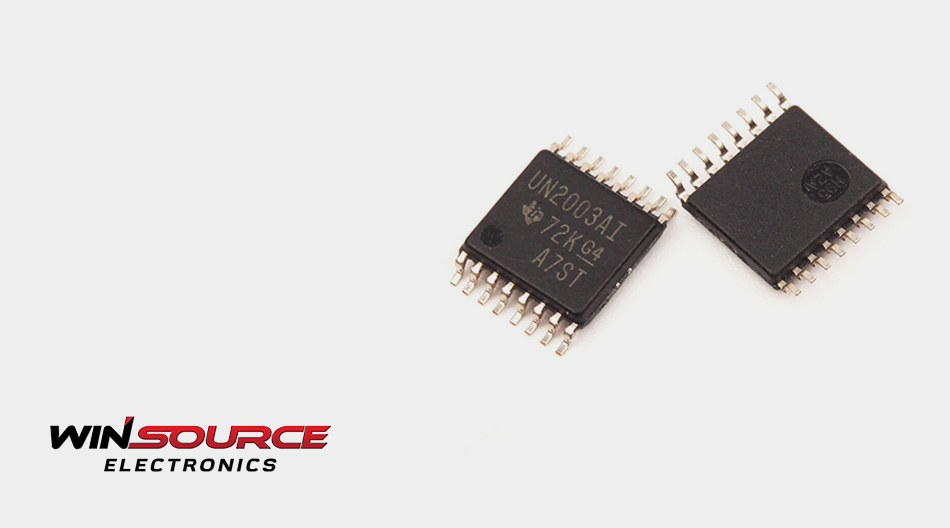
In practical electronic system design, there is often a significant capability gap between logic control circuits and the loads they are expected to drive. The current and voltage levels provided by microcontrollers or logic devices are typically insufficient to directly drive relays, solenoids, stepper motors, or other inductive loads. Without a properly designed driver stage in the system architecture, this mismatch can lead not only to functional limitations but also to long-term reliability and lifespan risks.
ULN2003AIPWR has been widely adopted as a classic driver device precisely in this context. As a seven-channel Darlington transistor array, it has maintained long-term engineering value in multi-channel load control, interface isolation, and overall system simplification.
1. Device Structure and Driving Characteristics of ULN2003AIPWR
ULN2003AIPWR integrates seven NPN Darlington pairs, with each channel including an internal input resistor and a common-emitter output configuration. This architecture allows the device to interface directly with TTL or CMOS logic signals, eliminating the need for additional level-shifting or pre-amplification circuitry. From a system design perspective, this “direct logic interface” characteristic significantly reduces peripheral circuit complexity.
The high current gain provided by the Darlington structure enables ULN2003AIPWR to deliver higher collector currents with relatively low input drive capability, making it suitable for driving low- to medium-power loads. In addition, the device integrates common flyback diodes designed to suppress reverse voltage spikes generated when inductive loads are switched off. This feature is especially critical in applications involving relay coils or motor windings, serving as an essential protection mechanism for system stability.
From a packaging standpoint, ULN2003AIPWR is offered in a TSSOP package, which is well suited for high-density PCB layouts and multi-channel integration. This further contributes to its continued relevance in modern compact system designs.
2. Why ULN2003AIPWR Is Still Chosen in System Design
When selecting a driver solution, engineers must often balance integration level, cost, reliability, and design complexity. Despite the availability of various dedicated driver ICs and intelligent power devices on the market, ULN2003AIPWR continues to be used in a wide range of projects. The reason goes beyond its status as a “classic” component and lies more in the predictability and controllability it offers at the system level.
- Clear functional boundaries for system modeling and verification
ULN2003AIPWR does not attempt to integrate excessive control logic. Instead, it focuses on providing a straightforward interface between low-power control signals and load-driving capability. This clearly defined functionality makes it easier to analyze, verify, and reuse within system architectures.
- Centralized multi-channel driving to reduce component count and BOM complexity
For systems that need to control multiple relays, indicators, or actuators simultaneously, ULN2003AIPWR helps reduce the number of discrete components required. This simplifies routing and BOM structure, ultimately improving system maintainability.
- Mature applications and extensive engineering references to reduce uncertainty
The ULN2003 family has a long and stable application history, supported by abundant application notes, reference designs, and field-proven engineering experience. During debugging, failure analysis, and mass production validation, this level of maturity can significantly reduce trial-and-error costs and development time.
3. Typical Application Scenarios and Design Considerations
In real-world projects, ULN2003AIPWR is commonly found in industrial control modules, automation equipment, instrumentation, and embedded control systems. For example, in relay-driving applications, control signals from a microcontroller are amplified by ULN2003AIPWR to directly drive relay coils, achieving effective separation between logic and power stages. Its multi-channel architecture is equally well suited for stepper motor control or multi-actuator systems. However, designers must still pay close attention to the device’s operating limits. Single-channel current capability and total power dissipation under multi-channel conduction are critical parameters that should be carefully evaluated during system design. In applications involving high duty cycles or continuous conduction, thermal characteristics must be validated in conjunction with PCB heat dissipation conditions.
At the layout level, it is recommended to minimize the load loop length and carefully plan the grounding and power supply paths to reduce noise and coupling risks. These details often determine the stable performance of the driver circuit during long-term operation.
From a system selection standpoint, ULN2003AIPWR is not a solution that pursues high integration or advanced intelligence. Instead, it is a foundational driver device with clear positioning and well-defined boundaries. It is precisely this stability and predictability that allow it to continue delivering value across multiple generations of electronic systems.
In practical project execution, beyond the technical characteristics of the component itself, stable supply and reliable sourcing are equally important. Electronic component distributors such as WIN SOURCE can support engineering teams during component selection and procurement, helping system designs move more smoothly from concept to implementation.
© 2026 Win Source Electronics. All rights reserved. This content is protected by copyright and may not be reproduced, distributed, transmitted, cached or otherwise used, except with the prior written permission of Win Source Electronics.

COMMENTS