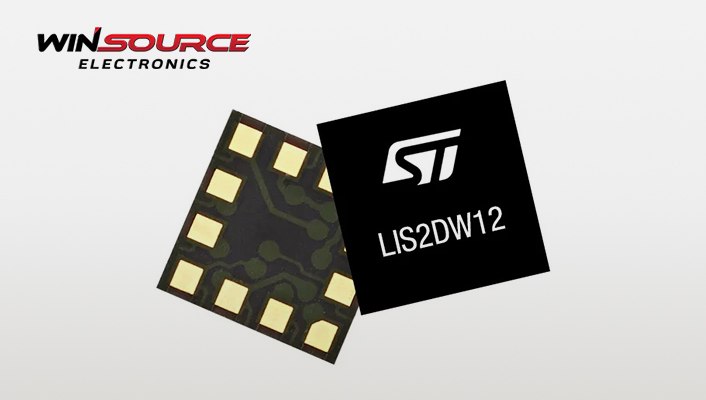
With the rapid development of wearable devices, IoT endpoints, and battery-powered systems, low-power sensors are becoming increasingly critical in system design. As a key component for motion sensing, state monitoring, and power management, accelerometer selection is no longer driven solely by accuracy specifications. Instead, greater emphasis is placed on power consumption, system integration, and long-term operational stability. Against this background, LIS2DW12TR has become a commonly adopted MEMS accelerometer for low-power applications.
1. Key Feature Analysis: Design Orientation for Low-Power Systems
In low-power end devices, accelerometers often serve as the front-end element for motion sensing and event triggering. From a system perspective, the primary challenge is not simply acquiring motion data, but minimizing unnecessary sampling and reducing continuous MCU involvement while maintaining always-on sensing. As a result, component selection typically requires a combined evaluation of operating mode coverage, event detection capability, and interrupt-based coordination to ensure alignment with overall power management and wake-up strategies.
From a positioning standpoint, LIS2DW12TR is designed for low-power continuous sensing scenarios, with its core advantages summarized in three aspects:
- Multi-mode power configuration: The device supports multiple operating modes, enabling motion detection and data output across different power levels. This allows system designers to balance performance requirements against power budget constraints through flexible configuration.
- Compact package and functional integration: LIS2DW12TR features a compact package suitable for space-constrained device designs. It also integrates multiple event detection functions, including wake-up detection, free-fall detection, and single/double-tap recognition. By offloading part of the motion event processing to the sensor level, overall system power consumption can be reduced.
- Interrupt-driven system coordination: Through interrupt-based operation, LIS2DW12TR works in coordination with the host controller and triggers system responses only when valid motion events are detected. This reduces continuous MCU activity, lowers average system power consumption, and helps extend battery life.
2. Application Scenarios: From Motion Sensing to State Monitoring
In practical deployments, LIS2DW12TR is commonly used in devices that are highly power-sensitive and expected to operate over long periods. In wearable applications, accelerometers are used not only for basic activity tracking, such as step counting, but also for functions like wear detection and sleep state monitoring. These use cases require the sensor to remain active for extended durations, placing higher demands on power efficiency and event-triggering strategies.
In IoT and asset tracking scenarios, accelerometers are more often used for monitoring state changes, such as vibration during transportation, movement detection, or abnormal event triggering. These systems typically rely on low-frequency monitoring and record or transmit data only when critical state changes occur. The low-power operating modes and event detection mechanisms of LIS2DW12TR allow devices to remain in low-energy states most of the time, while still responding effectively when events occur.
Additionally, in certain industrial and consumer electronic products, accelerometers are used to support power management strategies. For example, systems may dynamically switch operating modes based on whether the device is stationary or in motion. Such applications highlight the role of low-power accelerometers in system-level power optimization.
3. Design and Selection Considerations: Key Factors from an Engineering Perspective
During the accelerometer selection process, engineering teams typically evaluate multiple factors in parallel. Beyond basic parameters such as measurement range and resolution, power characteristics, interface compatibility, and long-term supply stability are equally important. LIS2DW12TR offers a balanced combination of low power consumption and functional integration, making it suitable for projects with clearly defined battery life requirements. From a system design perspective, effective use of embedded event detection capabilities can optimize overall power performance without increasing hardware complexity. At the same time, package type and soldering reliability should be matched to the target application environment to reduce assembly risks during mass production and ensure long-term stability.
As projects transition from sample validation to volume production, supply chain stability becomes a critical factor in successful deployment. Selecting partners with experience in electronic component distribution and the ability to support multi-stage delivery requirements can help reduce supply chain uncertainty and improve execution efficiency. As an electronic components distributor, WIN SOURCE has long supported a wide range of low-power and embedded application projects, offering experience in component selection support and supply coordination.
© 2026 Win Source Electronics. All rights reserved. This content is protected by copyright and may not be reproduced, distributed, transmitted, cached or otherwise used, except with the prior written permission of Win Source Electronics.