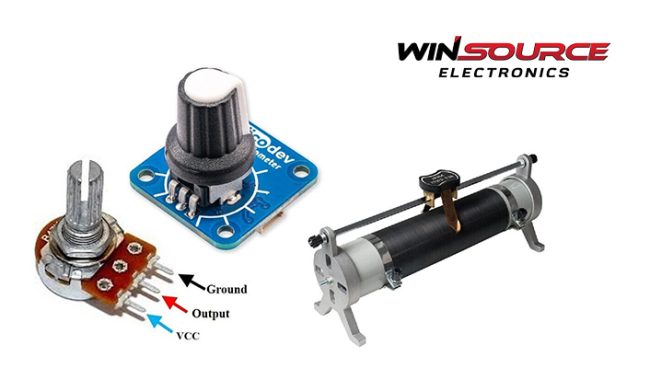
The Anatomy of a Potentiometer:
At its core, a potentiometer is a three-terminal resistor with a special twist – quite literally!
Comprising a resistive element, a sliding contact (wiper), and two fixed terminals, the potentiometer allows for variable resistance.
The resistive element can take various forms, such as a coiled wire or a thin layer on a substrate.
What sets potentiometers apart is the ability to adjust the resistance by turning a knob or sliding a lever, altering the voltage division across the circuit.
As technology continues its relentless march forward, the humble potentiometer is not left behind.
Traditional potentiometers, reliant on mechanical movement, have faced challenges such as wear and limited lifespan.
Enter the digital potentiometer, a modern marvel that replaces the conventional design with electronic switches, offering a new realm of possibilities.
Digital Precision
Digital potentiometers, also known as “digits,” provide a higher degree of precision and control compared to their analog counterparts.
With no mechanical parts to wear out, these digital marvels offer a longer lifespan and greater accuracy.
This shift to digital control aligns seamlessly with the digital era, where precise and programmable adjustments are the norm.
How Are Potentiometers Made?
The manufacturing of potentiometers involves several intricate steps to ensure their functionality and reliability.
The process begins with the creation of a resistive element, often a coiled wire or a thin layer on a substrate.
This element is carefully integrated with two fixed terminals and a sliding contact known as the wiper.
The assembly, comprising the resistive element and terminals, is then encapsulated to protect it from environmental factors and mechanical stress.
This encapsulation ensures the durability of the potentiometer, allowing it to withstand the rigors of various applications.
The final touch involves attaching the knob or slider, the user interface that enables the adjustment of resistance.
This component, whether it’s a rotating knob or a sliding lever, is designed for ease of use, providing a tactile interface for users to control the resistance within an electronic circuit.
Programmability and Memory
One of the key advantages of digital potentiometers is their programmability.
Users can control resistance digitally, allowing for automated adjustments in response to changing conditions.
This programmability also opens the door to incorporating memory functions, enabling devices to remember specific settings.
This feature is particularly valuable in applications where consistency and repeatability are crucial.
Integration with Microcontrollers
Digital potentiometers often integrate seamlessly with microcontrollers, enhancing their versatility.
This integration facilitates communication with other digital components in a system, enabling dynamic adjustments based on real-time data or user inputs.
The synergy between digital potentiometers and microcontrollers has given rise to sophisticated and intelligent electronic systems.
Space-Efficiency and Miniaturization
With the increasing demand for smaller and more compact electronic devices, digital potentiometers contribute to space efficiency.
Their compact size and the absence of bulky mechanical components make them ideal for applications where size constraints are paramount.
Also, the versatility of digital potentiometers allows for precise and programmable control, enabling designers to optimize space usage while maintaining high performance.
This makes them indispensable in modern electronics, where the balance between functionality and size is crucial.
Applications in IoT and Wearables
The rise of the Internet of Things (IoT) and wearable technology has further propelled the significance of digital potentiometers.
In these applications, where space, power efficiency, and precision are critical, digital potentiometers offer an elegant solution.
Whether adjusting sensor parameters or controlling the intensity of LEDs, these components enable seamless integration into the fabric of smart devices.
Dimming the Lights
Potentiometers also find a home in lighting controls, particularly in dimmer switches.
By incorporating a potentiometer into the circuit, users can modulate the amount of electrical current reaching the light source, thereby adjusting its brightness.
This not only adds a touch of ambiance to a room but also contributes to energy efficiency by allowing users to use only the light they need.
Challenges and Innovations
While potentiometers have been a staple in electronics for decades, they do face challenges such as wear and tear due to mechanical movement.
To address this, manufacturers continue to innovate, developing digital potentiometers that replace traditional mechanical parts with electronic switches.
These digital counterparts offer enhanced reliability and longevity, catering to the demands of modern electronic devices.
Future Developments
While digital potentiometers bring numerous benefits, challenges persist, such as potential susceptibility to electrical noise and the need for careful design considerations.
Manufacturers continue to address these challenges, developing innovative solutions to enhance the performance and reliability of digital potentiometers.
Unveiling the Potentiometer: A Resistor with a Twist – The Wrap
In the symphony of electronics, potentiometers orchestrate precision and control as we’ve found out in our latest blog.
Embrace innovation and explore a world of possibilities at the WIN SOURCE store, where quality components meet your electronic needs.
Shop today for a seamless journey into the heart of technology.
© 2025 Win Source Electronics. All rights reserved. This content is protected by copyright and may not be reproduced, distributed, transmitted, cached or otherwise used, except with the prior written permission of Win Source Electronics.