
Understanding the Basics
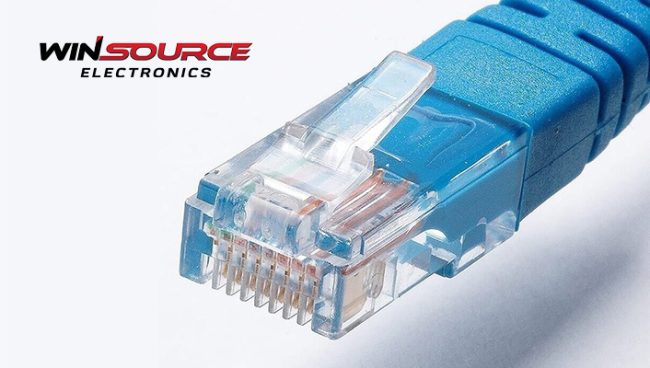
The term “RJ45” stands for “Registered Jack 45,” and it refers to the standardized physical interface used for connecting networking equipment, primarily Ethernet cables.
The RJ45 connector has eight pins, and it’s designed to work with twisted pair cables, commonly known as Cat5e, Cat6, or Cat6a cables.
So how are these electronic components created?
How Are RJ45 Connectors Made?
The process of creating an RJ45 connector involves meticulous attention to wiring configuration and precision.
The eight insulated copper wires, color-coded according to the TIA/EIA-568 standard, are carefully stripped to expose the conductors.
These conductors must align precisely with the designated pin assignments within the RJ45 connector.
Once the wires are correctly positioned, a crimping tool is used to secure the wires in place.
This crimping process not only ensures a firm connection but also establishes the electrical conductivity necessary for efficient data transmission.
The connector’s design incorporates a small plastic housing that not only holds the wires in place but also provides strain relief to prevent damage to the delicate connection points.
The final result is a well-crafted RJ45 connector ready for deployment in networking environments.
This connector, when attached to the ends of twisted pair cables, facilitates the seamless and reliable exchange of data between various networked devices, playing a vital role in the functionality of Ethernet networks.
Evolution of RJ45 Connectors
The journey of the RJ45 connector traces back to the 1970s when it was first introduced as part of the telecommunications industry standards.
Over the years, it has evolved to keep up with the increasing demand for faster and more reliable data transmission.
Today, RJ45 connectors are a staple in networking, supporting Gigabit and even 10 Gigabit Ethernet speeds.
Key Features and Components
The RJ45 connector consists of several key components, including the connector body, pins, and a plastic locking tab.
The design ensures a secure and reliable connection while allowing for easy insertion and removal.
The eight pins inside the connector correspond to specific wire colors in the Ethernet cable, maintaining consistency in wiring schemes.
Applications in Networking
RJ45 connectors find applications in various networking scenarios, from home setups to large-scale enterprise environments.
They are commonly used for connecting computers, routers, switches, and other networking devices.
Their versatility has made them the go-to choice for wired Ethernet connections, offering a stable and cost-effective solution.
Challenges and Solutions
While RJ45 connectors are robust, they are not without challenges.
Issues like crosstalk, interference, and connector damage can impact network performance.
To address these concerns, manufacturers have developed enhanced versions of the RJ45 connector, such as the Cat6 and Cat6a standards, which provide better shielding and improved performance.
Future Trends
As technology continues to advance, the role of RJ45 connectors remains pivotal.
However, emerging technologies like Wi-Fi 6 and 5G are shaping the landscape of connectivity.
The future may see a gradual shift towards wireless solutions, but the reliability and speed of wired connections, facilitated by RJ45 connectors, are likely to remain essential in critical applications.
Unlocking the Potential of RJ45 Connectors – To Finish on…
Explore the intricate web of our connected world, where the RJ45 connector shines as a symbol of simplicity’s extraordinary power.
Despite its unassuming appearance, it serves as the linchpin, facilitating seamless communication among our devices.
As we step into a future marked by escalating digital connectivity, the unpretentious RJ45 connector remains an indispensable force, connecting us all.
Stay tuned to our blog for the latest product updates, and visit our store for all your RJ45 needs, whether you’re a hobbyist or working on an industry project, we’ve got you covered!
© 2025 Win Source Electronics. All rights reserved. This content is protected by copyright and may not be reproduced, distributed, transmitted, cached or otherwise used, except with the prior written permission of Win Source Electronics.

COMMENTS