
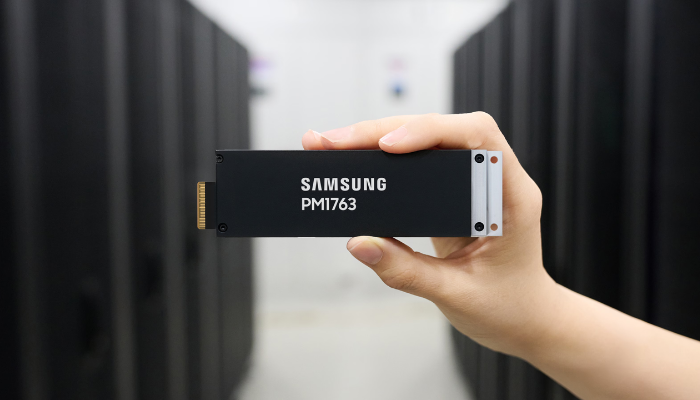
*Image from the internet; all rights belong to the original author, for reference only.
From GPUs to AI Servers: How Samsung’s eSSD Production Is Changing Next-Generation AI Hardware Architecture
As artificial intelligence models continue to grow in scale, the hardware requirements of AI servers are also evolving.
In recent years, AI computing development has mainly focused on improving GPU performance and expanding high-bandwidth memory (HBM) capacity. However, as large AI models, generative AI applications, and real-time inference workloads become more common, overall system performance is increasingly influenced by how efficiently data can be stored, accessed, and transferred.
Samsung’s production of enterprise SSDs for next-generation AI platforms, including its connection with NVIDIA’s Vera Rubin architecture, highlights this shift. High-performance storage is becoming an increasingly important part of AI server design.
So why are SSDs becoming more important for AI servers, and what changes does this bring to the broader electronic component landscape?
Q1: Why are AI servers placing more importance on enterprise SSDs?
AI servers have different storage requirements compared with traditional servers.
In conventional systems, storage is mainly used for data retention and access. AI servers, however, need to continuously process large amounts of data, including training datasets, model files, and information generated during inference.
As AI models become larger and more complex, data loading speed can become a factor that limits overall system efficiency.
Even with powerful GPUs, performance can be affected if data cannot be delivered quickly enough to the computing units.
This is why enterprise SSDs are becoming increasingly important. Compared with traditional storage solutions, enterprise SSDs are designed to provide:
- Higher data throughput
- Lower access latency
- More consistent performance under continuous workloads
These capabilities make high-performance SSDs an important component in next-generation AI server architectures.
Q2: What does Samsung’s eSSD production for NVIDIA Vera Rubin indicate?
Samsung’s development of enterprise SSDs for AI applications and its connection with NVIDIA’s next-generation Vera Rubin platform reflect a broader change in AI server hardware design.
Previously, AI server discussions were mainly focused on:
- GPUs for computing performance
- HBM for high-speed memory access
However, as AI workloads become more demanding, server performance depends not only on processing capability but also on how efficiently data moves throughout the system.
High-performance SSDs can help AI systems load models and access data more efficiently, while technologies such as PCIe 6.0 enable faster communication between processors, storage devices, and other high-speed components.
Therefore, this development is not simply an improvement in SSD performance. It represents a broader evolution in how AI servers are designed and optimized.
Q3: Why are AI inference applications increasing demand for faster storage?
The development of AI is gradually expanding from model training to real-world deployment.
Training workloads usually focus on large-scale computation, while inference applications place greater emphasis on response speed and real-time data access.
For example, applications such as:
- Enterprise AI assistants
- Intelligent search systems
- AI agents
need to quickly access model information, user context, and application data.
In these scenarios, storage performance directly affects response time and user experience.
As AI applications become more interactive and data-intensive, high-speed storage will play a more important role in improving AI system efficiency.
Q4: Besides GPUs and SSDs, what other components are important for next-generation AI servers?
AI servers are not powered by a single type of component. Their performance depends on the cooperation of multiple hardware elements.
In addition to GPUs, HBM, and enterprise SSDs, next-generation AI systems also require a wide range of supporting electronic components.
As data transfer requirements increase, high-speed interface components become increasingly important. Components such as PCIe-related devices, Interface ICs, and signal integrity solutions help maintain reliable communication between different hardware modules.
At the same time, increasing AI accelerator power consumption creates greater demand for advanced power management components, including PMICs, Power ICs, MOSFETs, and voltage regulation devices.
The growth of AI server storage also increases demand for memory and storage-related components, including NAND Flash, Memory Devices, and Storage Controllers.
Together, these components form the hardware foundation that enables modern AI computing systems.
Q5: How will AI server development influence electronic component sourcing?
As AI server architectures become more complex, companies need to consider more than just core computing components.
A complete AI server system may involve:
- Computing components
- Storage components
- Power management components
- High-speed interface components
- Control-related devices
A shortage of any critical component can affect product development schedules and manufacturing plans.
In addition, AI servers and data center equipment usually require long operational lifecycles. This makes component lifecycle planning increasingly important.
Companies need to consider factors such as:
- Product availability
- Lifecycle status
- Long-term supply requirements
- Alternative component options
Early BOM analysis and component lifecycle management can help reduce uncertainty during product development and production.
Conclusion
Samsung’s eSSD production for next-generation AI platforms reflects the changing hardware requirements of AI servers.
The future development of AI systems will not depend only on more powerful GPUs and higher-bandwidth memory. Storage performance, high-speed connectivity, and reliable power management will also play important roles.
For companies developing AI servers, industrial computing systems, and advanced electronic products, understanding these hardware trends and planning component requirements in advance will help improve product reliability and reduce supply risks.
© 2026 Win Source Electronics. All rights reserved. This content is protected by copyright and may not be reproduced, distributed, transmitted, cached or otherwise used, except with the prior written permission of Win Source Electronics.

COMMENTS