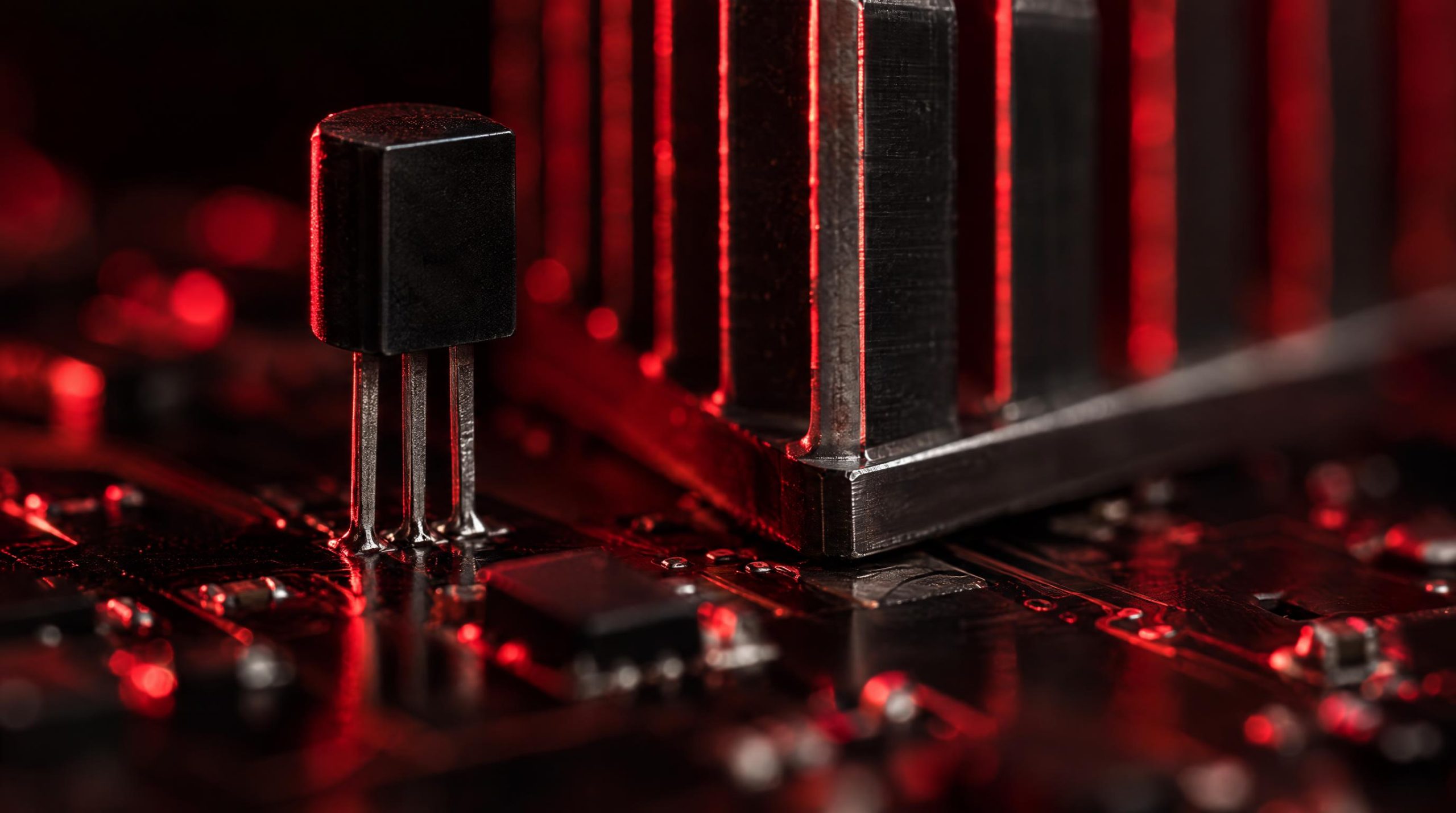
Temperature measurement sits at the heart of an enormous range of electronic systems — from server thermal management and battery protection circuits to medical wearables and automotive powertrain control. The component responsible for that measurement in most modern designs is a temperature sensor IC: a silicon-based device that converts ambient or junction temperature into an electrical signal a microcontroller or monitoring circuit can use.
Selecting the right temperature sensor IC involves more than picking an accuracy figure from a datasheet. The output type — analog or digital — shapes how the part integrates into a system, what additional circuitry it requires, how susceptible it is to noise, and how straightforward firmware development will be. Beyond design selection, there is a growing challenge that product teams encounter years after a design is frozen: the original sensor IC reaches end-of-life (EOL), and the replacement question becomes urgent.
This guide covers the full picture. It explains how analog and digital temperature sensor ICs work, compares representative devices from manufacturers including Texas Instruments, STMicroelectronics, Analog Devices, NXP, and Microchip, walks through practical selection criteria, and addresses the lifecycle and sourcing considerations that keep long-running products in production.
Analog vs. Digital Output — Selection, Comparison & Legacy Sourcing
|
⚡ Analog Output
|
Digital Output
|
|
Hybrid / Analog-Plus
|
EOL & Legacy Sourcing
|
|
What Is a Temperature Sensor IC?
|
Silicon-based sensing circuits that produce analog or digital output representing measured temperature — with key on-chip features that eliminate external signal conditioning.
|
−55°C
to +150°C
Typical Range
|
±0.1°C
Best-in-class Accuracy
|
|
16-bit
Max Digital Resolution
|
I2C / SPI
Digital Interfaces
|
How It Works
Continuous voltage output proportional to temperature — no internal ADC. Output feeds directly into a comparator or MCU ADC pin. ✅ Strengths
+ Ultra-low cost, minimal circuitry
+ Continuous signal — ideal for analog PID loops
+ No firmware driver required
+ Simple 3-pin TO-92 integration
⚠️ Limitations
− Susceptible to EMI & board-level noise
− Resolution limited by downstream ADC quality
− Consumes ADC channels on MCU
− No programmable alerting without extra circuitry
|
Digital Output
How It Works
On-chip delta-sigma ADC converts temperature to a digital word, transmitted over I2C, SPI, SMBus, or 1-Wire serial bus to the host MCU. ✅ Strengths
+ Immune to board-level noise & long trace runs
+ Factory-calibrated — no external calibration
+ Programmable alert thresholds & interrupt pins
+ Multi-device bus — up to 8 sensors per I2C line
⚠️ Limitations
− Higher per-unit cost vs. analog devices
− Requires serial bus & firmware driver
− Unnecessary conversion step for pure analog loops
|
|
Common Devices at a Glance
|
|
ANALOG
LM35
Texas Instruments
10 mV/°C, −55 to +150°C, TO-92
|
ANALOG
TMP36
Analog Devices
Sub-zero capable on single supply
|
DIGITAL
LM75 / LM75B
NXP / TI / STMicro
I2C, 9-bit, overtemp alert output
|
|
DIGITAL
DS18B20
Maxim / Analog Devices
1-Wire, ±0.5°C, 12-bit, multi-point
|
DIGITAL
TMP117
Texas Instruments
±0.1°C, 16-bit, I2C, medical-grade
|
DIGITAL
MCP9808
Microchip
I2C/SMBus, ±0.5°C, alert output with 3 limits
|
|
Selection Decision Framework
|
|
Q1
|
Is a serial bus already present?
Yes → Digital sensor adds virtually no hardware cost. No → Analog may be the simpler path.
|
|
Q2
|
How electrically noisy is the environment?
Noisy (industrial/automotive) → Digital for noise-immune serial output. Clean (consumer/lab) → Analog performs reliably.
|
|
Q3
|
What accuracy level is required?
±2°C OK → LM35, TMP36, LM75. ±0.5°C → DS18B20, MCP9808. ±0.1°C → TMP117 (medical/precision).
|
|
Q4
|
Does the design need programmable alerting?
Yes → Digital I2C/SMBus with configurable alert pins (fan control, throttling, shutdown). No → Analog or analog-plus may suffice.
|
|
Legacy & EOL Risk — What You Need to Know
|
|
⏳
Long Lifecycles, Real EOL Risk
Industrial, medical & infrastructure hardware runs 10–20+ years. Niche sensor ICs and specific package or grade variants can reach EOL before the product does. |
Counterfeit & Storage Risk
Improperly stored semiconductors degrade silently. Ask any supplier for traceability, storage history and risk-matched inspection. |
|
Re-certification Cost
For validated medical or industrial boards, an EOL sensor without a pre-qualified alternative can trigger a costly and time-consuming redesign & re-certification cycle. |
LM75 Drop-in Alternatives
Pin- & register-compatible successors exist: NXP PCT2075, TI TMP75/TMP275, STMicro STLM75 — worth pre-qualifying during original design phase. |
|
4 Proactive Sourcing Strategies
|
|
1
|
Lifecycle Monitoring
Track PCNs and EOL alerts from the original component manufacturer (OCM). Most major sensor vendors publish these well in advance of last-time buy (LTB) dates — but only teams actively watching will catch them in time.
|
|
2
|
Multi-Source BOM Design
Qualify a primary sensor and at least one alternative during the original design phase. This is significantly harder to do retroactively — the investment pays dividends during any shortage event.
|
|
3
|
Last-Time Buy (LTB) Inventory
Execute an LTB order to stock sufficient inventory for the expected remaining product lifetime when an EOL notice is issued. Carries upfront cost but eliminates sourcing uncertainty for a defined window.
|
|
4
|
Qualified Functional Equivalents
When a direct replacement is unavailable and LTB is no longer possible, evaluate functionally equivalent alternatives: compare output type, interface, register map, accuracy, package, and supply voltage — ideally before production pressure creates urgency.
|
Everything you need to remember from this guide
|
For most new designs, digital I2C/SMBus sensors deliver the best combination of accuracy, noise immunity, and integration simplicity. |
Analog sensors retain value in cost-sensitive, electrically quiet applications or where continuous signals feed directly into existing circuitry. |
|
⚠️
EOL risk is real. Sensor ICs — especially niche parts and package or grade variants — can be discontinued before long-lifetime industrial or medical products are retired. |
Act proactively. Multi-source BOMs, PCN monitoring, and early supply chain engagement cost little compared to a reactive shortage scramble. |
Temperature Sensor ICs: Analog vs. Digital Output & Legacy Sourcing Guide | WIN SOURCE — Global Independent Distributor of Electronic Components | AS9120 · ISO 9001 · ISO 14001 · ERAI Member
What Is a Temperature Sensor IC?
IC temperat>What Is a Temperature Sensor IC?icon-based sensing circuits that produce either an analog or a digital output representing the measured temperature. Unlike thermistors, RTDs, or thermocouples — which produce raw resistance or voltage changes that require significant external conditioning — IC temperature sensors integrate much of that signal chain on-chip. Key characteristics include a moderate temperature range typically up to around 150°C, good linearity, low cost, and optional on-chip features such as comparators, alert outputs, and digital interfaces, all packaged in compact surface-mount or through-hole housings.
The result is a sensor family that covers an enormous span of system complexity: from a simple three-pin analog device wired straight to an ADC pin, to a multi-channel digital sensor sitting on an I2C bus and generating programmable thermal alerts. Understanding where on that spectrum your application falls is the first step toward the right component choice.
Analog-Output Temperature Sensors
Analog-Output Temperature Sensors4pt">How Analog Output Works
An analog temperature sensor IC p>How Analog Output Worksor current output that is directly proportional to the measured temperature. The relationship is linear: as temperature rises, the output voltage rises by a fixed amount per degree. No internal ADC is involved — the sensor simply reflects the physical temperature as an electrical quantity. That output then travels to the rest of the circuit, where it is typically fed into a comparator, amplifier, or the ADC input of a microcontroller for further processing.
The simplicity of this architecture is both its strength and its constraint. There are very few components between the sensing element and the output pin, which keeps the design straightforward and cost low. However, the analog signal is a continuous value that can pick up noise from the power supply, nearby switching circuits, or long PCB traces before it reaches the ADC. In electrically quiet environments with short signal paths, this is rarely a problem. In noisier settings, it becomes a meaningful accuracy concern.
Common Analog Temperature Sensor ICs
Several analog tempera>Common Analog Temperature Sensor ICsgns over decades of use:
- LM35 (Texas Instruments): One of the most widely used analog temperature sensors in history, the LM35 outputs 10 mV per degree Celsius with no external calibration required. It covers a range of -55°C to +150°C and is available in the familiar TO-92 through-hole package. Its analog output requires an ADC for digital systems, and its readings can be susceptible to noise in industrial environments or over long wire runs.
- TMP36 (Analog Devices): Similar in concept to the LM35, the TMP36 includes a voltage offset that allows it to measure temperatures below 0°C on a single-ended supply, which makes it practical in applications where sub-zero sensing is needed without a negative supply rail.
- LM335 (Texas Instruments, STMicroelectronics): Outputs a voltage proportional to temperature in Kelvin (10 mV/K), making it useful in absolute-temperature measurement scenarios. Like the LM35, it requires external ADC processing for digital systems.
These devices are commonly found in the 3-pin TO-92 package, though surface-mount variants exist. Their longevity in the market reflects genuine utility, but it also means many of the designs built around them are long-lived — a point addressed in the sourcing section below.
Strengths and Limitations of Analog Output
Analog temperature se>Strengths and Limitations of Analog Outputinely well suited to certain situations. They are low cost, require minimal supporting circuitry in simple designs, and can provide fine-grained, continuous readings that feed directly into analog control loops without the latency of digital conversion cycles. For HVAC systems, simple thermostat circuits, or legacy designs where the microcontroller already has spare ADC channels, the analog approach is hard to argue against on cost grounds alone.
The real limitations emerge when precision, noise immunity, or system integration become priorities. Analog signals are sensitive to power supply noise and can degrade over long trace runs or cable lengths. Resolution is bounded by the quality of the downstream ADC and voltage reference, not just the sensor itself. And as system architectures become more digital and bus-based, adding an analog sensor means adding ADC hardware or using up a precious ADC channel that might be needed elsewhere.
Digital-Output Temperature Sensors
Digital-Output Temperature Sensorsow Digital Output Works
A digital temperature sensor IC performs the analog-to-digital conversion on-chip, using an internal ADC (commonly a delta-sigma type) to convert the sensed temperature into a digital word. That word is then communicated to the host microcontroller over a serial bus. The serial interface handles both directions: the microcontroller reads temperature data from the sensor, and it can write configuration data — such as programmable alert thresholds — back to the sensor’s registers. When a measured temperature crosses a set limit, the sensor can assert an alert or interrupt pin to notify the host processor without polling.
Because the digital value is fully conditioned before it leaves the chip, it is largely immune to the board-level noise problems that affect analog signals. Digital sensors are also typically factory-calibrated, meaning no external calibration or linearization is required to get accurate readings straight out of the box. These characteristics have made digital output the dominant architecture for new designs across computing, consumer, industrial, automotive, and medical applications.
Digital Interfaces: I2C, SPI, SMBus, and 1-Wire
The serial interface>Digital Interfaces: I2C, SPI, SMBus, and 1-Wiregrates into a system. Several formats are common:
- I2C / SMBus: The most prevalent interface for local temperature sensing. I2C uses two wires (SDA and SCL) and allows multiple devices on one bus. SMBus is a subset of I2C with defined timing and alert protocols, widely used in servers, laptops, and industrial equipment. Many sensors allow up to eight devices on a single bus through configurable address pins.
- SPI: A four-wire interface offering higher speed and simpler protocol overhead than I2C, common where higher data rates are needed or an SPI bus is already in use.
- 1-Wire: A single-wire protocol that carries both power and data, which makes it attractive in wire-constrained applications. Multiple sensors can share one line, each identified by a unique 64-bit address. The DS18B20 from Maxim Integrated (now part of Analog Devices) is the canonical example, widely used in industrial, environmental, and fluid-temperature monitoring.
- PWM / Frequency output: Some devices transmit temperature as a square wave whose frequency or period is proportional to temperature in Kelvin. This approach suits applications requiring optical isolation, since only a single optoisolator is needed to cross an isolation barrier.
Common Digital Temperature Sensor ICs
The range of digital temperatu>Common Digital Temperature Sensor ICs2C devices to high-precision, feature-rich parts targeting demanding applications:
- LM75 / LM75B (NXP, Texas Instruments, STMicro): The LM75 is an industry-standard I2C digital temperature sensor with a built-in delta-sigma ADC and a programmable overtemperature output. It provides 9-bit resolution and has become a foundational reference design for processor thermal monitoring. Multiple pin- and register-compatible successors exist, including NXP’s PCT2075 and TI’s TMP75 and TMP275.
- DS18B20 (Maxim Integrated / Analog Devices): A 1-Wire digital sensor measuring -55°C to +125°C with ±0.5°C accuracy and programmable resolution up to 12 bits. Its unique addressability and single-wire architecture make it a go-to choice for multi-point sensing in industrial and environmental applications.
- TMP117 (Texas Instruments): A high-precision I2C/SMBus sensor offering 16-bit resolution, 0.0078°C resolution, and accuracy up to ±0.1°C across the -20°C to +50°C range with no external calibration. It meets ASTM E1112 and ISO 80601 requirements for electronic patient thermometers, positioning it well in medical applications.
- MCP9808 (Microchip): An I2C/SMBus local sensor with ±0.5°C maximum accuracy and a configurable alert output with upper, lower and critical temperature limits, available in compact DFN and MSOP packages, suited to industrial and computing designs.
- TMP112 / TMP112-Q1 (Texas Instruments): A compact ±0.5°C digital sensor available in an automotive-qualified variant, operating from 1.4 V to 3.6 V and packaged in a 2.56 mm² footprint — practical for space-constrained automotive and portable designs.
Strengths and Limitations of Digital Output
Digital sensors offer meaningful advanta>Strengths and Limitations of Digital Output eliminates the need for external calibration circuits or look-up tables. The digitized output is resistant to board-level noise and is unaffected by cable or trace length in the way analog voltages can be. Multiple sensors can share a common serial bus without consuming additional MCU pins, and programmable alert thresholds allow the sensor to autonomously notify the host when temperature limits are exceeded — useful in fan control, thermal shutdown, and battery management applications.
The trade-offs are modest but real. Digital sensors are generally more expensive per unit than simple analog alternatives. Integrating them requires a working serial bus and a software driver; in very constrained embedded environments with no existing I2C or SPI implementation, that overhead may not be trivial. And for applications that genuinely require a continuous analog signal — feeding directly into a PID controller’s analog input, for example — a digital sensor introduces an unnecessary conversion step. These are edge cases in most modern designs, but they are worth recognizing.
The Middle Ground: Analog-Plus Sensors
Between pure analog-output devices and full digital>The Middle Ground: Analog-Plus Sensorsstrong>analog-plus sensors. These ICs produce an analog output but supplement it with a single digital output line — typically a comparator output that asserts when a threshold temperature is crossed. The digital output is not a serial bus; it carries only a single binary state. In the simplest version, a fixed internal threshold trips the output when temperature rises above a preset limit. Some devices allow the threshold to be adjusted with an external resistor; others have programmable thresholds set via a brief strobe sequence.
More sophisticated analog-plus devices encode temperature data as the frequency or period of a square wave rather than as a DC voltage level. A microcontroller’s counter or timer peripheral reads this value directly. These single-wire frequency or period-output sensors are particularly useful when optical isolation is needed, since a single-channel optoisolator carries the full temperature information — a topology that pure analog sensors cannot match without much more circuitry. They also reduce copper runs in automotive and HVAC applications where multiple sensors may be deployed across distances. Accuracy on these devices is broadly comparable to entry-level digital I2C sensors; check the datasheet figure for the specific part.
Choosing Between Analog and Digital Output
There is no universal answer — the right output typ>Choosing Between Analog and Digital Outputstem. A useful decision framework starts with four questions:
- Is a serial bus already present in the design? If the MCU already runs I2C or SPI for other peripherals, adding a digital temperature sensor costs almost nothing in hardware. If not, analog may be simpler.
- How electrically noisy is the environment? In clean lab or consumer environments, analog sensors perform reliably. In industrial enclosures, motor drives, or automotive applications with significant electromagnetic interference, digital sensors with their noise-immune serial outputs are the more reliable choice.
- What accuracy and resolution does the application need? For system-protection applications where ±2°C is acceptable, a simple analog sensor or an I2C device like the LM75 is sufficient. For medical patient monitoring or precision calibration, a device like the TMP117 with ±0.1°C accuracy is required.
- Does the design need programmable alerting or remote monitoring? Digital I2C/SMBus sensors with programmable alert thresholds handle thermal management functions — fan control, throttling, shutdown — without polling overhead. Analog sensors do not provide this without additional comparator circuitry.
For IoT edge nodes, wearables, server management boards, battery management systems, and automotive ECUs, the combination of digital output, factory calibration, and programmable alerting consistently justifies the modest additional cost. For simple, cost-sensitive consumer products or legacy retrofit designs where an analog ADC channel is already available, the analog approach remains sound.
Legacy Temperature Sensor ICs and EOL Risk
Temperature sensor ICs have long product lifespans relative t>Legacy Temperature Sensor ICs and EOL Riskt immune to end-of-life (EOL) and discontinuation. Products designed five to fifteen years ago regularly depend on components that have since been discontinued. Even where a long-running part number remains in production, individual package options, temperature grades and second-source versions can be withdrawn, and niche sensing ICs from manufacturers whose portfolios have been rationalized or consolidated through acquisition are discontinued outright. Check the manufacturer’s product page or PCN for the current status of each part on the BOM.
The risk is compounded in sectors where equipment lifecycles extend well beyond the sensor’s production lifetime. Industrial control systems, medical instruments, and infrastructure hardware are frequently expected to remain in service for ten to twenty years or longer. When the temperature sensor on a validated medical or industrial board reaches EOL, a redesign is not always possible without triggering costly re-certification. Sensors, as a category, follow rapid technology evolution cycles — older MEMS sensors, legacy analog sensing devices, and niche industrial sensing ICs are often discontinued as manufacturers introduce higher-precision, lower-power, or more integrated alternatives, creating a persistent challenge for mature products with long fixed form factors.
A second concern is authentication. Once a part is past last-time-ship, purchasable stock can still exist across a number of supply channels, and what decides whether that stock is safe to buy is how the supplier manages quality — traceability, storage history, and inspection matched to the risk the part carries. Semiconductors and ICs require controlled temperature and humidity storage conditions, and parts that have been improperly stored degrade in ways that may not be detectable until they fail in the field. This makes authentication and traceability non-negotiable when sourcing legacy temperature sensor ICs, and the questions are the same whoever is quoting.
Sourcing Strategies for Legacy Temperature Sensor ICs
The most effective approach to legacy component risk i>Sourcing Strategies for Legacy Temperature Sensor ICsy-chain resilience into their bill of materials before the first prototype ships are in a fundamentally different position from those who discover a shortage after a production run is underway. For temperature sensor ICs, several strategies are worth building into standard practice:
- Lifecycle monitoring: Track product change notifications (PCNs) and EOL alerts from the original component manufacturer (OCM). Most major sensor vendors publish these well in advance of last-time buy (LTB) dates — but only procurement teams that are actively watching will catch them in time.
- Multi-source BOM design: Where possible, qualify a primary and at least one alternative sensor during the original design phase. For I2C devices based on the LM75 register architecture, pin- and software-compatible alternatives from NXP (PCT2075), TI (TMP75, TMP275), and STMicroelectronics (STLM75) exist and are worth pre-qualifying. This is harder to implement retroactively, but the investment pays dividends during any shortage event.
- Last-time buy (LTB) inventory: When an EOL notice is issued, executing an LTB order to stock sufficient inventory for the expected remaining product lifetime is a standard risk-mitigation strategy. It carries upfront cost and storage overhead, but it eliminates sourcing uncertainty for a defined window.
- Alternative and equivalent solutions: In cases where a direct replacement is not available and a last-time buy is no longer possible, a functionally equivalent alternative from a current product line may be the only path forward. Evaluating alternatives requires careful comparison of output type, interface protocol, register map compatibility, accuracy, package, and supply voltage — a task best carried out early, before production pressure creates urgency. Final approval of any substitute rests with the customer’s engineering team.
Sourcing runs the length of a product’s life — prototype builds, volume production, and the years after a part is withdrawn while a fielded design still has to be supported — so these strategies work best when they are set up at design time rather than when an EOL notice lands.
Working with a Supply Chain Partner
WIN SOURCE is a global independent distributor of electronic components, support>Working with a Supply Chain Partnerlifecycle management and alternative solutions. Its catalog includes analog and digital output temperature sensors from manufacturers including Texas Instruments, STMicroelectronics, Analog Devices, NXP, and Microchip — the same vendors that produce the parts discussed throughout this guide — covering current-production parts as well as hard-to-find ones, with verified stock and cross-reference support.
The practical value of a supply chain partner lies in engagement timing. Bringing a distributor with global sourcing reach and lifecycle management tools into a procurement plan before a component enters shortage or EOL status — not after — gives engineering and procurement teams options: early access to available inventory, time to properly evaluate qualified alternatives, and the ability to structure a cost-effective long-term supply arrangement. WIN SOURCE’s WinLink BOM tool and WinConnect API integration are designed to support that kind of proactive engagement, making it straightforward to monitor availability across an entire bill of materials rather than reacting part by part. WIN SOURCE holds AS9120, ISO 9001:2015 and ISO 14001 certifications and is a member of ERAI.
Conclusion
Temperature sensor ICs span a wide design space, from low-cost three-pin analog devices that output a voltage pro>Conclusionperature, to high-precision digital sensors with factory calibration, programmable alerts, and multi-device bus support. The right choice depends on system architecture, noise environment, accuracy requirements, and whether programmable thermal management features are needed. For most new designs, digital-output sensors with I2C or SMBus interfaces offer the best combination of accuracy, noise immunity, and integration simplicity. Analog-output sensors retain a clear role in cost-sensitive, electrically quiet applications or where a continuous analog signal feeds directly into existing circuitry.
The lifecycle dimension matters as much as the design selection. Temperature sensor ICs — particularly niche parts and specific package or grade variants — carry real EOL risk for long-lifetime products. Building multi-source BOMs, monitoring PCNs, pre-qualifying functional equivalents, and engaging supply chain partners early are the practical steps that keep products in production after a part is withdrawn. The cost of acting early is modest; the cost of reacting after a shortage hits is not.
Frequently Asked Questions
What is the difference between an analog and a digital temperat>Frequently Asked Questionsnt-family:Arial,Helvetica,sans-serif;font-size:12pt">An analog sensor outputs a voltage (or current) proportional to temperature — the LM35, for example, gives 10 mV per °C — which a comparator or ADC must then read. A digital sensor digitizes the temperature on-chip and reports it over I2C, SMBus, SPI or 1-Wire, usually factory-calibrated and with programmable alert thresholds.
Is the LM35 or the TMP36 better?
Both are analog sensors with a 10 mV/°C scale. The TMP36 adds a 500 mV offset so it can report tempe>Is the LM35 or the TMP36 better?ve supply; the LM35 needs a negative bias or supply to read below zero but offers a wider rated range. Choose by supply arrangement and the temperature range you need, and confirm figures in the current datasheet.
How many LM75-type sensors can share one I2C bus?
Most LM75-compatible sensors have three address pins, allowing up to eight devices o>How many LM75-type sensors can share one I2C bus?so check the datasheet of the specific part.
What can replace an LM75 temperature sensor?
Pin- and register-compatible devices include NXP’s PCT2075, TI’s TMP75 and TM>What can replace an LM75 temperature sensor?ccuracy, supply range, package and address options against your design; final approval of any substitute rests with your engineering team.
How do I manage EOL risk for a temperature sensor on a long-life product?
Monitor PCNs and EOL notices for every sensor on the BOM, qu>How do I manage EOL risk for a temperature sensor on a long-life product? buy when a notice arrives, and source any remaining stock from suppliers that document traceability and storage conditions.
Part discontinued, obsolete or hard to find?
WIN SOURCE is a global independent distributor of electronic components, supporting compo>Part discontinued, obsolete or hard to find?nt and alternative solutions. Visual inspection, non-destructive testing and electrical testing are applied according to material risk, customer requirements and the applicable quality process, and orders are covered by the published return policy and a 3-year warranty on eligible components.
Stock and pricing are updated daily — search a part number or contact us for current availability, lead time and a quote.
© 2026 Win Source Electronics. All rights reserved. This content is protected by copyright and may not be reproduced, distributed, transmitted, cached, or otherwise used without the prior written permission of Win Source Electronics.