* Question
What Status and Monitoring Outputs Does the LTC1733 Provide?
* Answer
The LTC1733 provides three status outputs—CHRG, ACPR, and FAULT—plus charge-current monitoring through PROG. These signals describe charger operation rather than provide a complete assessment of battery health.
Status and Monitoring Functions
Signal | Function | Interpretation |
CHRG | Charge-status indication | Strong pull-down during charging; approximately 25 µA weak pull-down after current falls below the C/10 threshold; high impedance after timed termination. |
ACPR | Input-power indication | Pulls low when the input exceeds the undervoltage-lockout threshold and is at least 30 mV above battery voltage. Otherwise, it is high impedance. |
FAULT | Fault indication | Pulls low for a trickle-charge timeout or an out-of-range battery temperature detected through NTC. |
PROG | Analog charge-current monitoring | Its voltage, together with the programming resistance, allows charge current to be calculated. It is also used for current programming and shutdown. |
The NTC pin is a temperature-sensing input, not a status output. FAULT reports the associated temperature condition.
C/10 Detection Does Not Mean Charging Has Stopped
For this device, C/10 detection means the charge current has fallen to approximately 10% of the programmed full-scale current. It does not necessarily mean one tenth of the battery’s rated capacity per hour.
The LTC1733 continues charging after this indication until its termination timer expires. Therefore, a C/10 indication should not be treated as an immediate charge-complete signal.
Connecting the Outputs to Indicators
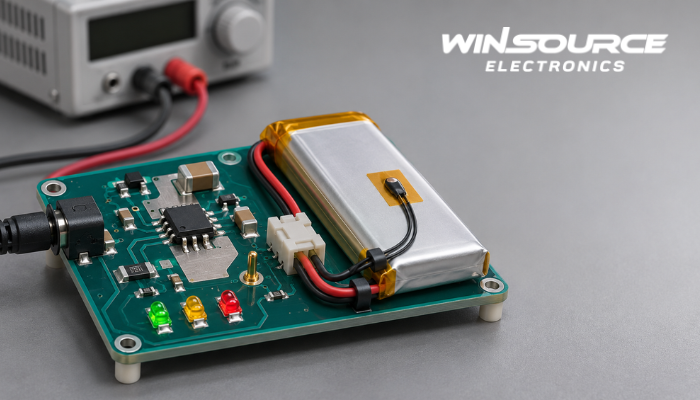
The manufacturer’s evaluation board connects CHRG, ACPR, and FAULT to separate LED indicators through current-limiting resistors. This provides a straightforward visual indication of charge status, input-power availability, and faults.
For a microcontroller interface, account for CHRG’s weak pull-down state when selecting the sensing circuit. A simple binary interpretation can lose information.
Does It Detect Battery Performance?
The original phrase “detect battery performance” is too broad. The LTC1733 provides useful charging information and a current-monitoring function that can support gas-gauging circuitry. These features do not independently measure battery capacity, internal resistance, or state of health.