* Question
What Are the Main Types of Analog Meter Movements, and How Do They Work?
* Answer
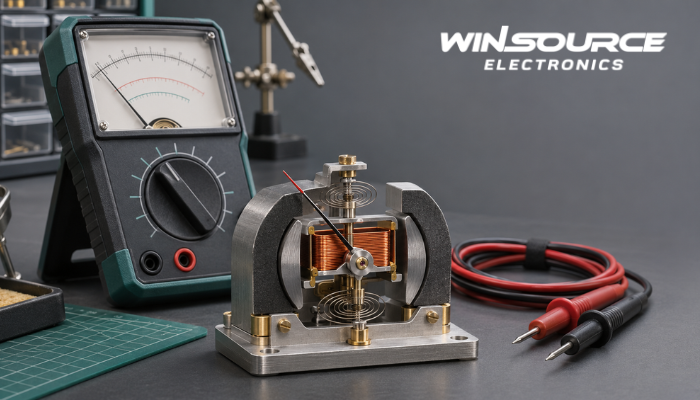
Two common operating principles used in analog ammeters and voltmeters are permanent-magnet moving-coil (PMMC) and moving-iron (MI) mechanisms. The meter movement converts an electrical input into pointer deflection.
Traditional analog multimeters commonly use a sensitive moving-coil movement with additional circuits for voltage, current, resistance, and AC measurement. These two mechanisms are important examples, rather than an exhaustive classification of all analog instruments.
Permanent-Magnet Moving-Coil Movements
A PMMC movement contains a lightweight coil positioned in the magnetic field of a permanent magnet. Current through the coil produces torque, rotating the coil and its attached pointer. Control springs provide an opposing torque.
Within the designed operating range, pointer deflection is approximately proportional to coil current. This gives the movement a substantially uniform scale for direct current measurement.
Key characteristics include:
- High sensitivity:Small currents can produce a useful pointer deflection.
- Polarity sensitivity:Reversing current reverses the direction of torque.
- Direct DC response:The basic movement responds to current flowing in one direction.
- Need for range-conversion circuits:Series resistors extend voltage ranges, while parallel shunts extend current ranges.
With ordinary AC applied directly, the torque reverses each half-cycle, so the movement does not provide a useful steady indication. AC measurement therefore requires rectification or another suitable conversion circuit.
Moving-Iron Movements
A moving-iron instrument uses a stationary current-carrying coil to create a magnetic field. This field moves a soft-iron element through attraction or repulsion, causing pointer deflection.
Because the deflecting effect does not reverse when current polarity reverses, the mechanism can operate on both AC and DC in principle. However, the actual instrument must be used within its specified calibration, frequency, and operating limits.
Its characteristics include a generally nonuniform scale, particularly near zero, and potential errors associated with magnetic hysteresis, frequency, and external magnetic fields. Moving-iron instruments are commonly encountered in electrical panel metering.
How Do the Two Types Compare?
Characteristic | Moving-Coil — PMMC | Moving-Iron — MI |
Moving element | Coil | Soft-iron element |
Magnetic field source | Permanent magnet | Current-carrying stationary coil |
Polarity sensitivity | Sensitive to current direction | Deflection direction is independent of current polarity |
Direct measurement capability | DC | AC or DC, subject to instrument specifications |
Typical scale | Approximately uniform for DC | Generally nonuniform |
Common application | Analog multimeters and sensitive DC indicators | AC panel ammeters and voltmeters |
Manufacturer documentation distinguishes moving-iron AC instruments, moving-coil DC instruments, and moving-coil instruments equipped with rectifiers for AC measurement.
How Does an Analog Multimeter Measure AC?
Many analog multimeters rectify the AC input before applying it to the moving-coil movement. Such instruments commonly respond to the average rectified value, while their AC scales are calibrated to indicate the RMS value of a sine wave. HIOKI, for example, specifies average-rectifying AC measurement for its 3030-10 analog multimeter.
Distorted or nonsinusoidal waveforms can therefore produce significant reading errors. An RMS-calibrated scale does not, by itself, mean that the instrument performs true-RMS measurement.
Practical Selection Considerations
Check measurement range, accuracy, input resistance, frequency response, and waveform limitations. Analog voltmeters can load high-impedance circuits, and pointer readings can be affected by parallax or incorrect zero adjustment.
Digital multimeters use electronic conversion and a numerical display rather than a mechanical pointer movement, so PMMC and moving-iron classifications do not describe their operating mechanism.