* Question
What Is a Hall-Effect Ride Height Sensor?
* Answer
A Hall-effect ride height sensor, sometimes called a vehicle-level or suspension-height sensor, is a contactless position sensor that measures the vertical position of the vehicle body relative to the axle or suspension. Its signal allows an electronic control unit to detect changes in vehicle height caused by passenger load, cargo, acceleration, braking, cornering, or suspension movement.
How Does It Work?
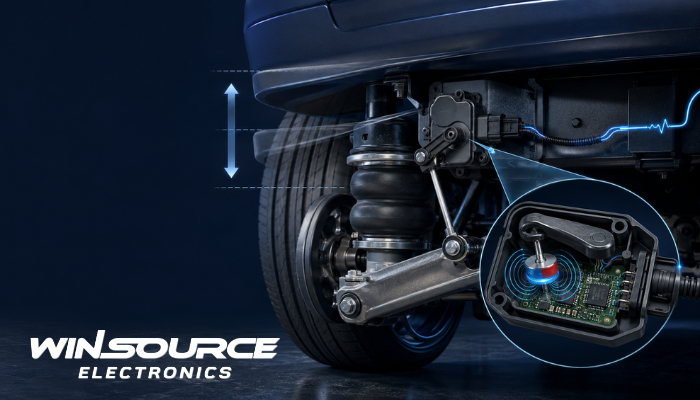
The sensor housing is normally attached to the vehicle body, chassis, or axle. A linkage connects its lever arm to a moving suspension component, such as a control arm.
As the suspension moves:
- The linkage rotates the sensor lever.
- The lever moves a permanent magnet inside the sensor.
- The magnet’s position changes the magnetic field passing through a Hall-effect sensing element.
- The sensor electronics convert this change into an electrical signal.
- The control unit interprets the signal as suspension position or vehicle height.
Depending on the design, the output may be an analog voltage, a pulse-width-modulated signal, or a digital communication signal. Some safety-related sensors use two independent measurement channels so the control unit can detect implausible readings.
Unlike a potentiometric height sensor, a Hall-effect sensor has no sliding electrical contact. This contactless design reduces internal wear and supports reliable operation under repeated suspension movement.
Common Applications
Hall-effect ride height sensors provide position data for:
- Electronic air suspension:Maintains the selected ride height by controlling the compressor, valves, and air springs.
- Adaptive suspension:Adjusts damping according to suspension movement and vehicle operating conditions.
- Automatic headlamp leveling:Corrects the headlamp angle when passenger or cargo loads change the vehicle’s position.
- Chassis and stability control:Supplies suspension-position information for handling and comfort functions.
- Load and axle-level monitoring:Helps determine changes in vehicle attitude or loading.
Ride height sensors are commonly mounted near the suspension, where they are exposed to vibration, water, road salt, dirt, stones, and temperature changes. Their housings, connectors, seals, and linkages must therefore be suitable for harsh automotive environments.
Common Faults and Symptoms
A Hall-effect ride height sensor may produce incorrect readings because of:
- A bent, broken, seized, or disconnected linkage
- Incorrect sensor installation or lever orientation
- Connector corrosion or moisture ingress
- Damaged wiring, power, or ground circuits
- Internal magnet or electronic-circuit failure
- Suspension modifications that move the sensor outside its calibrated range
Possible symptoms include uneven vehicle height, incorrect air-suspension operation, headlamps pointing too high or low, reduced adaptive-suspension performance, warning messages, and stored diagnostic trouble codes.
Selection and Replacement Considerations
When selecting a replacement sensor, verify the mounting position, lever direction, linkage dimensions, connector and pinout, supply voltage, output type, angular range, environmental rating, and vehicle compatibility. Similar-looking sensors may use different signal ranges or calibration curves and may not be interchangeable.
After replacement or suspension work, the vehicle’s reference height may need to be recalibrated with an appropriate diagnostic tool. Mechanical installation should also be checked before electrical diagnosis because a damaged or incorrectly positioned linkage can produce a valid electrical signal that represents the wrong ride height.