* Question
Which four different information frames does CAN define?
* Answer
The CAN (Controller Area Network) protocol defines four types of frames to facilitate communication between nodes. Each frame serves a specific purpose in the CAN network. Here are the four different information frames defined by CAN:
1. Data Frame
– Purpose: To transmit data from one node to another in the network.
– Details:
– Contains actual data payload (up to 8 bytes in Classical CAN or up to 64 bytes in CAN FD).
– Includes fields such as the identifier, control bits, data length, and a CRC for error detection.
2. Remote Frame
– Purpose: To request data from another node without transmitting data itself.
– Details:
– Similar to the Data Frame but with no data field (data length is specified as 0).
– Contains the identifier of the requested data frame.
– Typically used in applications where one node queries another for specific information.
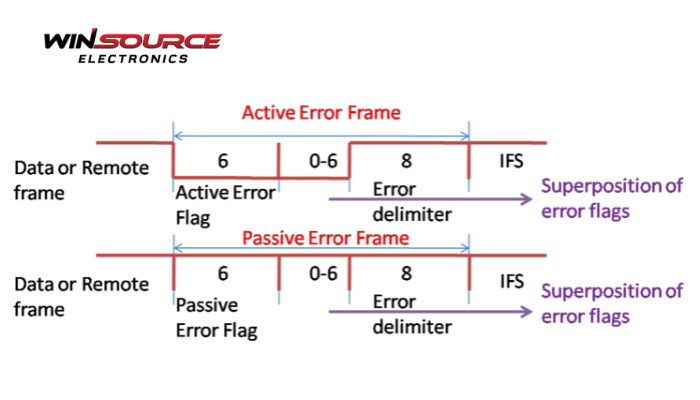
3. Error Frame
– Purpose: To signal errors detected on the network by any node.
– Details:
– Triggered when a node detects a communication error (e.g., CRC mismatch or bit stuffing error).
– Contains error flags and other error-specific information.
– Helps maintain network integrity by notifying all nodes of an issue.
4. Overload Frame
– Purpose: To provide additional time for a node to process data or handle internal conditions.
– Details:
– Generated when a node is overwhelmed and cannot process the next frame immediately.
– Contains overload flags and is sent during inter-frame spaces.
– Rarely used in modern systems as most controllers handle data efficiently.
These frame types ensure that the CAN protocol supports robust communication, including data transfer, error handling, and network synchronization.