
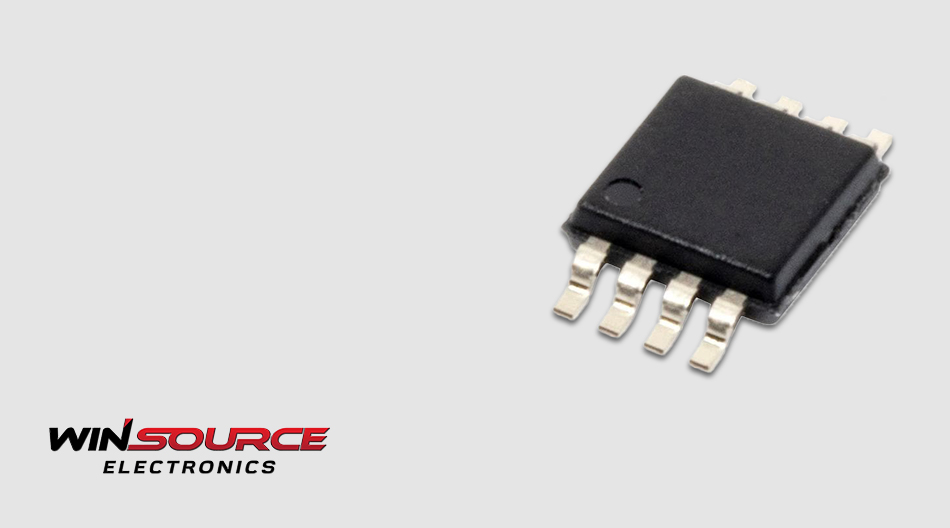
In precision analog design, the operational amplifier often sets the true performance ceiling of the entire signal chain. This is especially critical in low-noise sensing, DC/low-frequency measurement, and ADC front-end buffering, where linearity consistency matters more than a single eye-catching specification. The ADA4500-2ARMZ is a dual-channel precision RRIO (rail-to-rail input/output) amplifier. Its key value is not simply “higher bandwidth” or “lower offset,” but the use of a Zero Input Crossover Distortion architecture that enables more predictable linear behavior across the full input common-mode range. Understanding this mechanism helps engineers evaluate its system-level benefits more rationally.
1. Where Crossover Distortion Comes From in RRIO Amplifiers
Most RRIO amplifiers achieve full common-mode coverage from the negative rail to the positive rail by using complementary input pairs: one pair operates near the low-voltage end of the common-mode range, while the other pair operates near the high-voltage end. When the input common-mode voltage passes through the handover region between these pairs, small but real discontinuities can appear in transconductance, offset, open-loop gain, or input noise. Such discontinuities may be difficult to observe on an oscilloscope, yet in high-precision, low-frequency systems they can manifest as zero-point drift, gain error that varies with common-mode voltage, or seemingly inexplicable nonlinearity. For bridge-type sensors, slowly varying chemical/electrochemical sensing signals, and high-impedance sources, this crossover behavior is often a hidden but critical source of error.
2. The Essence of the “Zero Crossover Distortion” Architecture
The ADA4500-2 is designed to suppress the non-continuity in the transition region to a level that becomes negligible at the system level. Its internal input stage employs a specialized rail-to-rail structure and bias control so that the transconductance change between the two complementary input pairs is smoother in the handover region, avoiding the subtle distortion or gain step typically seen near zero input in conventional RRIO designs. Put simply, the design does not eliminate input-pair handover; instead, it makes the transition effectively invisible. As a result, input linearity, offset, and distortion remain more consistent across the full common-mode range, and system calibration and error budgeting stay more stable across operating points. This is why ADA4500-2 tends to offer more predictable behavior than many comparable RRIO precision amplifiers in low-frequency measurement signal chains.
3. Key Specifications and Their System-Level Meaning
From an electrical-performance perspective, the ADA4500-2ARMZ sits in the “precision + mid-speed” category. It supports single-supply operation with RRIO capability, delivers relatively low input noise density with good low-frequency noise control, and provides picoamp-level input bias current suitable for high-impedance interfaces. Its bandwidth and slew-rate performance are sufficient for most sensing applications and typical ADC front ends in the 10–100 kS/s range. In other words, it is not intended for ultra-high-speed precision amplification above tens of MHz, but rather for practical engineering scenarios that require low noise, stable offset behavior, consistent linearity, and straightforward single-supply integration. During design, the following strengths should be emphasized:
- When signal amplitude is small and the input common-mode voltage crosses the mid-range transition region, zero crossover distortion primarily improves system predictability.
- When source impedance is high or DC-error sensitivity is critical, low bias current and low 1/f noise deliver measurable benefits.
- When full-scale ADC driving is needed, RRIO operation combined with stable linearity helps maximize dynamic-range utilization rather than shifting the burden to calibration.
4. Typical Usage Recommendations and Design Considerations
In sensor signal-conditioning applications, the ADA4500-2ARMZ can serve as the core device for front-end buffering, gain amplification, or active low-pass filtering. For high-impedance or weak-signal inputs, it is recommended to add appropriate RC filtering and over-voltage protection at the input to reduce the impact of external electromagnetic interference (EMI) and transient disturbances on measurement stability. Closed-loop gain and filter cutoff frequency should be set according to system bandwidth requirements to avoid excessive bandwidth that would unnecessarily accumulate noise.
In ADC-driving applications, particular attention should be paid to the dynamic load presented by the sampling capacitor and switch network at the amplifier output. To improve phase margin and transient stability, a common practice is to insert a small series isolation resistor between the amplifier output and the ADC input, and to select a suitable compensation strategy based on actual sampling bandwidth and input capacitance. This approach typically suppresses loop ringing or overshoot caused by sampling current spikes, thereby improving effective dynamic range and linearity in the conversion chain. It should also be noted that the value of the zero crossover distortion architecture lies mainly in consistent linearity and predictable error behavior across the full common-mode range. Its design intent is not equivalent to the extreme offset reduction of zero-drift amplifiers, nor is it aimed at ultra-high-speed or high-voltage operating domains. Therefore, component selection should be based on a comprehensive assessment of signal bandwidth, common-mode range, error budget, and supply conditions to ensure the device’s advantages are fully realized in the target system.
Overall, the ADA4500-2ARMZ addresses a frequently overlooked linearity handover issue in RRIO precision amplifiers through its Zero Input Crossover Distortion architecture, making sensor and ADC front ends more stable under full common-mode conditions and easier to manage in error budgeting. For engineering teams that must optimize BOMs and source parts across multiple supply channels, choosing a reliable distribution partner is equally important. WIN SOURCE, with broad multi-brand coverage and rapid component-sourcing support, can provide efficient supply and qualified alternates once the device is selected, helping designs move to implementation more smoothly.
©2025 Win Source Electronics. All rights reserved. This content is protected by copyright and may not be reproduced, distributed, transmitted, cached or otherwise used, except with the prior written permission of Win Source Electronics.

COMMENTS