
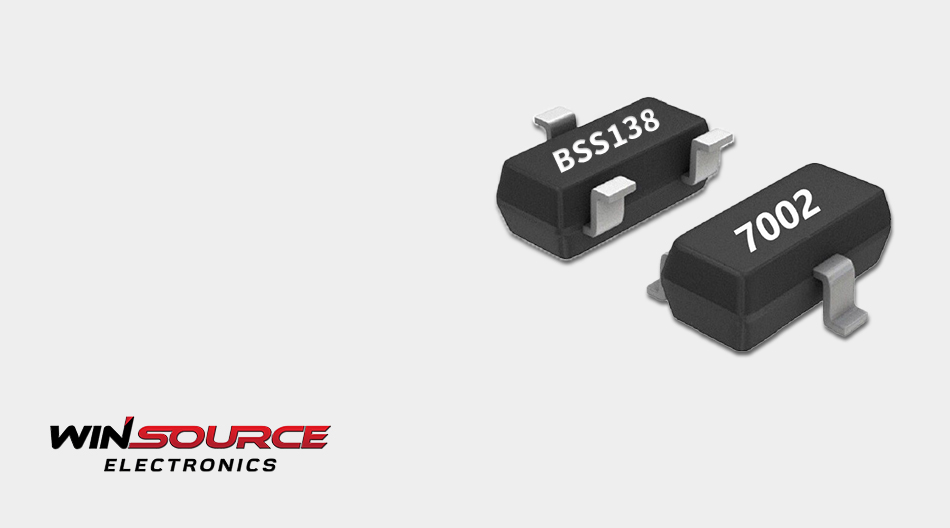
In low-power electronic systems and signal-level applications, small-signal MOSFETs often play a fundamental yet critical role in level shifting, signal control, and light-load switching. BSS138 and 2N7002 are two N-channel MOSFETs frequently considered together during the component selection process. While they share similar package sizes and basic functionality, their design priorities and system-level suitability are not entirely the same.
In practical projects, these two devices are not simply interchangeable. Understanding their differences in electrical characteristics, application focus, and system compatibility is an important step toward reducing design uncertainty and improving overall reliability.
1. Key Electrical Characteristics and Their Design Impact
From a structural perspective, both BSS138 and 2N7002 are enhancement-mode N-channel MOSFETs intended for low-current, small-signal applications. However, their differences are mainly reflected in the effective operating range of key electrical parameters, which typically influence design outcomes in the following areas:
- Gate drive margin (Vgs headroom): BSS138 can reach a usable conduction region at lower Vgs levels, making it more compatible with 1.8V, 2.5V, and 3.3V logic systems.
- Conduction loss and voltage drop (Rds(on) behavior): The Rds(on) characteristics of the two devices vary with Vgs, directly affecting switching losses and power dissipation.
- System drive conditions: BSS138 is better suited for direct drive by MCUs or low-power SoCs, while 2N7002 is typically used in systems with more stable and clearly defined gate drive voltages.
More specifically, BSS138 stands out for its lower gate drive requirement. It can achieve stable conduction at relatively low Vgs levels, often eliminating the need for additional level-shifting or gate-driving circuitry.
In contrast, 2N7002 exhibits more conservative conduction behavior at low gate voltages. For designs sensitive to voltage drop and power loss, relying solely on maximum rated parameters is not recommended. Instead, designers should evaluate the Rds(on) versus Vgs relationship at the actual operating point to determine whether conduction losses remain within acceptable limits.
2. Differentiated Application Suitability
In real-world applications, BSS138 is widely used in logic level shifting circuits, particularly for bidirectional interfaces such as I²C and GPIO. These applications place higher demands on conduction consistency and signal stability under low-voltage conditions, where BSS138 has demonstrated strong suitability through both its electrical characteristics and extensive field usage.
By comparison, 2N7002 is more commonly applied in general-purpose low-current switching or signal-enable functions, such as simple load control, power path switching, or interface isolation. In these systems, sufficient gate drive voltage is typically available, allowing the device’s mature and versatile characteristics to meet design requirements.
It is also important to note that although the two devices share similar package dimensions, variations in package tolerances, thermal performance, and consistency may exist among different manufacturers. For space-constrained designs or applications with long-term reliability requirements, verification against the specific datasheet is essential rather than assuming direct interchangeability based on part number alone.
3. Selection Strategy from a System-Level Perspective
When choosing between BSS138 and 2N7002, comparing datasheet parameters in isolation is often less effective than defining system-level priorities. Key considerations include whether low-voltage logic compatibility is critical, whether flexibility and second-source availability are preferred, and whether the device will operate primarily in signal-level or switching roles. In practice, engineers must balance electrical performance, application maturity, and supply chain stability. For widely used small-signal MOSFETs, multi-source availability and consistent quality play an important role in maintaining long-term design sustainability.
Within this context, electronic component distributors such as WIN SOURCE can provide engineering teams with broader component options and relevant information support, serving as a reference during design-phase evaluation and assisting in selecting components that better align with system requirements.
© 2026 Win Source Electronics. All rights reserved. This content is protected by copyright and may not be reproduced, distributed, transmitted, cached or otherwise used, except with the prior written permission of Win Source Electronics.

COMMENTS