
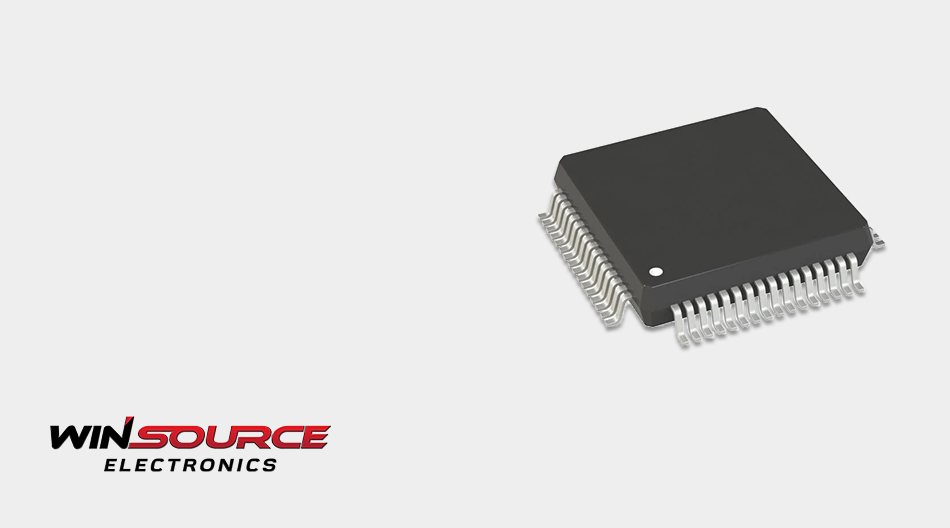
In modern embedded system design, MCU selection is no longer just about whether a device can run code. It requires a broader evaluation of processing performance, peripheral resources, real-time responsiveness, development maturity, and long-term production adaptability. As a high-performance MCU from STMicroelectronics, the STM32F446RET6 is built on the Arm Cortex-M4 core and combines strong computing capability with a rich set of on-chip peripherals. This makes it highly suitable for both industrial control and smart embedded applications. For engineering teams, the value of such a device often lies not in one isolated parameter, but in its contribution to system integration efficiency, control accuracy, and interface flexibility.
1. Core Application Value in Industrial Control Systems
In industrial environments, controllers must meet multiple requirements at the same time, including real-time responsiveness, stability, and environmental adaptability. With its relatively high operating frequency, rich timer resources, and multiple communication interfaces, the STM32F446RET6 is well suited for applications such as motor control, sensor acquisition, industrial human-machine interfaces, and edge control nodes. In particular, in systems that require fast interrupt response and multi-task coordination, this MCU can provide a stable foundation for control logic.
For applications such as motor drives, digital power, and process control, engineers typically pay close attention to PWM output capability, ADC sampling performance, and control algorithm execution efficiency. The STM32F446RET6 offers a good balance across these aspects, making it suitable for system designs that rely on closed-loop regulation and real-time feedback. Compared with entry-level devices that only satisfy basic control requirements, it is better positioned for industrial board-level solutions that demand higher control precision and more functional integration.
In addition, industrial systems often need to work in coordination with host systems, display modules, actuators, and communication units. The SPI, I2C, USART, and CAN interfaces provided by the STM32F446RET6 give it strong integration advantages in industrial control boards, gateway modules, and auxiliary control units. This level of interface flexibility can help design teams reduce the burden of external components while improving overall architectural consistency.
2. Functional Integration Advantages in Smart Embedded Devices
In smart embedded systems, the MCU is no longer limited to single-function control. Instead, it often needs to handle data acquisition, signal processing, communication management, and local control at the same time. As a result, device selection is determined not only by processing capability, but also by peripheral resources, expansion flexibility, and development suitability. Based on the Cortex-M4 core, the STM32F446RET6 provides solid processing performance and a relatively complete set of on-chip resources, giving it a strong application foundation across a wide range of smart devices.
Suitable for multi-function system architectures
Smart terminals often need to perform sensor acquisition, actuator control, interface communication, and status management on the same hardware platform. The STM32F446RET6 offers rich peripheral resources and real-time processing capability, allowing multiple functional modules to operate together efficiently. This makes it suitable for system designs with a high level of functional integration.
Convenient for sensor and peripheral connectivity
In applications such as environmental monitoring, home control, and portable devices, systems often need to connect with various sensors, display units, and communication modules. The STM32F446RET6 provides practical interface configuration and resource allocation capabilities, helping reduce system integration complexity while leaving room for future expansion.
Supports basic local processing and algorithm execution
Some smart devices require more than basic control. They may also need filtering, data preprocessing, or simple algorithm execution. With floating-point operation capability and DSP-related features, the STM32F446RET6 is better suited for applications that require a certain level of local processing performance.
Helps balance development efficiency and iteration needs
For smart device projects that require ongoing upgrades, engineering teams usually place greater importance on resource headroom and development ecosystem support. The STM32F446RET6 maintains a good balance between performance, peripherals, and development support, which helps shorten development cycles and reduce adjustment costs during later product iterations.
3. Selection Logic of STM32F446RET6 from a System Design Perspective
In practical projects, whether the STM32F446RET6 is the right choice usually depends on the overall system requirements for real-time control, interface count, algorithm processing capability, and software ecosystem support. If a project needs to support multiple peripheral connections, more complex control logic, or future functional expansion, then a mid-to-high-performance MCU like this is often more sustainable than an entry-level alternative. It can meet current requirements while also preserving room for future iterations.
At the same time, device selection should also take into account the engineering team’s experience, familiarity with development tools, and supply assurance considerations. The STM32 platform benefits from mature development resources, library support, and broad application experience, which makes the STM32F446RET6 easier for engineering teams to adopt during the design-in stage. For projects that value both design efficiency and long-term production stability, this level of ecosystem maturity is itself an important system advantage.
Overall, the STM32F446RET6 is widely adopted in industrial and smart embedded systems not because of any single outstanding parameter, but because it achieves a strong balance among performance, peripheral resources, control capability, and engineering practicality. For teams that need to make integrated decisions based on application requirements, system architecture, and supply alignment, this type of device continues to offer substantial reference value. As the market continues to recognize the application value of mature component models, platforms such as WIN SOURCE, which closely follow both electronic component supply and real-world application scenarios, are also continuously tracking changes in actual demand for such devices.
© 2026 Win Source Electronics. All rights reserved. This content is protected by copyright and may not be reproduced, distributed, transmitted, cached or otherwise used, except with the prior written permission of Win Source Electronics.

COMMENTS