
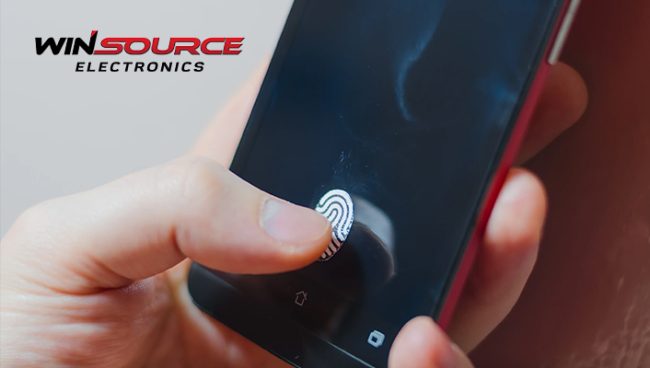
1. Capacitive Fingerprint Sensors
Capacitive sensors are a prevalent choice due to their reliability and speed in capturing fingerprint data.
By creating an electrostatic field on a surface, they accurately detect the unique patterns of ridges and valleys in a fingerprint.
Their use of electrical fields makes them resilient against common contaminants like water or dust, offering a consistent and accurate user authentication experience.
Widely integrated into smartphones and laptops, capacitive sensors have become a standard feature due to their quick response times and ability to deliver high-resolution images for precise fingerprint matching.
2. Optical Fingerprint Sensors
Utilizing light, optical sensors capture the fingerprint’s image through a camera.
While cost-effective, they might face challenges in environments with varying light conditions.
Their functionality relies on a visual snapshot of the fingerprint’s surface, making them suitable for stationary and relatively controlled settings such as door locks.
However, they might encounter issues in direct sunlight or low-light environments, affecting their accuracy.
3. Ultrasonic Fingerprint Sensors
Ultrasonic sensors stand out for their ability to use high-frequency sound waves to map the intricate features of a fingerprint.
Unlike other sensors, they are less affected by external elements like water or dirt on the fingertip, making them highly reliable even in adverse conditions.
Their operation involves creating a 3D fingerprint map, enhancing accuracy and security.
Widely adopted in high-end smartphones, ultrasonic sensors have gained popularity for their consistent and dependable performance.
4. Thermal Fingerprint Sensors
These sensors rely on temperature differences between the ridges and valleys of a fingerprint to create an image.
While less often than her types, they provide a different approach to fingerprint recognition.
They work by detecting the heat patterns on the surface. They offer a unique authentication method, potentially making it more resilient against certain spoofing attempts.
5. Pressure-Based Fingerprint Sensors
Pressure sensors detect the pressure exerted by the ridges of a fingerprint.
They create a 3D representation, providing an additional layer of security. These sensors are often employed in specialized applications where a heightened level of authentication is necessary.
Their ability to measure the physical pressure exerted by a finger adds a unique dimension to fingerprint recognition, enhancing security measures.
6. Multispectral Imaging Fingerprint Sensors
Multispectral sensors use multiple light wavelengths to capture surface and subsurface fingerprint data.
By employing various light wavelengths, these sensors can extract more detailed information, making them suitable for high-security applications.
This technology enhances accuracy by capturing a deeper level of fingerprint detail, significantly reducing the possibility of spoofing.
So now we’ve covered some of the most important types of these fingerprint markers, let’s find out about what limitations you may find with certain types and some of the advantages.
Advantages and Limitations of Different Fingerprint Sensor Types
Each type of fingerprint sensor offers its unique set of advantages and limitations.
Capacitive sensors stand out for their speed and reliability, making them widely adopted in consumer devices.
They are, however, susceptible to being affected by dirty or wet fingers, sometimes leading to inaccurate readings.
Optical sensors, while cost-effective, face limitations in accuracy under varying light conditions. They might struggle in scenarios with too much or too little light, affecting their performance.
Ultrasonic sensors, on the other hand, excel in various conditions, offering reliable performance in adverse environments.
Their ability to penetrate contaminants like water or dust ensures consistent readings.
However, the technology might be more expensive to implement, which affects their widespread adoption in all devices.
Thermal sensors present a novel approach but are not as commonly found in consumer devices due to their unique but niche method of operation.
Pressure-based sensors offer an added layer of security, but their adoption is more restricted to specialized applications due to their specific functionality requirements.
Multispectral imaging sensors, despite their exceptional accuracy, might be costly to implement, making them more prevalent in high-security applications where accuracy is paramount.
Applications in Various Industries
Fingerprint sensor technology extends beyond smartphones and laptops.
In healthcare, these sensors ensure secure access to sensitive patient data, reducing the risk of unauthorized access.
They also find applications in the automotive industry, ensuring secure access to vehicles.
In banking and finance, fingerprint sensors play a vital role in securing financial transactions, providing a convenient and secure way for customers to access their accounts.
The use of fingerprint sensors in law enforcement has revolutionized crime investigation and identification processes.
It has significantly expedited criminal identification, aiding law enforcement in identifying suspects and solving cases.
So what does the future hold for this rapidly developing technology?
Future Innovations and Trends
Advancements in fingerprint sensor technology continue to push the boundaries of security and convenience.
The integration of multiple sensor types in a single device or system is an emerging trend.
For instance, combining capacitive and ultrasonic technologies can offer improved accuracy and resilience against varying conditions.
Future developments may also focus on enhancing the security features of these sensors, further safeguarding against spoofing attempts.
Additionally, increased miniaturization and cost-reduction efforts will likely pave the way for more widespread adoption of advanced sensor types in everyday devices.
To finish on…
In the ever-evolving landscape of fingerprint sensor technology, a multitude of sensor types—ranging from capacitive to multispectral imaging—have revolutionized security across various industries.
Their distinct functionalities come with advantages and limitations, shaping their applications in everything from smartphones and laptops to healthcare, automotive, banking, and law enforcement.
As we move forward, the fusion of sensor technologies and the relentless pursuit of heightened security features while balancing cost-effectiveness signals a promising future for this rapidly advancing field.
The future seems poised for more integrated, secure, and widely adopted fingerprint sensor solutions.
As we know, looking for those elusive electronic components can be a real treasure hunt! , we’re experts in providing rare Sensors and Transducers, even those hard-to-find, or discontinued ones!
We’ve got a stockpile ready, all with second-to-none quality control, complete with datasheets and an easy online buying experience.
Explore our store and uncover the electronic components you’ve been searching for!
© 2025 Win Source Electronics. All rights reserved. This content is protected by copyright and may not be reproduced, distributed, transmitted, cached or otherwise used, except with the prior written permission of Win Source Electronics.

COMMENTS