
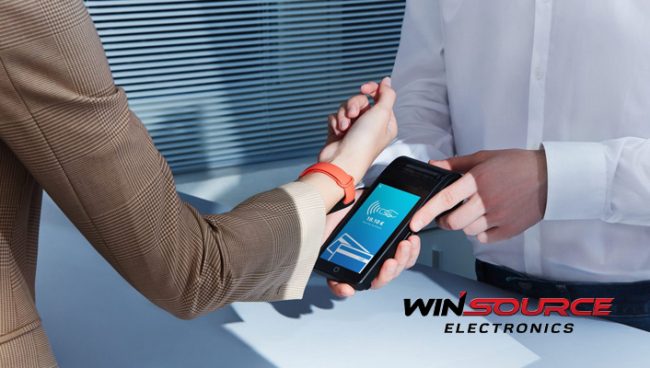
How Does NFC Work?
NFC technology relies on the interaction between two devices, one of which acts as an initiator and the other as a target.
When these devices are brought into proximity (usually within 4 cm or 1.6 inches), they can establish a connection. The interaction between these devices occurs through a series of well-defined steps:
Initiation: One device initiates the NFC communication by generating a radio-frequency field. This is typically the device that intends to send information.
Target Detection: The other device detects the initiator’s RF field and prepares for communication. This device is known as the target.
Handshaking: The initiator and target perform a handshake to ensure they are communicating securely. This handshake establishes a secure channel for data transfer.
Data Transfer: After the handshake, data is exchanged between the initiator and target. This data can be of various types, including text, images, URLs, or commands.
Termination: Once the data transfer is complete, the NFC connection is terminated, and the devices return to their idle state.
This process is remarkably fast and secure, making NFC suitable for a wide range of applications.
Practical Applications of NFC
NFC technology has found applications across a multitude of industries. Its versatility and ease of use make it a valuable tool for a wide range of purposes.
Now, let’s explore some of the most prominent applications of NFC technology:
1. Mobile Payments
One of the most well-known applications of NFC is in the field of mobile payments.
NFC-enabled smartphones can be used to make contactless payments at a wide variety of retailers.
With the aid of mobile payment apps like Apple Pay, Google Pay, and Samsung Pay, users can securely complete transactions by simply tapping their phones on a compatible payment terminal.
NFC technology has significantly improved the convenience and security of transactions, reducing the need for physical credit or debit cards.
Users can also store loyalty cards, gift cards, and boarding passes on their smartphones, consolidating their wallet contents into a single, portable device.
2. Access Control and Security
NFC’s ability to create secure connections is leveraged in various access control and security applications.
Access cards with embedded NFC chips grant authorized personnel entry to secure locations such as office buildings, parking garages, and restricted areas. This technology enhances security, as lost or stolen cards can be easily deactivated and replaced.
Moreover, NFC is used in electronic passports and identity documents, increasing the authenticity and traceability of these crucial documents.
NFC-enabled devices also enable secure two-factor authentication, adding an extra layer of security to online accounts and transactions.
3. Transportation and Ticketing
NFC has revolutionized the transportation and ticketing industry by simplifying the purchase and use of tickets for buses, trains, subways, trams, and more.
Commuters can use their NFC-enabled devices to check in and out of public transportation, eliminating the need for paper tickets or smart cards.
Additionally, NFC technology has been integrated into rideshare services, making it effortless for passengers to hail a ride and pay for it securely through their smartphones.
This not only enhances user experience but also streamlines payment processes for drivers.
4. Healthcare
NFC plays a vital role in healthcare by improving patient care and streamlining administrative tasks.
Healthcare professionals use NFC-enabled devices to access patient records, ensuring quick and secure information retrieval.
It is also used for medication management, allowing patients to scan NFC-tagged medication packages to access dosage instructions and relevant information.
Furthermore, NFC technology is employed to track and authenticate medical equipment and supplies, reducing the risk of errors and increasing overall safety.
5. Marketing and Advertising
NFC technology has brought innovation to marketing and advertising efforts.
By incorporating NFC tags into promotional materials, businesses can offer interactive and engaging experiences to their customers.
When users tap an NFC-enabled poster, product label, or business card with their smartphone, they can access additional information, promotions, or links to websites.
NFC-powered marketing campaigns can bridge the gap between physical and digital advertising, enabling businesses to create more immersive and trackable experiences for their customers.
6. Smart Homes and IoT
The Internet of Things (IoT) has seen significant benefits from NFC technology.
Home automation systems and smart appliances can be configured and controlled through NFC-enabled smartphones or tablets.
Users can tap their devices to set up or adjust lighting, thermostat settings, or audio systems without needing to navigate complex menus.
NFC can also be used for secure and seamless device pairing. When setting up a new IoT device, users can tap it with their smartphone to establish a connection and configure it easily.
7. Social Networking and Data Exchange
NFC’s peer-to-peer communication capabilities have led to innovative applications in social networking.
Users can share contact information, photos, videos, or other data by tapping their devices together.
This technology is especially popular at events, conferences, and networking sessions, where participants can quickly exchange information without the need for manual data entry.
Additionally, NFC tags can be embedded in business cards, posters, and other promotional materials, allowing users to access content or subscribe to services with a simple tap.
8. Gaming
NFC has made its mark in the world of gaming, offering players a more interactive and immersive experience.
Game consoles and handheld gaming devices often come equipped with NFC functionality, enabling players to interact with in-game content or unlock features in the game.
Near Field Communication – Final Thoughts
As the IoT ecosystem expands and the demand for contactless and secure interactions grows, NFC’s role in shaping our connected future is set to become increasingly prominent.
Its versatility and ease of use make it a powerful tool for simplifying our daily routines and enhancing the way we interact with the world around us.
For all your NFT needs, check our product catalog or contact us, and we’ll be happy to assist you.
© 2025 Win Source Electronics. All rights reserved. This content is protected by copyright and may not be reproduced, distributed, transmitted, cached or otherwise used, except with the prior written permission of Win Source Electronics.

COMMENTS