
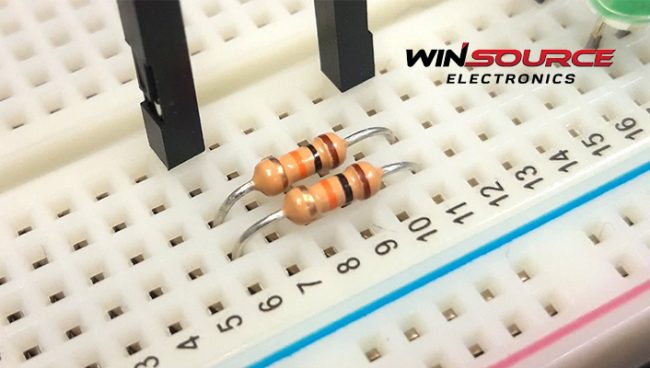
Introduction to Resistors
Resistors are passive electronic components designed to impede the flow of electrical current.
They are omnipresent in electronic circuits, offering resistance that can be varied based on their material and design.
The unit of resistance is the Ohm (Ω), which characterizes a resistor’s opposition to the current flow.
For a full range of resistors, be sure to check out our resistors product range here.
Resistors in Series – Configuration and Behavior
When resistors are connected end-to-end in a single pathway, forming a continuous loop for the current to flow, they are in series.
In this configuration, the same current passes through each resistor, connecting one to the next. The total resistance of resistors in series is simply the sum of individual resistances.
Mathematically, the formula for calculating the total resistance (Rtotal) in a series circuit is:
R total =R1 +R2 +R3 +…+Rn
Where R1, R2, R3, and Rn represent the individual resistances in the series.
Understanding Total Resistance in Series
The concept of total resistance in a series circuit is intuitive. As current encounters each resistor in series, it faces resistance, reducing the overall current flow.
This cumulative resistance in a series setup can be equated to a narrower pathway for the current to traverse.
Just as a narrow, winding river impedes the flow of water more than a wide, straight one, the total resistance in a series circuit restricts the flow of current.
Calculations and Examples
Let’s consider a simple scenario to illustrate the calculation of total resistance in a series circuit. Suppose there are three resistors in series: R1 = 100 Ω, R2 = 150 Ω, and R3 = 200 Ω.
The total resistance in this circuit would be: Rtotal = 100 Ω + 150 Ω + 200 Ω = 450 Ω
This means the overall resistance experienced by the current passing through these three resistors in series is 450 ohms.
Voltage Distribution in Series Circuits
In a series circuit, the voltage across the resistors also divides. According to Ohm’s law (V=I×R), the voltage drop across each resistor can be calculated by multiplying the current flowing through the circuit with the resistance of the individual resistor.
Applications of Resistors in Series
Resistors arranged in series find applications in various fields, playing a critical role in the functionality of different electronic devices and systems.
Let’s take a look at some sample applications so that we can illustrate how they would be used in various fields of work:
Voltage Divider Circuits
One of the most common and practical applications of resistors in series is in voltage divider circuits.
By strategically combining resistors in series, these circuits divide a higher input voltage into specific, lower output voltages. Such circuits are widely used in:
- Sensor Circuits:They’re integral in sensor interfaces, converting varying sensor voltages to levels compatible with microcontrollers or other processing units.
- Analog-to-Digital Converters (ADCs):In devices where analog signals need to be converted to digital, voltage dividers prepare these signals for precise measurement.
LED Circuits
Of course, resistors in series are frequently incorporated in Light Emitting Diode (LED) circuits to control the current passing through the LED.
This prevents the LED from drawing excessive current, which could damage the component. LED circuits often utilize resistors in series to:
- Ensure Optimal Performance:By limiting the current passing through the LED, series resistors help maintain the LED’s intended brightness and lifespan.
- Protect the LED:Overcurrent can significantly reduce an LED’s lifespan. Series resistors act as a barrier, ensuring a safe and consistent current flow.
Signal Processing
In audio and communication systems, resistors in series are employed for various purposes:
- Filter Circuits:Resistors are used in conjunction with capacitors to form filters that modify the frequency response of a circuit.
- Impedance Matching:Resistors in series aid in matching the impedance of different components in a circuit, allowing for efficient power transfer and signal fidelity.
Current Limiting
Series resistors are crucial in limiting the current in specific parts of a circuit:
- Safety Devices:Current-limiting resistors are often employed in fuses and other safety devices to restrict current during a fault or overload, preventing damage to sensitive components.
Temperature Sensing Circuits
And finally, in temperature sensing applications, resistors in series are utilized in:
- Thermistors:These are resistors with resistance values that vary with temperature. Placed in series with a temperature sensor, they allow for precise temperature measurements and controls.
Considerations in Applications
While resistors in series offer valuable functionality in various applications, it’s important to consider their limitations and potential challenges:
- Power Dissipation:Series resistors dissipate power in the form of heat, which can be a concern in high-power applications and may necessitate heat sinks or specific resistor types.
- Voltage Drops:Excessive series resistance can lead to considerable voltage drops, affecting the performance of the circuit or device.
Understanding these applications and the considerations associated with resistors in series is crucial in harnessing their potential effectively within electronic systems.
Remember, always apply common sense safety rules and qualified expertise when working with components!
Challenges and Considerations
While series circuits have their advantages, they also present challenges.
Essentially, the total resistance in a series circuit increases with the addition of each resistor, potentially reducing the overall current flow and affecting the performance of the circuit.
Moreover, failure of one resistor in a series arrangement can disrupt the entire circuit’s operation, emphasizing the vulnerability of this configuration to component failures.
Resistors in Series – Conclusion
Understanding the behavior of resistors in series is fundamental in electronics. It is pivotal for engineers and hobbyists alike in designing and analyzing circuits.
The simple concept of combining resistances in series serves as the building block for more complex circuitry, forming the foundation for various electronic devices and systems.
In essence, the cumulative effect of resistors in series alters the overall resistance in a circuit, influencing the flow of current and voltage distribution.
With diverse applications and significant implications, the study and application of resistors in series remain a cornerstone of electrical engineering and technology.
We hope this has provided a grounding in the applications of resistors in series. For all your resistor requirements, check out our extensive resistor product range here. Or simply contact us here to let us know your needs.
© 2025 Win Source Electronics. All rights reserved. This content is protected by copyright and may not be reproduced, distributed, transmitted, cached or otherwise used, except with the prior written permission of Win Source Electronics.

COMMENTS