
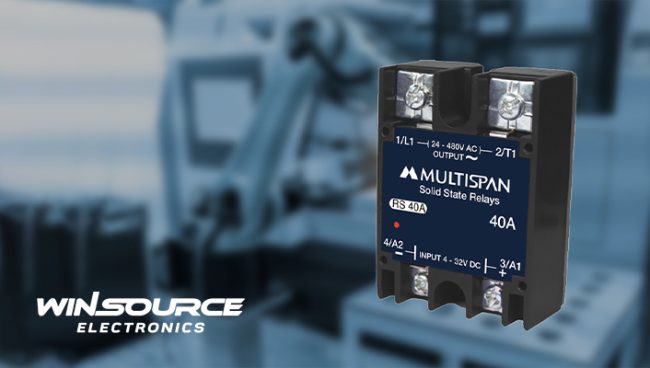
Introduction to Solid State Relay
A solid state relay is an electronic switch that controls electrical currents using solid state electronic components, such as semiconductor devices.
The fundamental principle behind SSRs involves using components, like thyristors, transistors, or integrated circuits, to perform the same function as traditional electromechanical relays.
That’s the introduction, but how do solid state relays work? Let’s get into that next.
How a Solid State Relay Works
The SSR functions by employing an opto-isolator, which consists of an LED and a photosensitive semiconductor device.
When a current is applied to the LED, it emits light, which activates the semiconductor device. This, in turn, triggers the switching action, allowing current to flow through the relay.
The absence of moving parts distinguishes SSRs from their electromechanical counterparts, leading to increased durability and reliability.
Advantages of Solid State Relays
High Reliability: SSRs lack mechanical parts and are prone to wear and tear, offering increased longevity and reliability compared to traditional relays.
Noise-Free Operation: The absence of moving parts results in silent operation, which is especially beneficial in applications where noise is a concern.
Fast Switching Speed: SSRs exhibit rapid response times, allowing quick and precise control over electrical currents.
Enhanced Safety: With no physical component contacts to wear out, SSRs pose lower risks of arcing and sparking, reducing fire hazards and improving safety.
Compact Design: A solid state relay typically has a smaller footprint, enabling more streamlined integration into various systems.
Longevity: The absence of mechanical wear ensures a longer operational lifespan than electromechanical relays.
With so many advantages, a solid-state relay can be used in multiple applications. Let’s review some of the more common applications next.
Applications of Solid State Relays
SSRs find applications in diverse industries, owing to their numerous advantages – as we’ve outlined above:
Industrial Automation: In manufacturing plants, SSRs control motors, heaters, and other devices because they can reliably switch high currents.
HVAC Systems: Heating, ventilation, and air conditioning systems benefit from SSRs due to their noiseless operation and precise control over heating elements.
Medical Equipment: SSRs are used in medical devices where noise and reliability are critical factors.
Photovoltaic Systems: SSRs regulate the power flow efficiently in solar power systems.
Food Industry: SSRs are utilized in food processing and packaging machinery due to their reliability and cleanliness.
Lighting Control: They’re used in dimmer switches and lighting control systems for their precise and rapid switching capabilities.
Challenges and Considerations
While SSRs offer numerous advantages, they do present some challenges:
Heat Dissipation: Solid state relays can generate heat during operation, necessitating proper heat dissipation mechanisms.
Voltage Drop: SSRs might have a small voltage drop across the device, affecting the efficiency of the system.
Cost: Initial costs can be higher than electromechanical relays, although the long-term benefits often outweigh this. If you’re looking for distribution of Solid state relays, then check our SSR product range here.
Technological Advancements of the Solid State Relay
The future of solid state relays appears promising. Continuous advancements in semiconductor technology promise even more efficient, compact, and cost-effective SSRs.
Moreover, as industries increasingly prioritize energy efficiency and reliability, SSRs are expected to play a more significant role in powering smart and sustainable systems.
Here’s what’s expected of future advancements, and prospects of the solid state relay.
Optimized Thermal Management
One significant area of improvement lies in thermal management. With higher current-carrying capacities, SSRs can generate substantial heat during operation. Innovative heat sink designs and advanced materials are being employed to enhance heat dissipation, ensuring optimal performance and longevity of the relay.
Reduced Voltage Drop
Developments in semiconductor technology have contributed to minimizing the inherent voltage drop across solid-state relays. Manufacturers are continuously working to decrease this drop, maximizing efficiency and reducing energy loss, making SSRs more attractive for high-efficiency applications.
Enhanced Compatibility and Integration
Furthermore, there’s a focus on improving the compatibility of SSRs with different control systems. Advancements in interface circuitry allow SSRs to seamlessly integrate with various control signals, expanding their versatility and applicability across a wide range of systems.
Solid State Relay – Final Thoughts and Next Steps
A solid state relay represents a significant evolution in electrical switching technology, offering a range of advantages over traditional electromechanical relays.
Their reliability, noise-free operation, and fast switching speed make them indispensable in various industries, from industrial automation to renewable energy applications.
As technology advances, solid state relays will likely continue to redefine the landscape of electrical control systems, becoming integral components in the ever-evolving realm of modern engineering and automation.
If you’re looking for the versatility, reliability, and efficiency of solid state relays for future-proof electrical switching, then check our solid state relay product range here.
We hope this provides a comprehensive overview of the solid state relay and its significance in the realm of electrical engineering! Contact us if you have any questions or need assistance with purchasing.
© 2025 Win Source Electronics. All rights reserved. This content is protected by copyright and may not be reproduced, distributed, transmitted, cached or otherwise used, except with the prior written permission of Win Source Electronics.

COMMENTS