
Introduction to Transformers
Transformers are devices designed to transfer electrical energy between circuits via electromagnetic induction.
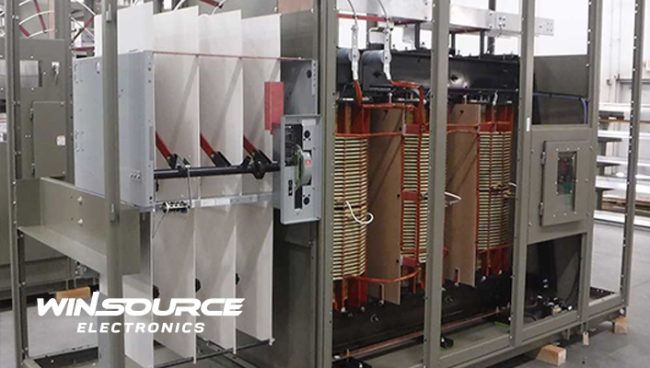
They are constructed of two coils of wire, known as the primary and secondary windings, typically wound around a shared iron core.
The primary coil, connected to the input voltage source, induces a changing magnetic field in the iron core, which subsequently causes a voltage to be induced in the secondary coil.
That tells you what a step-down transformer does, but what is the function of a step-down transformer?
Function of Step-Down Transformers
Step-down transformers, as the name suggests, perform the task of decreasing the incoming voltage level.
This reduction is achieved by having more turns in the primary coil than in the secondary coil.
The ratio of turns between the coils determines the transformation ratio …subsequently altering the input voltage to a lower output voltage.
For instance, a transformer with a 10:1 turns ratio will reduce a 1000-volt input to a 100-volt output.
Design and Construction
As for its design, constructing a step-down transformer involves intricate engineering to ensure efficient voltage reduction and safe electricity transmission.
The primary and secondary windings are wound on a laminated iron core.
The core’s material and construction significantly influence the transformer’s efficiency and magnetic properties. Here are more details on the various components of a step-down transformer.
Core Material
The iron core is typically made from thin, insulated layers of high-permeability materials, such as silicon steel or ferrite.
These materials reduce energy losses due to hysteresis and eddy currents, ensuring a more efficient transfer of power.
Windings
The primary and secondary windings consist of insulated copper wires wound around the core. The ratio of turns between these coils defines the voltage transformation ratio. Generally, the wire size and insulation materials are chosen to handle the specific current and voltage ratings of the transformer.
Insulation and Enclosure
Proper insulation between the windings and the enclosure is essential for safety and optimal performance. Insulation materials prevent short circuits and ensure electrical current flows only through the intended pathways.
Let’s briefly discuss the principles by which a step-down transformer operates.
Principle of Operation
Step-down transformers operate on the principle of Faraday’s law of electromagnetic induction.
When an alternating current (AC) passes through the primary coil, it generates a changing magnetic field in the iron core.
This changing magnetic field induces a voltage in the secondary coil according to the ‘turns ratio’. The output voltage is directly proportional to the turns ratio and inversely proportional to the input voltage.
Applications of Step-Down Transformers
Step-down transformers find extensive application across various industries and everyday devices due to their ability to lower voltage levels for safe utilization.
Electrical Power Distribution
One of the primary applications of step-down transformers is in electrical power distribution.
You might already know that Power Stations generate electricity at very high voltages to reduce energy losses during transmission – before delivering electricity to homes and businesses. So transformers step down the voltage to safer levels for consumer use.
Electronics and Appliances
In households, step-down transformers are integral to power electronic devices and appliances.
Many household gadgets and electronics, such as laptops, mobile phone chargers, and audio systems, require lower voltage than what is supplied through power outlets.
As a much scaled-down version of the power station transformer’s purpose, step-down transformers in adapters and chargers reduce the voltage to levels compatible with these devices.
Industrial Machinery
Of course, in industrial settings, various types of machinery and equipment operate on different voltage requirements.
Once again, step-down transformers facilitate the safe use of these machines by adjusting the voltage to the necessary levels.
So what kinds of energy loss and efficiencies are relevant with a step down transformer?
Efficiency and Energy Losses
While transformers are designed for efficient energy transfer, they’re not quite 100% efficient.
Energy losses occur due to factors such as resistance in the windings, hysteresis, and eddy currents in the core material.
Of course, major efforts in transformer design aim to minimize these losses for optimal performance and energy conservation.
Transformer Regulation and Standards
To ensure safety and performance, transformers must adhere to specific regulations and standards.
Regulatory bodies set standards for design, manufacturing, and testing. This serves to guarantee the reliability and safety of transformers in various applications.
Step Down Transformer – Conclusion and Sourcing
Step-down transformers are integral components in electricity distribution, enabling the safe and efficient transmission of power across various industries and in everyday applications.
Their ability to reduce high voltages to safer levels has far-reaching implications, from powering household devices to industrial machinery.
If you’re looking for a worldwide supplier of step down transformers, with a wide product range, then look no further than WIN SOURCE. Check our range of step down transformers here. If you need further assistance, then simply contact us and we’ll be happy to assist.
© 2025 Win Source Electronics. All rights reserved. This content is protected by copyright and may not be reproduced, distributed, transmitted, cached or otherwise used, except with the prior written permission of Win Source Electronics.

COMMENTS