
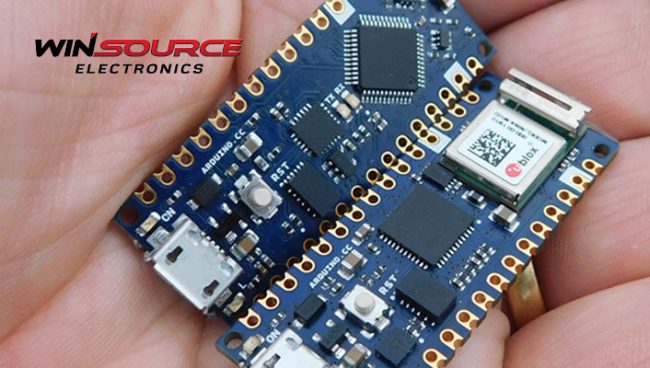
What is Arduino Nano 33 IoT?
The Arduino Nano 33 IoT is a tiny, feature-rich development board that encapsulates immense potential within its diminutive size.
Developed by Arduino, a prominent force in the open-source hardware and software domain, this board is an embodiment of versatility packed with advanced functionalities.
At its core, the Nano 33 IoT board is powered by a 32-bit Arm Cortex-M0+ processor, offering substantial computing capabilities.
Equipped with built-in wireless connectivity, including Wi-Fi and Bluetooth, it enables seamless integration with the IoT ecosystem.
Operational Mechanism
The operational prowess of Arduino Nano 33 IoT lies in its ability to interface with a multitude of sensors, actuators, and other electronic components.
It runs on the Arduino Integrated Development Environment (IDE), simplifying the programming process through its user-friendly interface and extensive libraries.
The board supports a wide range of programming languages, including C++ and Python, enhancing its adaptability to diverse user preferences.
Utilizing the Wi-Fi and Bluetooth functionalities, the Nano 33 IoT can connect to the internet and communicate with other devices, facilitating data exchange and enabling remote control capabilities.
This connectivity serves as a bridge between the physical and digital realms, empowering users to create IoT applications that leverage real-time data acquisition and processing.
Industry Uses
The versatility of Arduino Nano 33 IoT extends across various industries, propelling innovation in several domains:
Smart Agriculture
In agriculture, this board facilitates smart irrigation systems, enabling farmers to remotely monitor soil moisture levels and automate irrigation processes, optimizing water usage and crop yield.
Healthcare
In the healthcare sector, it aids in the development of wearable devices that track vital signs such as heart rate, temperature, and activity levels.
These devices can transmit data to healthcare professionals for remote monitoring and analysis.
Industrial Automation
For industrial automation, the Nano 33 IoT is instrumental in creating smart factories where machines communicate and coordinate autonomously, enhancing efficiency and productivity.
Environmental Monitoring
It plays a crucial role in environmental monitoring systems, assisting in collecting and analyzing data related to air quality, temperature, and pollution levels, aiding in better environmental management.
Technical Specifications
Here are the main technical specifications for the Arduino Nano 33 IoT…
Microcontroller
The heart of Arduino Nano 33 IoT is the SAMD21 microcontroller, featuring a 32-bit Arm Cortex-M0+ core clocked at 48MHz. This potent processor provides ample computing power for various IoT applications.
Connectivity
The board’s integrated connectivity options include 2.4GHz Wi-Fi (IEEE 802.11 b/g/n) and Bluetooth 4.2/BLE. These wireless capabilities enable seamless interaction with the internet and other devices, facilitating data transfer and remote control functionalities.
Interfaces and I/O Pins
Arduino Nano 33 IoT features a range of digital and analog pins, offering flexibility in connecting sensors, actuators, displays, and other peripheral devices. Additionally, it includes UART, I2C, and SPI interfaces for interfacing with external components.
Power Management
Efficient power management is facilitated through a USB interface for programming and power supply, as well as a Li-Po charging circuit for portable applications, ensuring uninterrupted functionality.
Future Prospects and Innovations
As technology progresses, the Arduino Nano 33 IoT is poised to witness further enhancements and adaptations.
Future iterations may focus on augmenting processing power, expanding connectivity options, and integrating more advanced features while maintaining its compact size and affordability.
Additionally, improvements in power efficiency and integration of machine learning capabilities could open up new avenues for applications in edge computing and AI-driven IoT solutions.
Innovation is not solely confined to hardware upgrades. Continuous refinement of software development tools, expansion of libraries, and fostering a richer collaborative environment within the Arduino community will contribute significantly to its evolution.
Arduino Nano 33 IoT – Conclusion and Next Steps
The Arduino Nano 33 IoT epitomizes the convergence of hardware and software, empowering individuals and industries to explore the vast landscape of IoT applications. Its compact size, robust capabilities, and community-driven support make it a cornerstone in fostering innovation across diverse sectors.
As technology continues to advance, the Nano 33 IoT remains poised to lead the charge in revolutionizing IoT solutions, driving forward the interconnected future where smart devices seamlessly communicate and augment human experiences. Its impact transcends boundaries, fueling creativity and innovation in the ever-expanding realm of the Internet of Things.
If you need to purchase the Arduino Nano 33 IoT – in any quantity, then access our online store to purchase. Alternatively, download our brochure for more information about WIN SOURCE, or simply contact us with any questions, and we’ll be happy to help.
© 2026 Win Source Electronics. All rights reserved. This content is protected by copyright and may not be reproduced, distributed, transmitted, cached or otherwise used, except with the prior written permission of Win Source Electronics.

COMMENTS