
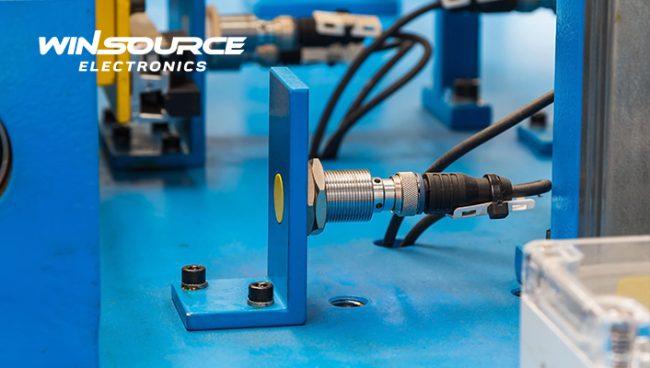
What are Proximity Sensors?
Proximity sensors are electronic devices designed to detect an object or material’s presence, absence, or proximity without any physical contact.
These sensors rely on various technologies to accomplish this task, making them versatile tools for numerous applications.
Provide data
The primary purpose of proximity sensors is to provide data or trigger specific actions when an object approaches or moves away from a target area.
They are commonly used in industrial automation, consumer electronics, automotive systems, and smartphones.
Types of Proximity Sensors
Proximity sensors come in several types, each based on distinct operating principles.
Let’s explore some of the most common types:
- Inductive Proximity Sensors Inductive proximity sensors utilize electromagnetic induction to detect the presence of metallic objects. When a metal object approaches the sensor, it disrupts its electromagnetic field, triggering a signal. These sensors are widely used in factories and manufacturing environments to detect the presence of metal parts on conveyor belts and assembly lines.
- Capacitive Proximity Sensors Capacitive sensors work on the principle of capacitance change. When an object with a different dielectric constant (the ability to store electrical energy) approaches the sensor, it alters its capacitance, leading to detection. Capacitive sensors are often employed in applications involving non-metallic materials, like plastics and liquids.
- Ultrasonic Proximity Sensors Ultrasonic proximity sensors emit high-frequency sound waves and measure the time it takes for the sound waves to bounce back after hitting an object. By calculating the time delay, these sensors can determine the distance to the object. They are widely used in automotive parking systems, industrial automation, and even in home automation for motion detection.
- Optical Proximity Sensors Optical sensors use light-based technology to detect objects. They can work in various modes, including reflective, transmissive, and through-beam. In reflective mode, the sensor emits a beam of light and detects its reflection on an object. Transmissive sensors have both a light source and a receiver on opposite sides, and they measure the interruption of the light beam. These sensors are employed in devices like touchless faucets and photocopiers.
- Magnetic Proximity Sensors Magnetic proximity sensors rely on the presence of magnetic fields to detect objects. These sensors are commonly used in security systems, such as reed switches, which are used in door and window alarms, and in automotive applications for wheel speed sensing.
- Hall Effect Proximity Sensors Hall effect sensors detect the presence or absence of a magnetic field, and they are often used in applications like position detection in electronic devices, automotive ignition systems, and current sensing in electronic circuits.
Working Principles
Understanding the underlying principles of proximity sensors is key to appreciating their versatility.
Most proximity sensors operate based on changes in electrical, magnetic, optical, or acoustic properties when an object enters its range.
Let’s take a closer look at the working principles of a few common types:
- Inductive Sensors:These sensors generate an electromagnetic field, and the presence of a conductive object disrupts the field, inducing a change in the sensor’s output.
- Capacitive Sensors: They rely on changes in capacitance, which is influenced by the dielectric constant of the material in proximity. When a different material approaches, the capacitance changes, leading to detection.
- Ultrasonic Sensors: These sensors emit sound waves and measure the time it takes for the waves to bounce back. The speed of sound and the time delay determine the distance to the object.
- Optical Sensors: Light-based sensors use changes in light intensity or reflection to detect objects. These sensors are sensitive to interruptions in the light path.
- Magnetic Sensors:They detect changes in magnetic fields when a ferrous object enters their range.
- Hall Effect Sensors:These sensors depend on the Hall effect, which is a voltage difference created by the presence of a magnetic field. The change in voltage output indicates the presence of a magnetic field.
Applications
The range of applications for proximity sensors is as diverse as their types and working principles.
Here are some common examples:
1. Automotive Industry
Proximity sensors are extensively used in vehicles for tasks like parking assistance, blind-spot monitoring, adaptive cruise control, and airbag deployment.
They enhance safety and convenience in modern automobiles.
2. Industrial Automation
In manufacturing and industrial settings, proximity sensors are crucial for tasks such as object detection, part counting, and ensuring the proper positioning of components on assembly lines.
3. Mobile Devices
Your smartphone likely contains proximity sensors, which are responsible for turning off the screen when you hold the phone to your ear during a call.
They also play a role in screen rotation and gesture recognition.
4. Home Automation
Proximity sensors are integral to smart home systems, controlling lights, doors, and thermostats based on the presence or absence of occupants.
5. Medical Equipment
In the healthcare sector, proximity sensors are used in applications like touchless faucets, automatic door openers, and patient monitoring devices.
6. Security Systems
Proximity sensors are employed in security systems for intrusion detection. They trigger alarms when an intruder enters a secured area.
The Future of Proximity Sensors
As technology continues to advance, proximity sensors are likely to become even more integral to our lives.
Their applications will extend into fields such as robotics, virtual reality, and augmented reality.
In robotics, for instance, proximity sensors will be crucial for enabling machines to navigate through complex environments and interact with objects and humans safely.
Unveiling the Magic of Proximity Sensors – To End On…
As we’ve found out, proximity sensors are the quiet heroes of our modern world, shaping the way we live and work.
Their unobtrusive presence is a testament to their efficiency, reliability, and adaptability.
As technology evolves, so will the capabilities of these sensors, ensuring that they remain at the forefront of innovation and continue to serve as the unseen guardians of our digital age.
Don’t forget to head over to our store for our quality-assured range of sensors and all your electronic component needs.
© 2025 Win Source Electronics. All rights reserved. This content is protected by copyright and may not be reproduced, distributed, transmitted, cached or otherwise used, except with the prior written permission of Win Source Electronics.

COMMENTS