
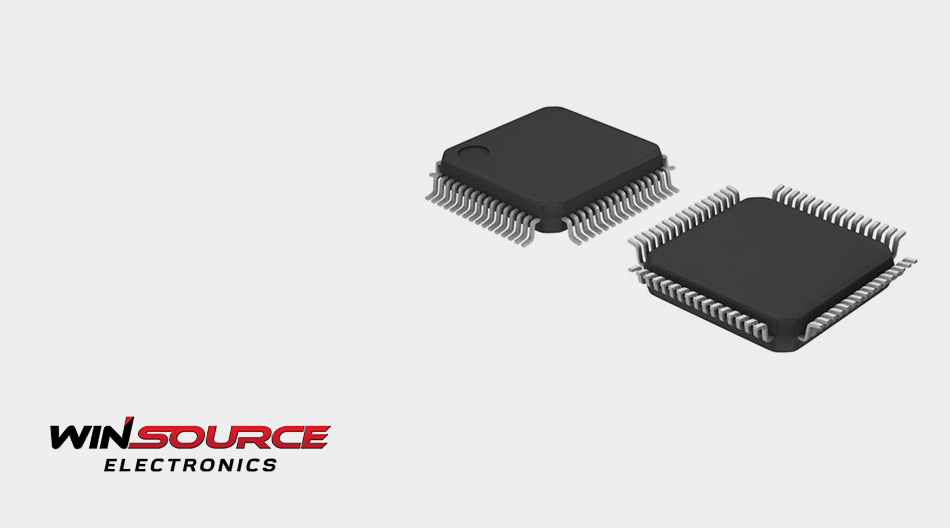
In embedded system design, microcontroller selection directly influences system architecture, development timelines, and long-term maintenance costs. Despite continuous MCU innovation in recent years, STM32F103RFT6TR remains widely adopted across industrial control, consumer electronics, and various embedded applications. This continued relevance is not accidental, but closely tied to its architectural positioning, functional configuration, and proven maturity in engineering practice.
1. A Stable Performance Foundation Based on the Cortex-M3 Architecture
STM32F103RFT6TR is built on the ARM Cortex-M3 core, with a maximum clock frequency of 72 MHz, offering a well-balanced combination of performance and power consumption among 32-bit MCUs. For most medium-complexity embedded systems, this performance level is sufficient to support real-time control and common data processing tasks, without introducing higher power requirements or unnecessary system complexity.
From a system architecture and engineering implementation perspective, its advantages can be summarized in three key aspects:
- Balanced performance and power positioning
The 72 MHz performance tier covers typical control tasks, data acquisition, and protocol processing, making it an “adequate and controllable” choice from an engineering standpoint.
- Deterministic real-time behavior that is easier to evaluate
Cortex-M3 supports interrupt nesting, fast context switching, and a relatively complete exception handling mechanism. This makes it easier to assess interrupt latency and scheduling load in systems with strict real-time requirements.
- Reasonable memory configuration supporting both functionality and iteration
The on-chip Flash and SRAM capacity typically accommodates complete application logic, while still leaving headroom for future feature expansion, logging, or buffering needs.
In practical engineering applications, this positioning—neither overpowered nor resource-constrained—helps achieve a balanced trade-off among cost, power consumption, and system complexity, reducing uncertainty during both the selection and development phases.
2. Peripheral Integration That Supports System-Level Design
The frequent adoption of STM32F103RFT6TR is also closely related to its peripheral configuration. The device integrates a wide range of commonly used communication interfaces, including USART, SPI, I²C, and USB, enabling it to support diverse application scenarios such as industrial control, sensor data acquisition, and communication module interfacing.
For system designers, a rich and mature peripheral set reduces external circuit complexity, minimizes dependency on additional components, and improves overall system reliability. Taking timers and PWM resources as an example, STM32F103RFT6TR has demonstrated stable performance in applications such as motor control, power regulation, and timing control, with extensive validation across mature projects.
In addition, its ample GPIO resources and suitable package options support medium-scale system integration, giving engineers greater flexibility during PCB layout and interface planning. Together, these factors form the device’s practical advantages in system integration.
3. A Mature Ecosystem and Long-Term Engineering Sustainability
In embedded system selection, hardware specifications alone are rarely sufficient. As part of the STM32F1 series, STM32F103RFT6TR benefits from a well-established software ecosystem, including comprehensive development toolchains, abundant reference code, and extensive community support.
For engineering teams, this translates into lower learning costs and more controllable development risks. The availability of mature projects and reference designs significantly improves debugging efficiency and issue resolution, helping shorten the transition from design to mass production.
From a long-term maintenance perspective, mature devices typically offer more predictable lifecycle expectations and clearer migration paths. This is especially critical for industrial and long-term supply projects, and remains one of the key reasons STM32F103RFT6TR continues to be selected.
Overall, STM32F103RFT6TR does not stand out by pushing specification limits. Instead, it achieves a stable balance among performance, peripheral integration, ecosystem maturity, and engineering sustainability. As a result, it has long served as a “reliable-type” option in embedded system design, particularly for projects with clear requirements for stability, maintainability, and system maturity. In real-world project execution, component availability and supply stability are also integral to engineering decision-making. Electronic component distributors such as WIN SOURCE support engineering teams by providing compliant sourcing channels and professional supply support, helping ensure continuity throughout the component selection and project implementation process.
© 2026 Win Source Electronics. All rights reserved. This content is protected by copyright and may not be reproduced, distributed, transmitted, cached or otherwise used, except with the prior written permission of Win Source Electronics.

COMMENTS