
*Image from the internet; all rights belong to the original author, for reference only.
A Hundred-Billion-Dollar Memory Manufacturing Bet: Decoding Micron’s New York Megafab Through Technology Roadmaps and Supply Chain Implications
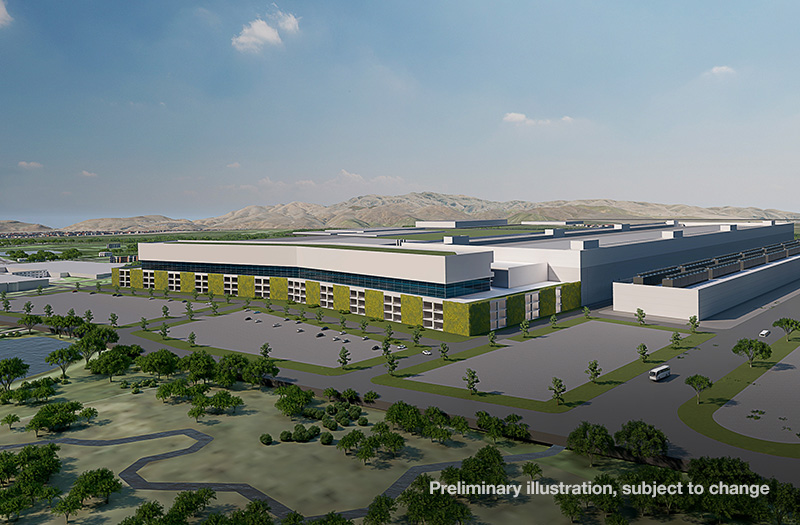
In January 2026, Micron Technology announced that it would officially break ground on its historic New York megafab project on January 16, 2026, in Onondaga County, New York. The announcement marked the transition of the project from long-term planning and regulatory review into the physical construction phase.
According to Micron’s official disclosure, the project represents a long-term investment of approximately USD 100 billion, making it one of the largest private manufacturing investments in New York State’s history. The site is designed as a multi-phase semiconductor manufacturing campus, with plans to support up to four advanced fabrication facilities over time.
Micron positioned the New York megafab as a cornerstone of its future manufacturing footprint, intended to support long-term demand for advanced memory technologies driven by AI, data center infrastructure, and high-performance computing. Senior company leadership, alongside federal, state, and local representatives, are expected to attend the groundbreaking ceremony, underscoring the project’s industrial significance.
Q1. How Large Is the New York Megafab, and How Is It Positioned Within the Industry?
The New York megafab is not a single-fab expansion but a multi-decade manufacturing campus designed to scale over several construction phases. Capital deployment will occur progressively, covering cleanroom construction, advanced tool installation, and long-term capacity ramping.
Within the broader U.S. semiconductor investment landscape, Micron’s project belongs to the same category of ultra-long-cycle manufacturing investments as TSMC’s Arizona fabs, Intel’s Ohio manufacturing campus, and Samsung’s Texas expansion. However, its positioning is distinct.
While those projects are primarily focused on logic and foundry manufacturing, Micron’s New York megafab is explicitly memory-centric. This makes it one of the few large-scale U.S. manufacturing investments dedicated almost entirely to advanced memory technologies, rather than mixed or logic-dominant production.
Q2. Why Is This Considered a Historic Investment for Micron?
From a capital perspective, this is Micron’s largest single manufacturing commitment to date. Strategically, however, the importance goes far beyond scale.
The New York megafab is expected to serve as a core node for advanced-node memory manufacturing within Micron’s global production network. By expanding advanced manufacturing capacity in the United States, Micron reduces geographic concentration risk while reinforcing long-term manufacturing resilience.
In memory manufacturing, facilities capable of supporting successive process-node transitions are both capital-intensive and scarce. A site designed from the outset for multi-generation expansion represents a long-term strategic asset rather than a cyclical capacity response.
Q3. What Role Does the CHIPS and Science Act Play in This Project?
The broader U.S. semiconductor investment environment has been shaped in part by the CHIPS and Science Act, which provides financial incentives and structural support for domestic manufacturing.
For Micron’s New York megafab, the Act functions as an enabling backdrop rather than a directional driver. It does not redefine Micron’s technology roadmap or product strategy, but it improves long-term project feasibility by helping offset capital intensity and reducing investment risk over extended timelines.
In this sense, policy support primarily affects where and how sustainably advanced manufacturing can be built, rather than what technologies are pursued.
Q4. Which Technology Roadmaps Will the New York Megafab Support?
The New York megafab is expected to focus on advanced DRAM and high-bandwidth memory (HBM) manufacturing.
Based on Micron’s publicly communicated roadmap, the site is likely to support 1β and 1γ DRAM process nodes, as well as advanced HBM3 and future HBM4-class products. These technologies emphasize higher density, improved power efficiency, and increasingly complex process integration.
In modern AI systems, memory has become a system-level performance constraint rather than a standalone component. For example, in accelerators such as NVIDIA’s H100, HBM3 stacks are tightly integrated with compute silicon, and overall system throughput is heavily influenced by memory bandwidth and energy efficiency. Such architectures place exceptional demands on wafer-level process consistency, yield control, and long-term scalability.
Q5. Does the Project Imply a Move Toward Advanced Packaging and Memory–Compute Integration?
While Micron has not disclosed specific packaging plans for the New York site, industry trends strongly suggest deeper integration between memory manufacturing and advanced packaging capabilities.
As HBM evolves toward higher stack counts and tighter coupling with compute dies, memory manufacturing can no longer be treated as an isolated front-end process. In accelerators such as AMD’s MI300, memory devices function as system-level building blocks rather than discrete packaged components.
This trajectory implies increasing coordination between wafer fabrication, stacking precision, and packaging yield management. From a long-term planning perspective, the New York megafab is structurally positioned to support such convergence.
Q6. What Does the Construction and Ramp Timeline Indicate?
The New York megafab will be developed in phases, with each stage encompassing facility construction, tool installation, process qualification, and yield ramping. These steps typically span multiple years.
Initial production is expected toward the latter part of the decade, with subsequent fabs coming online based on technology readiness and global capacity planning. This cadence confirms that the project is designed to support future memory generations, not to influence near-term supply conditions.
Q7. What Challenges Could the Project Face?
Like other large-scale U.S. semiconductor manufacturing initiatives, the New York megafab faces several structural challenges:
- Supply chain coordination risks during construction, particularly for advanced tools and specialty materials
- Long-term talent availability, as demand for experienced semiconductor engineers continues to exceed supply
- Sustained operating cost pressures, given the energy intensity and capital requirements of advanced memory fabs
These challenges are not unique to Micron, but they underscore the complexity of executing long-horizon manufacturing strategies.
Q8. What Does This Project Signal for the Global Semiconductor Supply Chain?
From a global perspective, Micron’s New York megafab reflects a structural rebalancing of advanced memory manufacturing capacity.
Unlike logic-centric investments, this project reinforces the strategic importance of memory within modern computing infrastructure. For system developers, the significance lies less in short-term availability and more in long-term confidence in technology evolution and manufacturing continuity—particularly for products such as HBM3 and future HBM4 generations.
Over time, such investments contribute to greater resilience in the global semiconductor supply chain by diversifying where critical manufacturing capabilities reside.
Conclusion
Micron’s New York megafab represents a long-term manufacturing and technology commitment, not a short-term market maneuver. Its importance lies in how it aligns advanced memory process development, system-level integration trends, and global supply chain resilience over the coming decade.
Rather than reshaping near-term supply dynamics, the project signals how memory manufacturing is evolving into a foundational pillar of next-generation computing infrastructure—and how capacity decisions made today will shape that future.
© 2026 Win Source Electronics. All rights reserved. This content is protected by copyright and may not be reproduced, distributed, transmitted, cached or otherwise used, except with the prior written permission of Win Source Electronics.

COMMENTS