
* Question
Compared with General Computer Network Systems, What Are the Key Characteristics of Fieldbus Systems?
* Answer
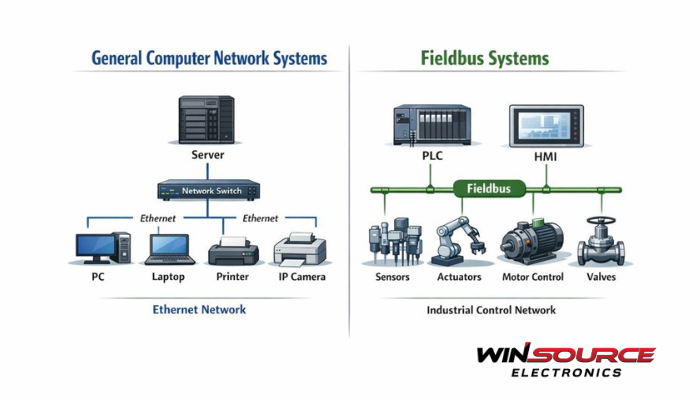
Compared with general computer network systems, fieldbus systems are specifically designed for industrial automation and real-time control environments. Their architecture, communication methods, and performance priorities differ significantly from conventional IT networks such as Ethernet-based office or data networks.
1. Real-Time and Deterministic Communication
One of the most important characteristics of fieldbus systems is deterministic communication.
Unlike general computer networks, which operate on best-effort data transmission, fieldbus protocols are designed to guarantee predictable response times. This is critical for real-time control tasks such as motion control, process automation, and safety interlocking.
2. Distributed Control Architecture
Fieldbus systems support decentralized control by allowing intelligent field devices—such as sensors, actuators, and controllers—to communicate directly over the bus.
In contrast, general computer networks typically rely on centralized processing and are not optimized for direct device-level control.
This distributed structure improves system flexibility and reduces wiring complexity in industrial installations.
3. High Reliability and Noise Immunity
Fieldbus networks are engineered to operate in harsh industrial environments. Key characteristics include:
- Strong resistance to electromagnetic interference (EMI)
- Stable communication over long distances
- Robust error detection and fault-tolerant mechanisms
General-purpose computer networks are usually designed for controlled office or data center environments and may not perform reliably under industrial noise conditions.
4. Prioritized and Cyclic Data Transmission
Fieldbus systems typically use cyclic or time-scheduled communication models to transmit critical process data.
Important control signals are assigned higher priority, ensuring timely delivery. In contrast, computer networks often handle data in an asynchronous and non-prioritized manner, which can introduce latency and jitter.
5. Simplified Protocol Stack and Low Overhead
To ensure fast and reliable communication, fieldbus protocols use relatively simple protocol stacks with low communication overhead.
General computer networks, such as TCP/IP-based systems, use more complex protocol layers, which increase latency and are less suitable for time-critical control tasks.
6. Integration of Power and Communication
Many fieldbus systems support both data transmission and power supply over the same bus cable.
This feature reduces wiring costs and simplifies installation, which is rarely a design goal of standard computer networks.
Summary
Compared with general computer network systems, fieldbus systems are characterized by deterministic real-time communication, distributed control, high reliability in harsh environments, and optimized data transmission for industrial automation. These features make fieldbus technologies essential for factory automation, process control, and embedded industrial systems, where timing accuracy and system robustness are critical.

COMMENTS