
* Question
How Many Types of Load and Store Instructions Are Defined by Addressing Modes?
* Answer
Load and store instructions are central to modern CPU architecture, especially in RISC-based processors where arithmetic operations cannot directly access memory. The diversity of load/store instructions largely depends on how the processor calculates the effective address of an operand.
From an address calculation perspective, load and store instructions can be classified into several core forms.
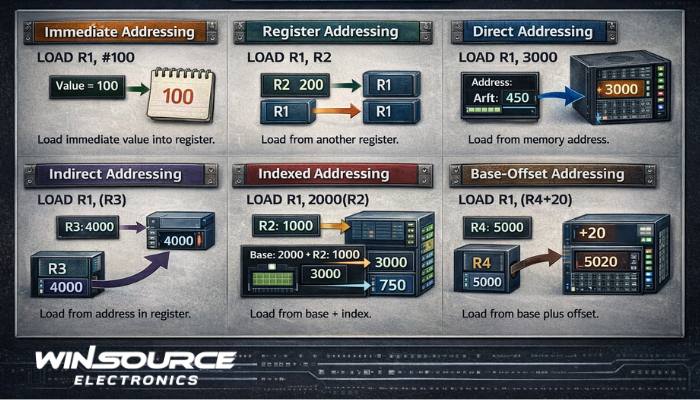
1. Direct (Absolute) Addressing
In direct addressing mode, the instruction contains the full memory address of the operand.
Effective Address = Address field inside the instruction
This method is straightforward but limited in flexibility. It is mostly found in early microprocessors or simple embedded systems with fixed memory layouts.
2. Register Indirect Addressing
Here, the instruction references a register that holds the memory address.
Effective Address = Contents of Register
Example:
LOAD R1, [R2]
This form is common in ARM, RISC-V, and MIPS architectures. It allows flexible memory access without increasing instruction length.
3. Base + Offset (Displacement Addressing)
This is the most widely used addressing mode in modern CPUs.
Effective Address = Base Register + Immediate Offset
Example:
LOAD R1, 16(R2)
It is heavily used for:
- Stack frame access
- Structure field access
- Local variable addressing
Most RISC architectures rely primarily on this addressing mechanism.
4. Indexed Addressing
Indexed addressing adds a second register for index calculation.
Effective Address = Base Register + Index Register
It is particularly efficient for array traversal and loop operations.
In some architectures, the index register may be automatically scaled depending on operand size.
5. Scaled Indexed Addressing (Base + Index × Scale + Offset)
Common in CISC architectures such as x86.
Effective Address = Base + (Index × Scale) + Offset
This form supports efficient high-level language constructs such as multi-dimensional arrays and complex data structures.
6. PC-Relative Addressing
Effective Address = Program Counter + Offset
This mode is widely used for:
- Branch instructions
- Position-independent code
- Embedded firmware
- Shared libraries
PC-relative addressing improves code relocation flexibility and security.
7. Auto-Increment / Auto-Decrement Addressing
Some architectures allow the address register to be automatically updated during the load/store operation.
Effective Address = Register (before or after update)
This is commonly used for:
- Stack operations
- Block memory transfer
- DMA buffer traversal
RISC vs. CISC: Why the Number Differs
RISC architectures typically implement fewer addressing modes to simplify pipeline design and improve instruction throughput.
CISC architectures offer more complex addressing forms to reduce instruction count and improve code density.
Therefore, the exact number of load/store instruction forms depends on the specific Instruction Set Architecture (ISA).
Engineering Insight
Understanding load/store addressing modes is essential for:
- Embedded system firmware optimization
- Compiler backend design
- Memory access performance tuning
- ISA comparison and processor selection
In high-performance or resource-constrained systems, memory access efficiency often determines overall execution behavior more than arithmetic throughput.

COMMENTS