
* Question
How to use the conversion method for programming?
* Answer
In embedded systems and electronics engineering, the conversion method typically refers to converting data between different numerical formats, voltage levels, protocols, or signal representations to enable a microcontroller, processor, or peripheral device to correctly interpret and process the information.
This method is widely used in ADC/DAC operations, communication interfaces (UART, SPI, I²C), fixed-point vs. floating-point arithmetic, and firmware-level data parsing.
Below is a structured explanation of how the conversion method is used in programming, especially in embedded development.
1. Identify the Input and Output Formats
The first step is to clearly define:
- What data format you receive
(e.g., analog voltage, binary, hex string, floating-point number) - What format the program requires
(e.g., integer, digital level, engineering units)
Example:
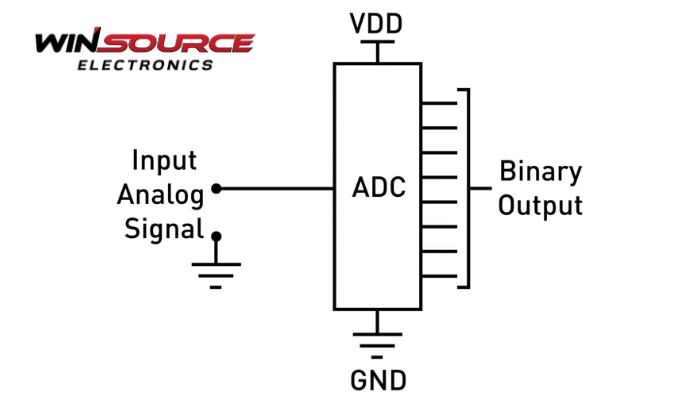
A microcontroller like the Microchip ATmega328P outputs ADC readings as a 10-bit integer. To get the actual voltage, you must convert the integer into engineering units.
2. Apply the Appropriate Conversion Formula
Different types of conversions require different mathematical or logical steps.
Common Conversion Scenarios
- Analog-to-Digital Conversion (ADC) Scaling
Voltage = (ADC_Value / ADC_Max) * Reference_Voltage
- Digital-to-Analog Conversion (DAC) Scaling
DAC_Output = (Desired_Voltage / Reference_Voltage) * DAC_Max
- Binary ↔ Decimal ↔ Hexadecimal
Use built-in language functions:
int(x, 2) for binary → decimal
hex(x) for decimal → hex
- Floating-Point → Fixed-Point
Useful for MCUs without an FPU(e.g., ARM Cortex-M0 series).
fixed = float_value * scaling_factor
- Unit Conversions
Example: temperature sensors such as the LM35output 10 mV/°C.
Temperature (°C) = ADC_Voltage / 0.01
3. Implement the Conversion in Code
Below is a simplified C example for embedded systems using an ADC conversion method:
#define VREF 5.0#define ADC_RES 1023.0
float get_voltage(int adc_value) {
return (adc_value / ADC_RES) * VREF;
}
This function takes a raw ADC reading and returns the actual voltage.
4. Validate the Conversion with Real Hardware
Always verify the conversion logic by comparing:
- Multimeter readings
- Oscilloscope results
- Sensor datasheet characteristics
For example, using an accelerometer such as ADXL345, you must confirm that the converted acceleration values match the expected ±2 g, ±4 g, or ±8 g ranges.
5. Optimize for Performance and Precision
Especially important for low-power or resource-limited MCUs.
- Replace floating-point operations with fixed-point when possible
- Use lookup tables for repetitive conversions
- Macro-define constants to avoid runtime overhead
Example for fixed-point optimization:
int voltage_fixed = (adc_value * 5000) / 1023; // mV
Technical Insight
The conversion method in programming is not a single technique, but a family of transformation strategies enabling different hardware and software components to communicate correctly. It is essential in:
- Sensor data processing
- Protocol translation
- MCU firmware design
- Embedded mathematics
- Signal interpretation
Understanding conversion methods improves system accuracy, firmware stability, and interoperability across components such as TI ADC128S052, STM32 ADC modules, or NXP LPC series MCUs.
Conclusion
Using the conversion method in programming involves identifying data formats, applying appropriate conversion formulas, implementing code-level transformations, and validating results with real hardware.
This method is fundamental to embedded development and ensures correct interaction between sensors, processors, and digital systems.

COMMENTS