
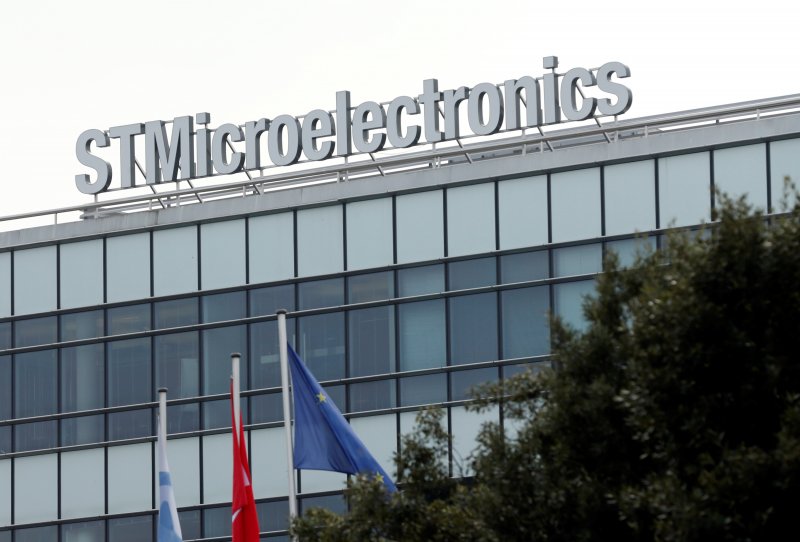
*Image from the internet; all rights belong to the original author, for reference only.
STMicroelectronics Secures €1 Billion EIB Credit Facility, Strengthening Europe’s Semiconductor Manufacturing Autonomy and Technological Depth
In mid-December 2025, STMicroelectronics signed a €1 billion credit facility agreement with the European Investment Bank (EIB), with the first €500 million tranche already executed. The funding will support accelerated R&D activities and large-scale semiconductor manufacturing across the company’s operations in Italy and France.
Viewed purely in financial terms, the agreement could appear to be another routine financing step under Europe’s broader semiconductor policy framework. Placed against the backdrop of a highly sensitive global electronic components supply chain and an accelerating trend toward regionalization, however, the implications extend well beyond capital provision.
This marks the ninth collaboration between STMicroelectronics and the EIB since 1994, bringing their cumulative financing to approximately €4.2 billion. As Europe repeatedly emphasizes “strategic autonomy” and “supply-chain resilience,” this funding serves as a clear signal: Europe is taking a more pragmatic approach to reinforcing the supply of critical chips and components that are already deeply embedded in industrial systems.
Q1: What kind of funding is this—and why is it not a direct subsidy?
First, it is important to clarify that this is not a direct fiscal subsidy, but a long-term, policy-oriented credit facility provided by the European Investment Bank.
Its objective is not short-term stimulus, but to channel sustained capital into core semiconductor capabilities within Europe.
Under the agreement:
- Approximately 60%of the funding will be allocated to manufacturing capacity expansion at key production sites in Catania and Agrate (Italy) and Crolles (France);
- The remaining 40%will support innovative semiconductor technologies and device R&D, strengthening differentiated technological capabilities.
This “manufacturing + R&D” structure ensures that the funding translates into very tangible outcomes: determining which components can be produced reliably in Europe, supplied over the long term, and used to support automotive, industrial, and energy-related sectors.
Q2: Why STMicroelectronics—and not new semiconductor manufacturing entrants?
From a global perspective, STMicroelectronics is not best known for leading-edge logic nodes. Its role within the electronic components supply chain, however, is highly pragmatic and deeply entrenched.
In automotive, industrial, and power-electronics systems, long-term, high-volume adoption typically centers on:
- Automotive- and industrial-grade MCUs, such as selected sub-families of the STM32 series;
- Power devicesincluding STPOWER MOSFETs, IGBTs, and SiC components;
- A broad range of analog, interface, and system-level devices.
These products do not compete on node leadership. Instead, they are extremely sensitive to supply continuity, batch consistency, and long-term lifecycle management.
In real engineering and procurement scenarios, a supply disruption often triggers re-validation, re-certification, or even system-level redesign—costs that far exceed the price of the individual component.
For this reason, Europe’s decision to reinforce ST reflects a deliberate strategy: strengthening critical nodes within an existing, proven supply chain, rather than attempting to build an entirely new and higher-risk ecosystem from scratch.
Q3: Why do manufacturing sites matter—and how do they relate to supply-chain stability?
The three manufacturing locations specified in the agreement are not symbolic choices.
One week prior to the signing, EIB Vice-Presidents Gelsomina Vigliotti and Ambroise Fayolle led a delegation to ST’s Catania facility. The site spans the entire silicon carbide (SiC) value chain—from materials to finished devices—and is regarded as one of the EIB’s key advanced manufacturing assets.
From a supply-chain perspective, such facilities are not pilot operations. They support:
- Long-term volume productionfor automotive and industrial customers;
- Ongoing delivery of already qualified and certified products;
- Critical capacity that cannot be easily relocated or replaced.
As a result, expanding manufacturing capacity does not mean an immediate increase in the number of product variants. Instead, it reinforces the long-term availability, delivery stability, and planning predictability of existing part numbers over the coming years.
Q4: What capabilities is the funding actually strengthening?
At the operational level, the investment does not target the most advanced logic nodes. Instead, it focuses on high-volume manufacturing capabilities with sustained, clearly defined demand.
The facilities in Catania, Agrate, and Crolles are core manufacturing and technology hubs for ST in Europe, supporting automotive, industrial, and power-related product lines.
This configuration reflects a realistic strategic choice: rather than competing head-on in the world’s most capital-intensive leading-edge race, Europe is prioritizing chip categories that its economy depends on most heavily.
Q5: Does this mean Europe is abandoning advanced-node competition?
More accurately, Europe is re-ordering its priorities.
Given the extreme capital intensity and geographic concentration of advanced logic manufacturing, Europe’s more urgent concerns are whether:
- Automotive, power, and industrial automation systems remain vulnerable to external supply disruptions;
- Energy transition and electrification efforts are supported by reliable, locally anchored component supply.
Mature nodes, specialty processes, and power semiconductors form the technological foundation of these systems. This is why the current financing emphasizes scaled manufacturing and differentiated technologies, rather than breakthrough node leadership.
Q6: How does this financing relate to the European Chips Act?
This agreement can be seen as a practical implementation example of the European Chips Act.
While the Chips Act defines strategic objectives, actual outcomes depend on who receives resources, where those resources are deployed, and whether the resulting capabilities can operate sustainably.
The EIB’s involvement creates a direct and executable financial channel between policy intent and industrial decision-making.
It also explains why Europe increasingly relies on credit facilities and co-investment mechanisms, rather than straightforward fiscal subsidies.
Q7: What changes can the electronic components supply chain expect?
It is important to remain realistic: investments of this nature will not immediately translate into shorter lead times or lower prices. Manufacturing expansion, yield ramp-up, and customer qualification inherently take time.
That said, the medium- to long-term implications are clear:
- A higher share of local manufacturing, reducing exposure to cross-regional disruptions;
- Improved stability for long-lifecycle components, benefiting OEMs and EMS providers reliant on existing part numbers;
- Gradual adjustments in procurement and distribution strategies, including safety-stock levels, second-source evaluations, and the weighting of regional manufacturing and delivery stability in long-term supply agreements.
For the electronic components supply chain, this is not a sudden inflection point, but a slow, structurally directional recalibration.
Q8: What is the key signal behind this agreement?
Beyond the headline funding figure, three signals stand out:
First, Europe is using public financial instruments to prioritize manufacturing continuity for critical electronic components.
Second, policy emphasis is shifting from technological “peak performance” toward supply resilience and deliverability.
Third, automotive, industrial, and energy-related devices will remain the central focus of Europe’s semiconductor strategy.
Conclusion
STMicroelectronics’ €1 billion EIB credit facility is not an end point, but a strategic recalibration of Europe’s semiconductor agenda under real-world constraints.
Rather than viewing it as support for a single company, it is more accurate to see it as a decision to reinforce chip and component supply capabilities that are already deeply embedded in automotive, industrial, and energy systems, instead of placing new bets on highly uncertain paths.
For the electronic components supply chain, the critical question is not the size of the financing, but whether it ultimately delivers verifiable capacity expansion, sustained part-number availability, and a more resilient regional manufacturing structure. Only then will Europe’s “strategic autonomy” move from policy language to something the supply chain can tangibly experience.
© 2025 Win Source Electronics. All rights reserved. This content is protected by copyright and may not be reproduced, distributed, transmitted, cached or otherwise used, except with the prior written permission of Win Source Electronics.

COMMENTS