
* Question
What Are the Main Aspects of Embedded Debugging?
* Answer
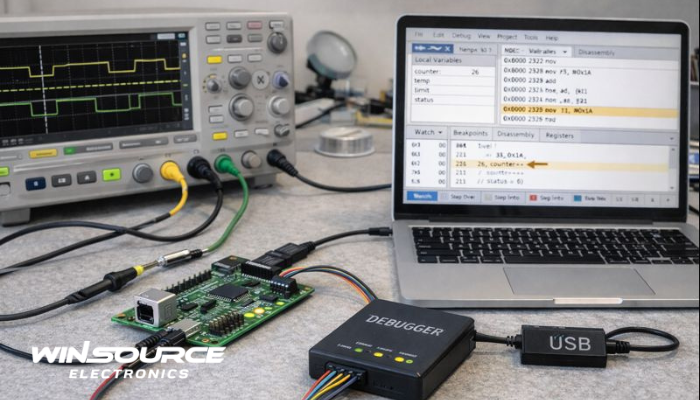
Embedded debugging refers to the process of identifying, analyzing, and resolving problems in embedded hardware and software systems.
Because embedded systems tightly combine hardware, firmware, and real-time behavior, debugging usually involves multiple aspects working together.
The main aspects of embedded debugging can be summarized below.
1. Hardware Debugging
Hardware debugging focuses on whether the physical circuit and components work as expected.
Key aspects include:
- Power supply stability and sequencing
- Clock source and frequency accuracy
- Reset circuit behavior
- Signal integrity on key interfaces
- Peripheral connections and pin mapping
Many embedded issues originate from hardware problems, especially during early development stages.
2. Software (Firmware) Debugging
This aspect deals with problems in the program code running on the embedded device.
Typical activities include:
- Verifying program logic
- Checking task flow and state transitions
- Debugging initialization and startup code
- Fixing configuration and parameter errors
Software debugging ensures that the firmware behaves correctly under normal conditions.
3. Interface and Communication Debugging
Embedded systems often communicate with external devices or networks.
Debugging focuses on:
- Serial interfaces (UART, SPI, I²C, CAN, etc.)
- Protocol configuration and timing
- Data format and message correctness
- Error handling and retries
Interface issues are common causes of system malfunction and require careful verification.
4. Timing and Real-Time Behavior Debugging
Many embedded systems are real-time systems, meaning timing is critical.
This aspect includes:
- Interrupt response timing
- Task scheduling and priority
- Latency and jitter
- Watchdog behavior
Incorrect timing may not cause immediate failure but can lead to intermittent or hard-to-reproduce bugs.
5. Power and Performance Debugging
Power and performance debugging evaluates how the system behaves under different workloads.
Key points include:
- Power consumption in active and sleep modes
- CPU utilization
- Memory usage and stack overflow risks
- Thermal behavior
This aspect is especially important in battery-powered and mobile devices.
6. Fault and Exception Debugging
This aspect focuses on abnormal conditions, such as:
- System crashes or resets
- Hard faults or exceptions
- Memory access errors
- Unexpected watchdog resets
Proper fault handling helps improve system reliability and safety.
7. Debug Tools and Observation Methods
Embedded debugging typically relies on tools such as:
- Debug probes (JTAG, SWD)
- Serial logs and trace outputs
- Logic analyzers and oscilloscopes
- Software breakpoints and watch variables
Choosing the right tools helps locate issues more efficiently.
Engineering Insight
Embedded debugging is not limited to fixing bugs—it is about understanding system behavior under real conditions.
Effective debugging usually requires combining hardware knowledge, software analysis, and real-time observation, rather than relying on a single method.
Conclusion
The main aspects of embedded debugging include:
- Hardware debugging
- Software (firmware) debugging
- Interface and communication debugging
- Timing and real-time behavior analysis
- Power and performance debugging
- Fault and exception handling
- Debug tools and observation techniques
Together, these aspects help engineers identify issues accurately and ensure stable, reliable embedded system operation.

COMMENTS