
* Question
How Are Automotive Sensors Classified?
* Answer
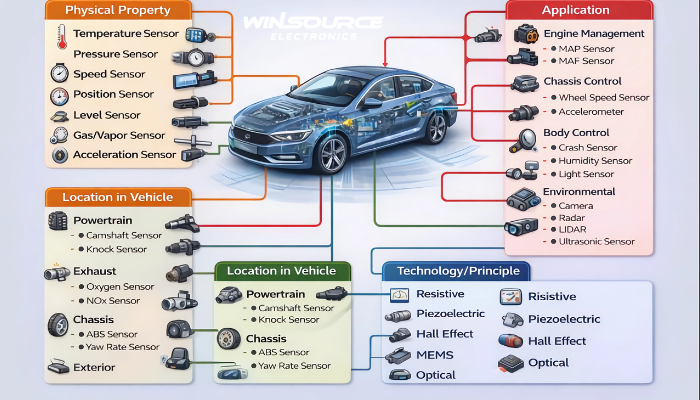
Automotive sensors can be classified in several ways based on their function, application area, and sensing principle. These sensors play a critical role in vehicle control, safety, efficiency, and driver assistance systems.
1. Classification by Application Area
Based on their functional role in the vehicle, automotive sensors can be grouped into the following categories:
- Powertrain Sensors
Used to monitor engine and transmission parameters such as speed, temperature, pressure, and air–fuel ratio. - Chassis and Dynamics Sensors
Measure vehicle motion and stability parameters, including wheel speed, acceleration, and yaw rate. - Body and Comfort Sensors
Support comfort and convenience features such as climate control, lighting, and seat positioning. - Safety and ADAS Sensors
Enable active and passive safety systems, including airbag deployment, collision avoidance, and driver assistance.
2. Classification by Measured Physical Quantity
Automotive sensors may also be classified according to the physical quantity they measure:
- Temperature Sensors(coolant, exhaust, battery)
- Pressure Sensors(manifold pressure, tire pressure, brake pressure)
- Position and Speed Sensors(crankshaft position, throttle position, wheel speed)
- Acceleration and Inertial Sensors(accelerometers, gyroscopes)
- Gas and Chemical Sensors(oxygen sensors, NOx sensors)
3. Classification by Sensing Principle
From a technical perspective, sensors can be categorized by their operating principle:
- Resistive Sensors
- Capacitive Sensors
- Inductive and Hall-Effect Sensors
- Piezoelectric Sensors
- Optical Sensors
Each sensing principle is selected based on accuracy, response time, durability, and environmental requirements.
4. Classification by Signal Type
Automotive sensors may also be classified by output signal type:
- Analog Sensors
- Digital Sensors
- Smart Sensors with Integrated Signal Processing
Smart sensors often include diagnostics and communication interfaces such as CAN or LIN.
Summary
Automotive sensors can be classified by application area, measured physical quantity, sensing principle, and signal type. This multi-dimensional classification reflects the increasing complexity of modern vehicles and the growing role of sensors in powertrain control, safety systems, and advanced driver assistance technologies.

COMMENTS