
* Question
What Challenges Do Amorphous Silicon (a-Si) TFTs Face When Driving OLED Displays?
* Answer
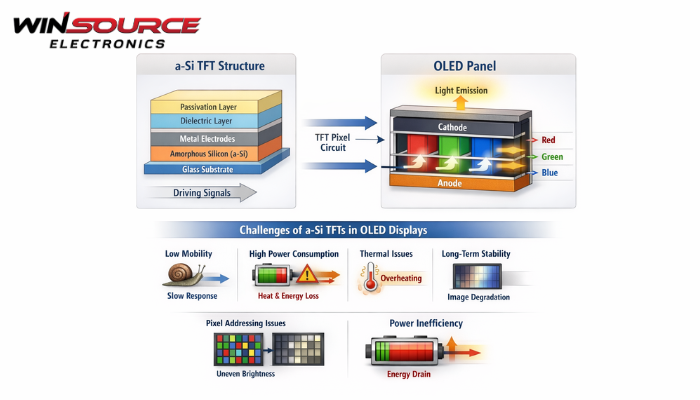
Thin-film transistors (TFTs) are a key component in active-matrix OLED (AMOLED) displays, where they control the current flowing through each OLED pixel. Among the available TFT technologies, amorphous silicon (a-Si) TFTs are widely used in LCD panels because of their mature manufacturing processes and relatively low cost. However, when applied to OLED driving circuits, amorphous silicon TFTs encounter several technical challenges that limit their effectiveness.
The following sections outline the main difficulties associated with using a-Si TFTs to drive OLED displays.
1. Low Carrier Mobility Limits Current Driving Capability
One of the most significant limitations of amorphous silicon TFTs is their low carrier mobility.
Typical mobility values:
- Amorphous silicon TFTs:~0.5–1 cm²/V·s
- Low-temperature polysilicon (LTPS) TFTs:~50–100 cm²/V·s
Because OLED pixels are current-driven devices, the driving TFT must deliver a stable and sufficiently large current. The low mobility of a-Si TFTs leads to:
- Limited current drive capability
- Larger transistor sizes required to achieve sufficient current
- Reduced pixel aperture ratio
In high-resolution displays, this limitation becomes particularly problematic because pixel areas are extremely small, leaving less space for larger TFT structures.
2. Threshold Voltage Instability
Another major challenge is threshold voltage (Vth) instability.
Amorphous silicon devices are sensitive to bias stress and temperature, which can cause shifts in the transistor’s threshold voltage over time. In OLED displays, this can lead to:
- Changes in the current delivered to the OLED pixel
- Pixel brightness variations
- Image non-uniformity across the display panel
Because OLED brightness directly depends on the driving current, even small Vth shifts can significantly affect display performance.
3. Poor Uniformity Across Large Panels
Amorphous silicon TFT fabrication often exhibits parameter variations across large substrates.
These variations may include differences in:
- Threshold voltage
- Mobility
- Leakage current
For LCD displays, such variations can often be compensated by the display driving scheme. However, OLED pixels require precise current control, making them more sensitive to transistor parameter mismatches. As a result, a-Si TFT arrays may cause:
- Brightness non-uniformity
- Color inconsistency
- Increased calibration complexity
4. Limited Circuit Integration Capability
OLED pixel circuits typically require multiple transistors per pixel to compensate for device aging and threshold voltage shifts. For example, advanced AMOLED pixel designs may use:
- 2T1C (two transistors + one capacitor)
- 5T1C or 7T1C compensation circuits
Due to the low performance and limited stability of a-Si TFTs, implementing complex compensation circuits becomes difficult. This limits the ability to:
- Compensate threshold voltage shifts
- Correct OLED aging effects
- Maintain stable brightness over long operating periods
As a result, displays based on a-Si TFTs may struggle to maintain long-term uniformity.
5. Higher Power Consumption
Because a-Si TFTs have low mobility, larger transistor dimensions are required to deliver the necessary current. This can increase:
- Parasitic capacitance
- Switching delays
- Overall power consumption
For modern portable devices such as smartphones, tablets, and wearable displays, energy efficiency is a critical design factor. Therefore, higher power consumption makes a-Si TFT technology less attractive for high-performance OLED displays.
6. Limited Suitability for High-Resolution AMOLED Panels
As display resolutions increase (e.g., 4K, 8K, and micro-OLED displays), the pixel size becomes smaller while current control requirements become stricter. The limitations of a-Si TFTs—especially low mobility and poor stability—make them less suitable for:
- High-pixel-density displays
- High refresh rate applications
- Advanced HDR displays
This is one reason why modern AMOLED panels often adopt LTPS TFT or oxide TFT (IGZO) technologies instead.
Conclusion
Although amorphous silicon TFT technology is mature and cost-effective, it faces several fundamental challenges when used to drive OLED displays. Key limitations include low carrier mobility, threshold voltage instability, poor uniformity, limited circuit integration capability, and higher power consumption. These factors make it difficult for a-Si TFTs to deliver the precise current control required by OLED pixels.
As a result, many modern OLED displays increasingly rely on LTPS or oxide TFT technologies, which provide higher mobility, better stability, and improved performance for high-resolution AMOLED panels.

COMMENTS