
* Question
What Are the Main I/O Port Expansion Methods for the MCS-51 Microcontroller?
* Answer
The MCS-51 (8051) microcontroller family is widely used in embedded systems for control, sensing, and communication tasks. However, many applications require more input/output (I/O) lines than the standard ports provided by the MCU. To address this limitation, engineers often implement I/O port expansion techniques that increase the number of accessible digital interfaces.
Below are the main expansion methods commonly used with MCS-51 microcontrollers.
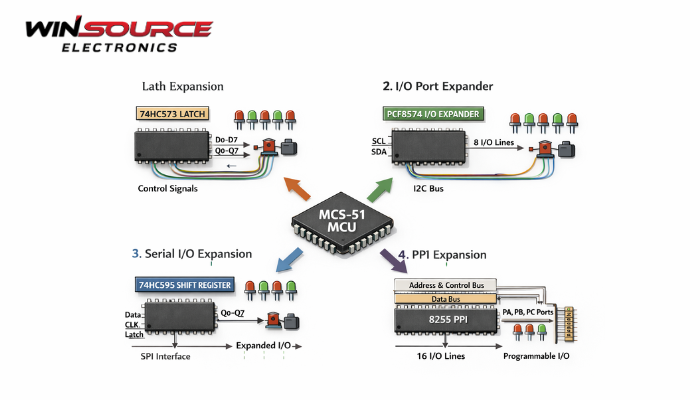
1. Parallel I/O Expansion Using External Latches or Buffers
One of the most straightforward expansion methods is to use external latches or buffer chips such as the 74HC373 or 74HC573. These devices allow the MCU to output data to additional I/O lines through a parallel interface.
Working principle:
The MCS-51 writes data to the latch via its data bus. A control signal (typically from a port pin) enables the latch to hold the data, which then drives external outputs.
Advantages:
- Simple circuit design
- Fast response due to parallel communication
- Suitable for driving LEDs, relays, and display modules
Typical applications:
- LED matrix displays
- Industrial control outputs
- Parallel data control systems
This method is often used when high-speed and deterministic control of multiple outputs is required.
2. I/O Expansion with Dedicated Parallel Interface Chips (e.g., 8255)
Another common solution is to use a programmable peripheral interface (PPI) such as the Intel 8255. The 8255 provides three programmable 8-bit ports, which can significantly increase the available I/O resources.
Key features:
- 24 programmable I/O lines
- Multiple operating modes (Mode 0, Mode 1, Mode 2)
- Support for handshake signals in advanced communication
Advantages:
- Flexible configuration of input or output ports
- Structured control through internal registers
- Suitable for complex embedded control systems
Typical applications:
- Data acquisition systems
- Industrial automation controllers
- Peripheral device interfacing
The 8255 approach is widely used when structured and configurable I/O expansion is required.
3. Serial I/O Expansion Using Shift Registers
Shift registers such as the 74HC595 (output) and 74HC165 (input) allow the MCS-51 to expand I/O using serial communication.
Working principle:
- Data is shifted serially from the MCU into the shift register.
- The register converts the serial data stream into multiple parallel outputs (or inputs).
For example:
- 74HC595– serial-to-parallel output expansion
- 74HC165– parallel-to-serial input expansion
Advantages:
- Requires only a few MCU pins (clock, data, latch)
- Highly scalable by cascading multiple registers
- Low hardware complexity
Typical applications:
- LED displays and indicator panels
- Keypad scanning systems
- Large digital output arrays
This method is ideal when many I/O lines are needed but MCU pins are limited.
4. Expansion via Serial Communication Interfaces (I²C or SPI)
Although the original MCS-51 architecture predates modern serial protocols, many derivatives support or can emulate I²C or SPI communication. This enables the use of dedicated I/O expanders such as:
- PCF8574 / PCF8575(I²C I/O expanders)
- MCP23S17 / MCP23017(SPI/I²C GPIO expanders)
Advantages:
- Minimal MCU pin usage
- High expandability with multiple devices on the same bus
- Simplified PCB routing
Typical applications:
- Embedded control systems
- Smart sensors and IoT nodes
- Industrial interface modules
This approach is widely used in modern 8051-based systems that integrate additional communication capabilities.
5. Memory-Mapped I/O Expansion
Another technique involves mapping external I/O devices into the external memory space of the MCS-51. Using address decoding logic, specific addresses correspond to external I/O ports.
Key characteristics:
- Uses the MCU’s external bus (address and data lines)
- Allows peripherals to be accessed as memory locations
- Often implemented with decoders such as 74LS138
Advantages:
- Structured expansion with multiple peripherals
- Suitable for complex embedded systems
- Compatible with external memory architecture
This method is frequently used in larger embedded control platforms where multiple peripherals must be integrated.
Conclusion
The MCS-51 microcontroller can expand its I/O capabilities through several hardware techniques, each suited to different application requirements. The most common expansion methods include:
- External latches and buffersfor simple parallel expansion
- Programmable interface chips (8255)for structured multi-port control
- Shift registersfor scalable serial expansion
- I²C/SPI I/O expandersfor modern embedded systems
- Memory-mapped I/Ofor complex system architectures
Selecting the appropriate expansion method depends on factors such as available MCU pins, communication speed, hardware complexity, and system scalability. By choosing the right approach, engineers can effectively extend the functionality of MCS-51-based embedded systems without replacing the core microcontroller.

COMMENTS