
* Question
What are the main performance indicators of the differential amplifier?
* Answer
A differential amplifier is a fundamental analog building block used to amplify the voltage difference between two input signals while suppressing common-mode noise.
Its performance is evaluated through several well-defined indicators that determine accuracy, stability, and suitability for precision measurement or signal-conditioning tasks.
Below are the most important performance indicators of a differential amplifier.
1. Differential Gain (Ad)
Definition
Differential gain represents how much the amplifier boosts the difference between the two input signals.
Significance
Higher differential gain improves the system’s ability to detect small differential signals—essential in:
- Sensor interfaces
- Current sensing
- Instrumentation amplifiers such as AD8227BRZ
Precision circuits rely on stable and predictable differential gain across temperature and frequency.
2. Common-Mode Rejection Ratio (CMRR)
Definition
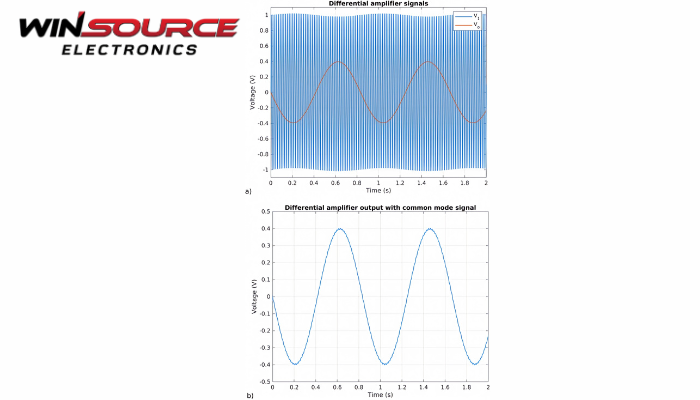
CMRR quantifies the amplifier’s ability to reject signals that appear equally on both inputs (common-mode signals).
Formula
CMRR=20log(Ad/ACM)
Significance
A higher CMRR means:
- Better noise immunity
- Superior suppression of interference such as power-line noise
More accurate differential measurements
High-precision amplifiers, such as INA826, often achieve CMRR values exceeding 100 dB.
3. Input Offset Voltage
Definition
The small voltage that must be applied between the amplifier’s inputs to make its output zero.
Impact
Offset voltage directly affects measurement accuracy, especially in:
- Low-voltage differential sensing
- High-gain applications
Instrumentation amplifiers target offset voltages in the microvolt range to minimize error.
4. Input Bias Current
Definition
The small DC currents entering the amplifier’s input terminals.
Impact
High input bias current can cause voltage drops across source impedances, introducing additional error.
Designers often choose amplifiers with femtoamp-level or picoamp-level bias currents for precision sensors and medical instrumentation.
5. Bandwidth and Slew Rate
5.1 Bandwidth
Indicates the frequency range over which the differential amplifier maintains its gain characteristics.
5.2 Slew Rate
Defines how fast the output can change in response to rapid input transitions.
Impact
Both determine suitability for:
- High-speed A/D front ends
- RF measurement
- Feedback control loops
- Audio differential stages
Amplifiers like OPA1612 provide high slew rates and wide bandwidth for demanding signal-processing tasks.
6. Noise Performance
Definition
Differential amplifiers generate internal noise that adds to input signals.
Key noise metrics:
- Input-referred voltage noise
- Current noise
- 1/f noise corner frequency
Low-noise differential amplifiers are critical in sensor acquisition, medical EEG/ECG, and precision metrology.
7. Power Supply Rejection Ratio (PSRR)
Definition
PSRR measures how well the amplifier prevents power-supply fluctuations from affecting the output.
Importance
High PSRR ensures stability in:
- Battery-driven systems
- Switching-supply environments
- Automotive electronics
Devices like LMV358 are frequently used for their robust PSRR characteristics.
Engineering Insight
The best differential amps optimize all indicators—high differential gain, outstanding CMRR, minimal noise, low offset, and strong PSRR—to deliver accurate and stable measurements.
These properties determine performance in applications ranging from industrial process control to high-resolution data converters.
Conclusion
The main performance indicators of a differential amplifier include:
- Differential Gain (Ad)
- Common-Mode Rejection Ratio (CMRR)
- Input Offset Voltage
- Input Bias Current
- Bandwidth and Slew Rate
- Noise Characteristics
- Power Supply Rejection Ratio (PSRR)
These parameters determine how effectively the amplifier processes differential signals while suppressing noise and disturbances, making them essential evaluation metrics for precision analog system design.

COMMENTS