
* Question
What Are the Two Major Benefits of Link Aggregation Compared to Separate Links Managed by STP?
* Answer
Link aggregation is a technique used in networking to combine multiple physical network links into a single logical link to increase bandwidth and provide redundancy. When comparing link aggregation to the use of separate links managed by Spanning Tree Protocol (STP), link aggregation offers several advantages. Below are the two major benefits:
1. Increased Bandwidth and Throughput
One of the most significant advantages of link aggregation is the increased bandwidth it provides. By combining multiple physical links into one logical connection, you can effectively increase the total available throughput between two devices.
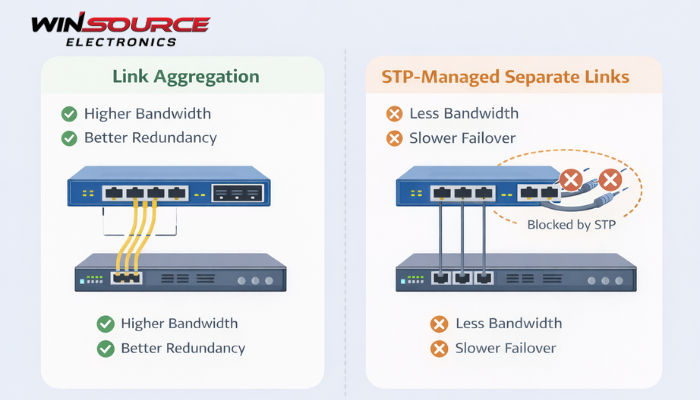
- Link Aggregation: By bundling multiple physical links (e.g., 2, 4, 8 links), you get higher total bandwidth. For instance, aggregating two 1 Gbps links gives a combined throughput of 2 Gbps, and so on.
- STP-managed Separate Links: In contrast, with STP, separate links are used individually, and the protocol blocks redundant paths to prevent network loops. This limits the use of the total bandwidth, as only one link (the active one) is utilized at any time, while others are placed in a blocked or standby state.
Why it matters: Link aggregation optimizes network capacity and improves the performance of data transfer by utilizing the full bandwidth of all available links, while STP restricts bandwidth usage due to the blocking of redundant paths.
2. Improved Redundancy and Fault Tolerance
Another key benefit of link aggregation is the improved redundancy and fault tolerance it offers. With link aggregation, if one link fails, the traffic is automatically redistributed over the remaining links without disrupting network operations.
- Link Aggregation: In a properly configured link aggregation setup (using standards like LACP—Link Aggregation Control Protocol), failure of one physical link does not cause downtime. The remaining links continue to handle traffic, ensuring continuous network operation.
- STP-managed Separate Links: While STP provides fault tolerance by blocking redundant paths and keeping them ready for activation if a primary path fails, it still introduces network downtime during the failover process. Additionally, STP can be slow to reconverge, especially in larger networks, which may lead to delays in recovering from a link failure.
Why it matters: Link aggregation offers seamless failover and faster recovery compared to STP-managed separate links, where network downtime and slower failover times can affect overall network performance and reliability.
Engineering Insight: Link Aggregation in Modern Networks
In modern high-performance networks, link aggregation is widely used to support bandwidth-hungry applications and ensure high availability. It is particularly beneficial in:
- Data centers: Where high throughput and reliability are critical.
- Enterprise networks: For connecting core and edge switches with redundant paths for reliability.
- Virtualization environments: To enhance network performance in hyper-converged infrastructures.
Link aggregation and STP are not mutually exclusive, and in fact, they are often used together in large networks to combine the benefits of both redundancy and performance.
Conclusion
Link aggregation offers two major benefits over separate links managed by STP:
- Increased bandwidth: Aggregating multiple physical links provides higher throughput than relying on single links managed by STP.
- Improved redundancy and fault tolerance: Link aggregation ensures that if one link fails, the remaining links continue to handle traffic without downtime, whereas STP introduces delays during failover.
These advantages make link aggregation a powerful tool for enhancing network performance and reliability, especially in environments where high availability and large-scale data transfers are essential.

COMMENTS