
* Question
What Are the Two Main Methods for Triggering Interrupt Signals in Microcontroller Systems?
* Answer
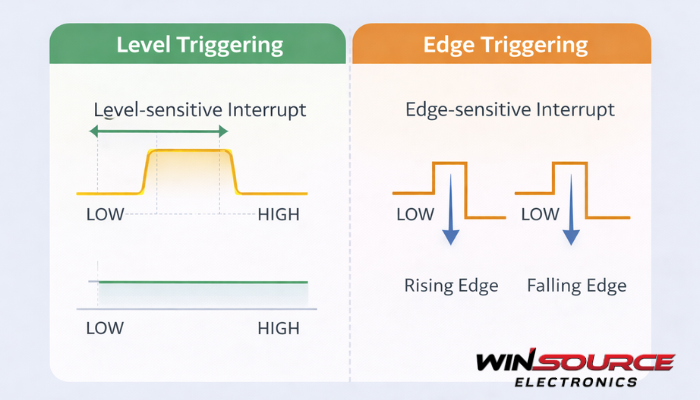
In microcontroller systems, interrupt signals are used to temporarily pause the main program and allow the processor to handle high-priority events. Interrupts enable more efficient processing by allowing the system to respond to external or internal events without continuously polling for them. There are two main methods for triggering interrupt signals: level triggering and edge triggering.
1. Level Triggering
In level triggering, the interrupt is triggered when the signal reaches a specific voltage level and remains at that level for a certain period of time. The interrupt is active as long as the signal stays at the triggering level.
Key Characteristics:
- Signal Type: The interrupt is activated by the constant levelof the signal (either high or low).
- Duration: The interrupt is maintained as long as the signal stays at the trigger level.
- Reset: Once the signal returns to its normal state, the interrupt is cleared.
Applications:
- Used for events that require continuous monitoring, such as detecting low battery levelsor temperature thresholds.
Why it matters: Level triggering is useful when you need to react to sustained conditions (e.g., a button press or sensor activation) rather than transient changes.
2. Edge Triggering
In edge triggering, the interrupt is triggered by the transition of a signal from one state to another — typically from low to high (rising edge) or from high to low (falling edge). The interrupt occurs only when the transition happens and is generally a one-time event.
Key Characteristics:
- Signal Type: The interrupt is activated on the edge(transition) of the signal.
- Rising Edge: Triggered when the signal changes from low to high.
- Falling Edge: Triggered when the signal changes from high to low.
- Duration: The interrupt occurs only during the transition and is cleared immediately after the event.
Applications:
- Commonly used in digital systems to respond to fast changes, such as in clock signalsor external event triggers (e.g., external switches, pulse signals).
Why it matters: Edge triggering is more suited for detecting short-lived events that occur at specific moments in time, making it ideal for high-speed data transfer or precise timing applications.
Engineering Insight: Choosing the Right Triggering Method
The choice between level triggering and edge triggering depends on the nature of the event and the desired system response:
- Level triggeringis used when an event requires sustained attention, such as a sensor monitoring a threshold over time.
- Edge triggeringis preferred for fast, discrete events where you only need to react to a state change, such as when synchronizing data or detecting a single pulse.
For instance, in real-time applications, edge-triggered interrupts are often preferred due to their ability to quickly respond to changes, whereas level-triggered interrupts are better suited for systems that require constant monitoring of conditions over time.
Conclusion
The two main methods for triggering interrupt signals in microcontroller systems are level triggering and edge triggering. Level triggering is used for events that need continuous monitoring, while edge triggering is more suitable for detecting discrete, time-sensitive transitions. Understanding when and how to use each method is essential for optimizing system performance and ensuring timely responses to critical events.

COMMENTS