
* Question
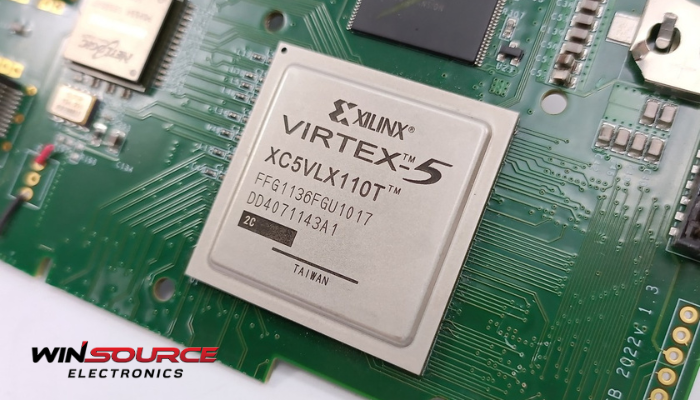
What Are the Key Features of the Xilinx Virtex-5 FPGA Series?
* Answer
The Virtex-5 series is a family of high-performance field-programmable gate arrays (FPGAs) developed by Xilinx (now part of AMD). Built on a 65-nm process technology, the Virtex-5 architecture provides significant improvements in logic density, processing performance, and power efficiency compared with earlier FPGA generations.
These devices are widely used in high-speed digital signal processing, communications infrastructure, aerospace systems, and advanced embedded computing platforms.
Below are the major features that define the Virtex-5 FPGA series.
1. Advanced 65-nm FPGA Architecture
Virtex-5 devices are fabricated using 65-nm CMOS technology, enabling higher logic density and improved performance.
Key architectural improvements include:
- Increased logic capacity
- Higher operating frequencies
- Lower power consumption compared with previous generations
The architecture is built around six-input lookup tables (6-input LUTs), which allow more complex logic functions to be implemented within a single logic element.
2. High-Performance Configurable Logic Blocks (CLBs)
The Configurable Logic Block (CLB) is the fundamental building unit of Virtex-5 FPGAs.
Each CLB contains:
- Two slices
- Four 6-input LUTs per slice
- Dedicated carry logic
- Storage elements (flip-flops)
This structure provides:
- Efficient implementation of combinational logic
- High-speed arithmetic operations
- Flexible register placement
The use of 6-input LUTs significantly improves logic efficiency compared with older 4-input architectures.
3. Integrated DSP48E Signal Processing Units
Virtex-5 FPGAs include dedicated DSP48E slices, which are specialized hardware blocks optimized for high-speed arithmetic operations.
Key capabilities include:
- High-speed multiplication
- Multiply-accumulate (MAC) operations
- Filtering and digital signal processing
- Fixed-point arithmetic acceleration
These DSP units are especially valuable in applications such as:
- Wireless communication systems
- Radar signal processing
- Video and image processing
- Software-defined radio (SDR)
4. High-Speed Serial Transceivers
Many Virtex-5 devices integrate RocketIO™ GTP/GTX serial transceivers, enabling high-speed serial communication.
Typical features include:
- Multi-gigabit data rates (up to several Gbps)
- Support for protocols such as PCI Express, Serial RapidIO, and Ethernet
- Integrated clock recovery and equalization
These transceivers make Virtex-5 devices suitable for high-bandwidth networking and data processing systems.
5. Large On-Chip Memory Resources
Virtex-5 FPGAs include substantial embedded memory resources that support high-speed data buffering and storage.
Memory resources include:
- Block RAM (BRAM)for high-speed data storage
- Distributed RAMimplemented using LUT resources
- FIFO support for streaming applications
These memory blocks are commonly used for:
- Packet buffering in communication systems
- Image frame storage in video processing
- Data caching in embedded processing systems
6. Flexible Clock Management System
Virtex-5 devices provide advanced clock management resources to support complex timing requirements.
Clock management features include:
- Digital Clock Managers (DCMs)
- Phase-locked loops (PLLs)
- Multiple global clock networks
These components enable:
- Frequency synthesis
- Clock phase adjustment
- Low-jitter clock distribution
Such capabilities are essential in high-speed digital systems where precise clock timing is required.
7. Multiple Device Platforms for Different Applications
The Virtex-5 family includes several specialized platforms optimized for different types of applications:
- Virtex-5 LX– optimized for logic-intensive applications
- Virtex-5 LXT– logic plus high-speed serial connectivity
- Virtex-5 SXT– optimized for DSP and signal processing
- Virtex-5 FXT– integrated high-speed serial transceivers and embedded PowerPC processors
This platform-based architecture allows designers to select the most suitable device for their application requirements.
8. Improved Power Efficiency
Despite offering higher performance and increased logic capacity, Virtex-5 devices are designed with improved power management techniques, including:
- Reduced static power consumption
- Dynamic power optimization
- Advanced power-gating strategies
This helps maintain system efficiency in high-performance computing and communication applications.
Conclusion
The Virtex-5 FPGA series represents a major advancement in programmable logic technology, offering high logic density, powerful DSP capabilities, multi-gigabit serial connectivity, and flexible clock management. Key features include the 65-nm architecture, 6-input LUT logic design, DSP48E processing blocks, embedded memory resources, and high-speed RocketIO transceivers.
These capabilities make Virtex-5 devices suitable for demanding applications such as digital signal processing, high-speed networking, embedded computing, and advanced industrial systems.

COMMENTS