
* Question
What Is a Duplexer in RF Communication Systems?
* Answer
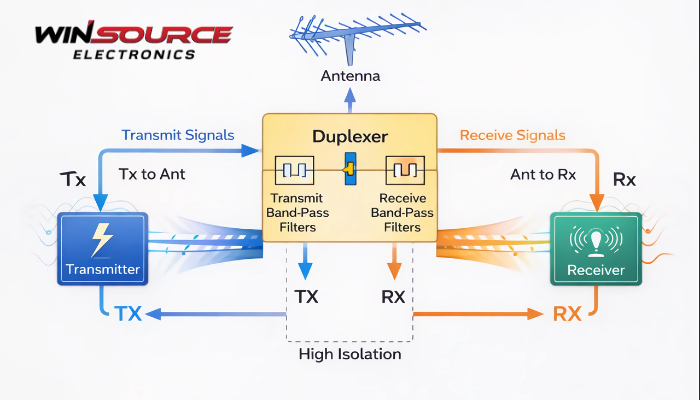
A duplexer is a radio frequency (RF) device that allows a transmitter and a receiver to share a single antenna while operating at different frequencies. It separates transmitted and received signals, enabling simultaneous transmission and reception without mutual interference.
How a Duplexer Works
A duplexer uses frequency-selective filtering to isolate transmit (TX) and receive (RX) signal paths:
- The transmitter signal is routed to the antenna while being blocked from entering the receiver
- The received signal is directed to the receiver while being isolated from the transmitter output
This frequency-based isolation prevents high-power transmit signals from damaging or desensitizing the receiver.
Main Types of Duplexers
Duplexers can be classified based on their operating principle and application:
- Frequency Division Duplex (FDD) Duplexers
Use separate frequency bands for transmission and reception. - Cavity Duplexers
Commonly used in high-power and base station applications for high isolation. - Ceramic or SAW Duplexers
Used in compact wireless devices such as mobile phones and IoT modules.
Key Characteristics
Important performance parameters of a duplexer include:
- Insertion loss
- Isolation between TX and RX paths
- Bandwidth and frequency selectivity
- Power handling capability
These characteristics determine the duplexer’s suitability for specific RF applications.
Summary
A duplexer is an RF component that enables a transmitter and receiver to share a common antenna by separating transmit and receive signals using frequency-selective filtering. It is a critical component in wireless communication systems such as mobile networks, radios, and RF front-end modules.

COMMENTS