
* Question
What Is Hardware Reset in a Microcontroller System?
* Answer
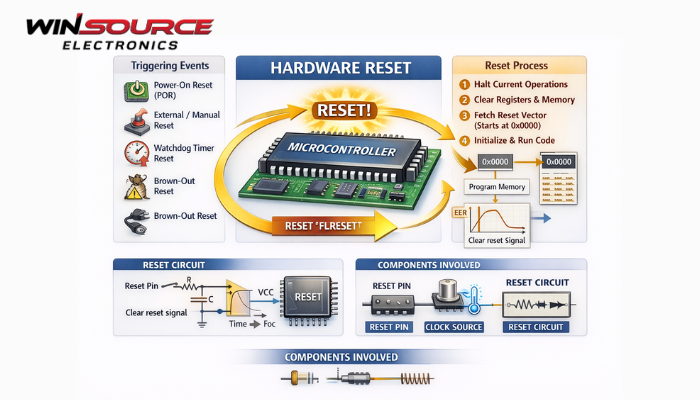
In microcontroller-based systems, a hardware reset is a method used to initialize or restart the processor through a dedicated hardware signal rather than software instructions. When a hardware reset occurs, the microcontroller immediately stops its current operation and returns to a predefined initial state, allowing the system to start executing the program from the beginning.
Hardware reset mechanisms are essential for ensuring reliable system startup and recovery from unexpected faults.
1. Definition of Hardware Reset
A hardware reset is triggered by an external electrical signal applied to the microcontroller’s RESET (RST) pin. When this signal is asserted—typically by driving the pin high or low depending on the device specification—the microcontroller performs a complete internal initialization.
During a hardware reset, several key operations occur:
- The program counter (PC)is cleared and set to the reset vector address.
- Internal registers are returned to their default states.
- Peripherals are initialized.
- Program execution restarts from the beginning of the firmware.
In the MCS-51 (8051) microcontroller, the reset vector is typically located at address 0000H, where the first instruction of the program resides.
2. How Hardware Reset Works in the MCS-51 MCU
For the 8051 microcontroller family, a hardware reset is generated by applying a high-level signal to the RST pin for at least two machine cycles while the oscillator is running.
When this condition is satisfied:
- The CPU halts the current operation.
- The internal registers are reinitialized.
- The program counter is set to 0000H.
- The program begins execution from the start of the firmware.
A common hardware reset circuit includes:
- A power-on reset capacitor
- A pull-down resistor
- Sometimes a manual reset push-button
This ensures that the system automatically resets when power is applied.
3. Typical Hardware Reset Circuit
In many 8051 systems, a power-on reset circuit is used to guarantee a reliable startup.
Typical components include:
- Resistor (R)connected to ground
- Capacitor (C)connected to VCC
- Optional reset push button
When the power supply is turned on, the capacitor temporarily drives the RST pin high, creating the required reset pulse. After the capacitor charges, the reset signal returns to a low level and normal program execution begins.
This circuit ensures the microcontroller starts from a known state every time the system powers up.
4. Hardware Reset vs. Software Reset
Although both methods restart the microcontroller, they differ in how they are triggered.
Hardware Reset
- Triggered by an external electrical signal
- Reinitializes the entire microcontroller system
- Used for power-on startup or system recovery
Software Reset
- Initiated through a program instruction or watchdog timer
- Executed by the CPU itself
- Typically used for controlled system restarts
Hardware reset is generally considered more reliable, especially when the system enters an abnormal state where software may no longer function correctly.
5. Common Applications of Hardware Reset
Hardware reset circuits are widely used in embedded systems to ensure stable operation.
Typical applications include:
- Power-on initializationof microcontrollers
- Manual reset buttonsfor debugging or user control
- Watchdog recovery systemsfor fault protection
- Industrial control systemsrequiring high reliability
In safety-critical designs, hardware reset often works together with watchdog timers to prevent system lockups.
Conclusion
Hardware reset is a fundamental mechanism in microcontroller systems that ensures reliable startup and system recovery. By applying an external reset signal to the reset pin, the microcontroller clears its internal state and restarts program execution from the reset vector.
In widely used architectures such as the MCS-51 (8051), hardware reset plays a crucial role in power-on initialization, fault recovery, and system stability, making it an essential feature in embedded electronics design.

COMMENTS