
* Question
What is single-photon detection?
* Answer
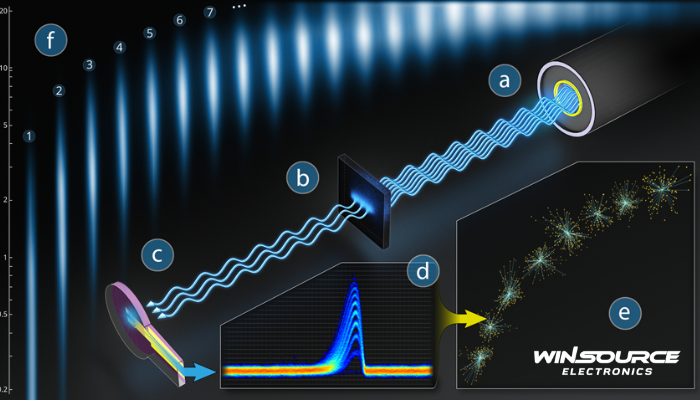
Single-photon detection refers to the ability of a sensor or detector to register the arrival of individual photons, the smallest quantized units of light. Unlike conventional photodetectors that measure continuous light intensity, single-photon detectors operate at the ultimate sensitivity limit, enabling the detection of extremely weak optical signals.
Key Characteristics of Single-Photon Detection
1. Sensitivity to Individual Photons
A single-photon detector produces a measurable electrical response—even when only one photon hits the sensing element. This requires ultra-low noise, high gain, and fast response circuits.
2. Discrete Output Signals
Instead of an analog amplitude, the output is typically a digital pulse indicating whether a photon was detected or not. This enables:
- Counting photons
- Measuring photon arrival times
- Enabling time-correlated single-photon applications
3. Extremely Low Noise Requirements
To reliably detect single photons, detectors must suppress:
- Thermal noise
- Dark counts (noise pulses without photon input)
- Background electromagnetic interference
High signal-to-noise ratios are essential for accurate performance.
Common Technologies Used for Single-Photon Detection
- SPADs (Single-Photon Avalanche Diodes)– Semiconductor devices that trigger an avalanche event when a photon is absorbed.
- PMTs (Photomultiplier Tubes)– Vacuum-tube detectors with very high internal gain.
- SNSPDs (Superconducting Nanowire Single-Photon Detectors)– Ultra-sensitive cryogenic detectors offering unmatched timing precision.
- APDs in Geiger mode– Avalanche photodiodes operated at high bias.
Where Is Single-Photon Detection Used?
Single-photon detection enables applications that operate with extremely low light levels or require precise timing, such as:
- Quantum communication and quantum key distribution (QKD)
- Lidar and time-of-flight ranging
- Fluorescence lifetime imaging (FLIM)
- Astronomy and deep-space optical sensing
- Medical imaging and molecular analysis
- Optical time-domain reflectometry (OTDR)
Summary
Single-photon detection is the process of sensing individual photons using ultrahigh-sensitivity detectors such as SPADs, PMTs, or superconducting nanowires. It underpins modern technologies in quantum communication, lidar, biomedical imaging, and scientific instrumentation where extremely low light signals must be measured with high precision.

COMMENTS