
* Question
What Is the Classification of the Interleaver?
* Answer
In digital communication systems, an interleaver is used to rearrange data sequences to improve error-correction performance, especially in noisy or fading channels.
Interleavers are essential in standards such as LTE, 5G NR, Wi-Fi, DVB, Turbo Codes, and LDPC Codes.
Interleavers can be classified based on structure, operation, and application context. Below are the most widely accepted classifications.
1. Classification by Structure
1.1 Block Interleavers
Block interleavers store data in a matrix and read it out in a different order—usually row-wise in, column-wise out.
Features:
- Simple implementation
- Fixed-size data blocks
- Common in convolutional code systems
Example: Used in DVB-T and some Turbo encoder designs.
1.2 Convolutional Interleavers
Data is passed through a series of delay lines with incremental lengths.
Features:
- Continuous operation (not block-based)
- Suitable for streaming data
- More robust against burst errors
Used in systems such as Trellis-coded modulation and legacy wireless modems.
2. Classification by Interleaving Pattern
2.1 Random Interleavers
Data positions are permuted according to a pseudo-random sequence.
Features:
- Excellent performance with Turbo and LDPC codes
- Avoids predictable patterns
- Higher computational complexity
Example: 3GPP Turbo Code uses a well-defined random permutation function.
2.2 Deterministic (Structured) Interleavers
Positions follow a predefined mathematical formula.
Types include:
- Algebraic interleavers
- Cyclic interleavers
- Helical interleavers
- Bit-reversal interleavers
- Quadratic permutation polynomial (QPP) interleavers
Example:
LTE uses QPP interleavers, enabling easy parallel decoding with predictable permutations.
3. Classification by Application Layer
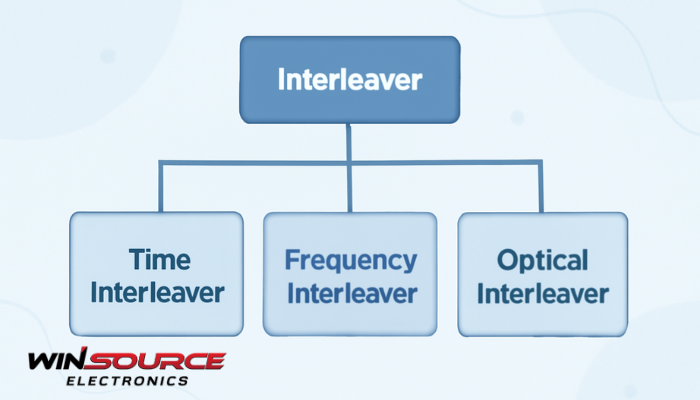
3.1 Time Interleavers
Spread data symbols across time slots to combat time-domain fading.
3.2 Frequency Interleavers
Spread symbols across different subcarriers—critical in OFDM systems like Wi-Fi and 5G—to mitigate frequency-selective fading.
3.3 Time–Frequency Hybrid Interleavers
Combines both dimensions to provide robust protection in harsh wireless environments.
Example: Used in DVB-T2 and 5G NR LDPC coding chains.
Engineering Insight
The choice of interleaver strongly affects:
- Decoder convergence speed
- Bit error rate (BER) performance
- Hardware/FPGA resource usage
- Latency and memory requirements
For instance, QPP interleavers are favored in LTE because they provide deterministic behavior suited for parallel Turbo decoding, while random interleavers often achieve better BER in LDPC but require more memory.
Communication ICs such as the Qualcomm Snapdragon modem or Broadcom BCM series Wi-Fi chips implement multiple interleaver types depending on coding and modulation schemes.
Conclusion
Interleavers can be classified into several categories:
- By structure:block and convolutional
- By interleaving pattern:random and deterministic (algebraic, cyclic, QPP, etc.)
- By application dimension:time, frequency, and hybrid
Each type provides different advantages depending on the communication system’s error environment, coding method, and performance requirements.

COMMENTS