
* Question
What Are the Main Components of an Ultrasound System?
* Answer
An ultrasound system is composed of several functional modules that work together to generate, transmit, receive, and process ultrasonic signals. Although specific implementations vary by application, the basic system architecture remains largely consistent across medical, industrial, and measurement-based ultrasound systems.
1. Ultrasonic Transducer
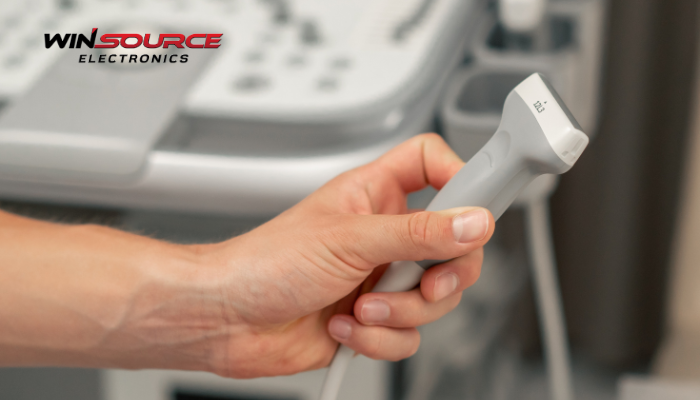
The ultrasonic transducer is the core component of the system.
It converts electrical signals into ultrasonic waves during transmission and converts reflected ultrasonic echoes back into electrical signals during reception.
Transducers are typically based on piezoelectric materials and are selected according to frequency, bandwidth, and application requirements.
2. Transmit (Excitation) Circuit
The transmit circuit generates high-voltage electrical pulses to excite the ultrasonic transducer.
This module determines:
- Pulse amplitude
- Pulse width and repetition rate
- Signal timing and synchronization
Accurate excitation control is essential for achieving sufficient penetration depth and signal resolution.
3. Receive Circuit
The receive circuit amplifies and conditions the weak echo signals returned from the target.
It usually includes:
- Low-noise amplifiers
- Gain control stages
- Filtering circuits
This module plays a critical role in improving signal-to-noise ratio (SNR).
4. Signal Processing Unit
The signal processing unit extracts useful information from the received ultrasonic signals.
Typical functions include:
- Signal amplification and filtering
- Time-of-flight calculation
- Envelope detection and digital signal processing
In modern systems, this unit often relies on digital processors or embedded controllers.
5. Control and Timing Unit
The control unit coordinates system operation by managing:
- Transmit and receive timing
- Trigger generation and synchronization
- Parameter configuration
This ensures precise timing alignment between signal transmission and reception.
6. Display or Output Interface
The display or output module presents processed results to the user or transmits data to external systems.
Depending on the application, this may include:
- Visual waveform or image display
- Distance, thickness, or defect measurements
- Digital communication interfaces
Summary
An ultrasound system typically consists of an ultrasonic transducer, transmit and receive circuits, signal processing unit, control module, and output interface. These components work together to enable accurate ultrasonic generation, detection, and analysis for various measurement and inspection applications.

COMMENTS