
* Question
What is the function of the arithmetic unit?
* Answer
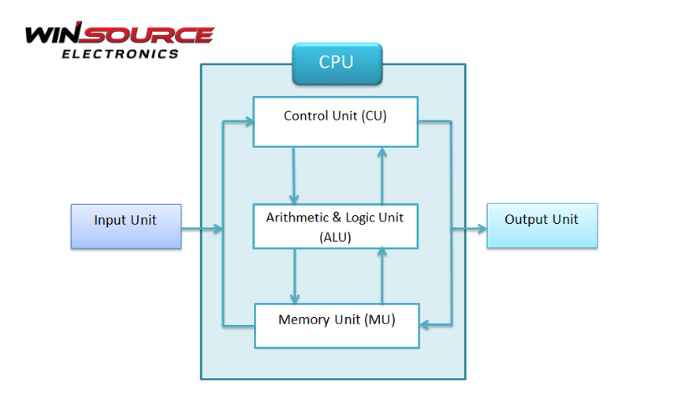
The arithmetic unit, often referred to as the Arithmetic Logic Unit (ALU), is the core computational component of a processor. Its primary function is to execute arithmetic operations such as addition, subtraction, multiplication, and division, as well as logical operations including AND, OR, XOR, and bit shifting. These operations form the foundation of all higher-level computing tasks, from simple data manipulation to complex algorithm execution.
In a microcontroller, microprocessor, or digital signal processor, the arithmetic unit works closely with the control unit and register file. The control unit issues instructions, while the arithmetic unit performs the actual data processing required to complete each command. Intermediate results are stored in registers, enabling fast access and efficient execution of sequential operations.
Beyond basic arithmetic, modern arithmetic units may incorporate specialized capabilities such as fixed-point and floating-point computation, vector processing, or hardware acceleration for encryption and signal processing tasks. These enhancements improve computational efficiency and allow the processor to handle demanding workloads such as real-time control, multimedia processing, or high-precision scientific calculations.
By providing reliable and high-speed mathematical and logical processing, the arithmetic unit serves as the engine that drives all digital system operations, directly influencing the performance and capability of the entire computing architecture.

COMMENTS