
* Question
What Is the Function of the Main Components of a Transformer?
* Answer
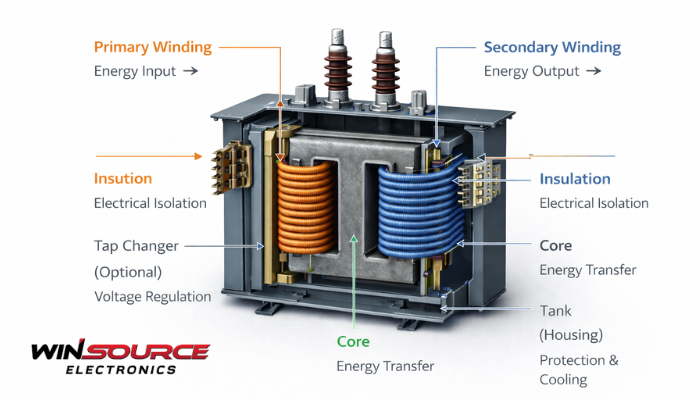
A transformer is an essential electrical device used to transfer electrical energy between two or more circuits through electromagnetic induction. It plays a critical role in voltage conversion, whether stepping up or stepping down the voltage, and is fundamental to the functioning of power distribution systems. The main parts of a transformer work together to perform this task. Below are the key components of a transformer and their functions.
1. Core
The core is the central component of a transformer and is typically made of laminated silicon steel sheets to reduce energy loss. Its primary function is to provide a controlled path for the magnetic flux generated by the current flowing through the windings.
Key Function:
- Magnetic Field Conduction: The core serves as the path for the magnetic flux created by the primary winding. This magnetic flux induces voltage in the secondary winding, enabling energy transfer.
- Efficiency: The core minimizes energy loss and enhances the efficiency of the transformer by reducing eddy currents and hysteresis losses.
Why it matters: The core’s material and design significantly impact the transformer’s efficiency and its ability to transfer energy.
2. Primary Winding
The primary winding is the coil of wire that receives the electrical input, typically connected to the power source. When an electric current flows through the primary winding, it generates a magnetic field that passes through the core.
Key Function:
- Energy Input: The primary winding is where electrical energy is fed into the transformer. The amount of current passing through this coil determines the strength of the magnetic field created.
- Magnetic Induction: This coil’s current generates a magnetic flux, which induces voltage in the secondary winding.
Why it matters: The primary winding is crucial for the initial energy transfer in the transformer, and its design affects the efficiency and operating voltage of the transformer.
3. Secondary Winding
The secondary winding is the coil that delivers the electrical energy to the output circuit. The voltage induced in the secondary winding depends on the number of turns of the coil and the turns ratio between the primary and secondary windings.
Key Function:
- Energy Output: The secondary winding receives the induced voltage from the magnetic field created by the primary winding. The voltage in the secondary winding is either stepped up or stepped down depending on the turns ratio.
- Voltage Transformation: The number of turns in the secondary winding relative to the primary winding determines the output voltage.
Why it matters: The secondary winding is responsible for delivering the transformed voltage to the load, whether that involves increasing or decreasing voltage levels for safe and efficient power distribution.
4. Insulation
Insulation is a crucial part of a transformer, especially for the windings. It prevents short circuits between the coils and ensures that the transformer operates safely.
Key Function:
- Electrical Isolation: Insulation ensures that the windings do not short-circuit or cause electrical faults. It maintains the proper voltage separation between the windings.
- Thermal Protection: It also helps in managing heat generation within the transformer by ensuring that the windings are kept safe from excessive heat damage.
Why it matters: Proper insulation is vital for ensuring the safe operation of the transformer, protecting both the windings and the transformer itself from electrical and thermal damage.
5. Tap Changer (Optional)
Some transformers, especially those used in high-voltage applications, have a tap changer. The tap changer allows for adjusting the turns ratio of the transformer to regulate the output voltage.
Key Function:
- Voltage Regulation: Tap changers allow for the adjustment of the transformer’s voltage output, typically used in applications requiring precise control of output voltage, such as power grids.
- Load Adjustments: By altering the number of turns in the winding, the tap changer ensures that the transformer maintains the desired voltage under varying load conditions.
Why it matters: Tap changers are crucial in applications that demand precise voltage control and stability, ensuring that voltage levels are optimized for changing load conditions.
6. Tank or Housing
The tank or housing is the outer casing that contains the transformer components and provides mechanical protection. The housing is typically filled with oil or other insulating material that also serves as a coolant for the transformer.
Key Function:
- Mechanical Protection: The tank protects the internal components from environmental damage and physical impact.
- Cooling: Oil-filled transformers use the insulating oil to dissipate heat generated by the core and windings during operation.
Why it matters: The tank or housing ensures the transformer’s longevity by protecting it from external elements and managing heat, which is crucial for maintaining efficient operation.
Engineering Insight: Transformer Design Considerations
The design and efficiency of a transformer depend on several factors, including:
- Core material: High-quality materials like laminated steel minimize energy losses.
- Turns ratio: The number of turns in the primary and secondary windings dictates the voltage transformation.
- Cooling system: Transformers in high-power applications require efficient cooling to prevent overheating.
Understanding the function of each component helps in optimizing transformer design for specific applications, such as power transmission, distribution, or industrial uses.
Conclusion
The main components of a transformer — the core, primary winding, secondary winding, insulation, tap changer, and housing — work together to efficiently transfer electrical energy while ensuring safety, reliability, and performance. The core handles the magnetic field, the windings transfer energy, and the insulation provides safety, while the tap changer adjusts output voltage and the housing protects the components and ensures cooling.
Understanding the role of each part of a transformer is crucial for optimizing its design and application, whether for power distribution, electrical circuits, or industrial equipment.

COMMENTS