
* Question
What Is the Function of the Interrupt Enable Register?
* Answer
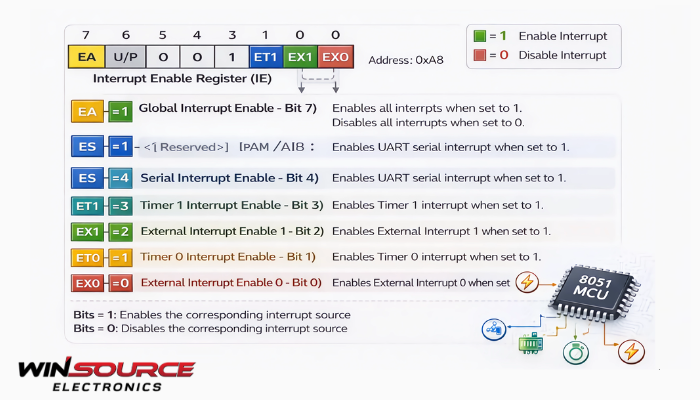
The interrupt enable register is a control register used in microcontrollers and processors to manage the activation of interrupt sources. Its primary role is to determine which interrupts are allowed to generate an interrupt request to the CPU.
1. Enabling and Disabling Interrupt Sources
Each bit in the interrupt enable register typically corresponds to a specific interrupt source, such as:
- Timers
- External interrupt pins
- Communication peripherals (UART, SPI, I²C)
Setting a bit enables the corresponding interrupt, while clearing the bit disables it.
2. Selective Interrupt Control
The interrupt enable register allows selective control of interrupts.
- Critical interrupts can be enabled while non-essential ones are disabled
- Interrupt behavior can be tailored to different operating modes
This improves system flexibility and responsiveness.
3. Preventing Unnecessary Interrupts
By disabling unused or irrelevant interrupts, the interrupt enable register helps:
- Reduce CPU overhead
- Avoid unintended interrupt servicing
- Improve overall system stability
4. Supporting Safe System Operation
During initialization, critical code execution, or power management states, interrupts may need to be temporarily disabled.
The interrupt enable register provides a controlled mechanism for managing interrupt behavior during these conditions.
Summary
The interrupt enable register controls which interrupt sources are allowed to trigger CPU interrupts. By selectively enabling or disabling interrupts, it helps manage system responsiveness, efficiency, and operational safety.

COMMENTS