
* Question
What Are the Different Types of Contact IC Card Readers and Their Applications?
* Answer
Contact IC card readers are widely used for applications that require secure identification and authentication, such as payment systems, access control, and data protection. These readers operate by physically connecting to the IC card via a contact interface, allowing communication between the card and the reader.
Here are the different types of contact IC card readers and their applications:
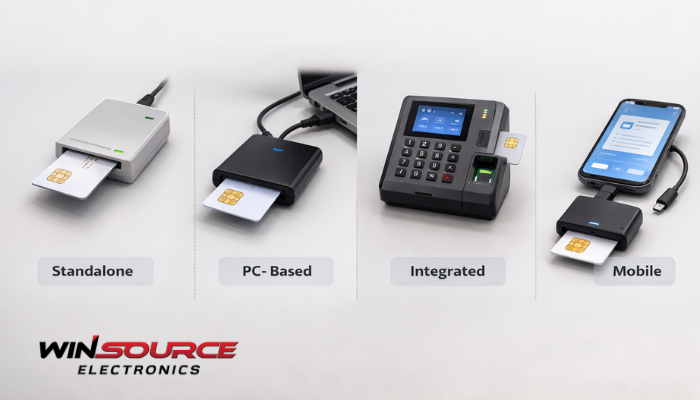
1. Standalone Contact IC Card Readers
Standalone contact IC card readers are self-contained devices that provide the functionality to read, write, and authenticate data from IC cards. They do not require a separate system for processing and can work independently.
Key Features:
- Interface: Typically features a USB, serial, or PS/2 interface for communication with a host system.
- Applications: Used in secure access control, attendance systems, and small payment applications.
Why it matters: Standalone readers are commonly used in environments where simplicity and quick setup are needed. They are ideal for small businesses or local systems that do not require complex configurations.
2. PC-based Contact IC Card Readers
PC-based contact IC card readers are designed to work in conjunction with a computer or other host system. These readers usually connect via USB, and they rely on the host computer to process the data read from the IC card.
Key Features:
- Interface: USB connection to the PC or host device.
- Software Integration: Comes with software to facilitate communication and data handling.
- Applications: Often used in enterprise-level systems for data access, identity verification, and payment systems.
Why it matters: These readers allow for more flexibility in software applications, and they are suitable for environments that require high-volume or complex processing.
3. Smart Card Readers with Security Features
Smart card readers with additional security features offer enhanced protection for sensitive data. These readers integrate security protocols like encryption and authentication mechanisms to ensure the integrity of the data being transmitted.
Key Features:
- Security Protocols: Support for advanced encryption, digital signatures, and authentication.
- Applications: Used in banking, government ID systems, and highly secure access systems.
Why it matters: These readers are critical for applications where security is paramount, such as financial transactions, access to classified data, and national security applications.
4. Integrated Card Readers
Integrated card readers combine a contact IC card reader with other functionalities, such as a keyboard, display, or biometric scanner. These readers are designed for applications where multiple forms of identification are needed, and they offer convenience in terms of space and functionality.
Key Features:
- Multi-functionality: Integration with other devices (e.g., fingerprint scanner, keypad).
- Applications: Ideal for complex access control systems, payment terminals, and kiosks.
Why it matters: Integrated readers are perfect for environments where space is limited and multiple types of identification are required in a single device, offering more versatile and convenient solutions.
5. Contactless IC Card Readers (Hybrid)
While this category primarily focuses on contact IC card readers, hybrid models that combine both contact and contactless functionality are becoming increasingly common. These readers can support both contact IC cards and contactless cards, providing flexibility for users who have different types of smart cards.
Key Features:
- Dual-Functionality: Ability to read both contact and contactless cards.
- Applications: Used in large-scale access control systems, transportation, and multi-purpose payment systems.
Why it matters: Hybrid readers are ideal for environments where both types of cards need to be supported, reducing the need for separate devices for each type of card.
6. Mobile Contact IC Card Readers
Mobile contact IC card readers are portable and can be used in conjunction with smartphones or tablets. These readers connect to mobile devices via Bluetooth, USB, or other wireless technologies and allow for easy processing of IC card data.
Key Features:
- Portability: Lightweight and compact design.
- Mobile Integration: Works with mobile apps to process card data on the go.
- Applications: Widely used in mobile payment systems, field services, and portable authentication solutions.
Why it matters: These readers provide flexibility for mobile workers and are increasingly important in applications such as mobile payments, customer loyalty programs, and remote access control.
Engineering Insight: Choosing the Right Contact IC Card Reader
When selecting a contact IC card reader, it is important to consider factors such as:
- Security requirements: Whether you need encryption and advanced authentication features.
- Connection type: USB, Bluetooth, or serial connection depending on the system architecture.
- Application scale: Whether the reader will be used in a small-scale or enterprise-level system.
- Multi-functionality: Whether additional features, such as biometric authentication, are needed.
Understanding these factors ensures that the selected card reader meets the specific requirements of the application while providing optimal performance.
Conclusion
Contact IC card readers are essential for secure identification, access control, and data handling applications. There are various types of contact IC card readers, including standalone, PC-based, and integrated systems, each suited for different use cases. When selecting the right reader, consider the security, functionality, and scalability requirements of your application.

COMMENTS