
* Question
Which feedback modes does the Cyclone III PLL support?
* Answer
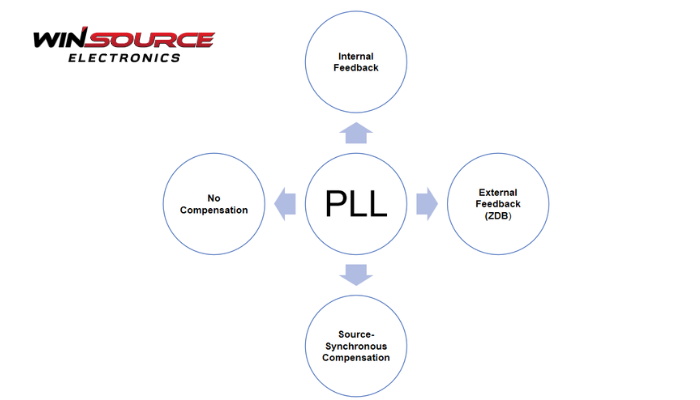
Cyclone III devices provide several PLL feedback/compensation modes to support different timing and clock-distribution scenarios. The main feedback modes are:
1. Internal Feedback Mode (Normal Mode)
- The PLL uses an internal feedback path.
- The output clock is phase-aligned with the reference clock inside the PLL.
- Simplest configuration; suitable for most general-purpose applications.
2. Zero-Delay Buffer (ZDB) / External Feedback Mode
- The feedback is taken externallyfrom a PLL output pin and routed back to the PLL’s feedback input.
- Eliminates clock tree delay so the output clock edge aligns with the input clock edge at the device boundary.
- Commonly used for driving external devices that require tight phase alignment.
3. Source-Synchronous Compensation Mode
- The PLL compensates for input or output delaysin source-synchronous interfaces.
- Used when capturing data using an incoming clock or forwarding a clock with data.
- Supports DDR, high-speed I/O, and other timing-critical interfaces.
4. No Compensation Mode
- The PLL does notperform delay compensation.
- Used for applications where only frequency synthesis is required, not phase alignment.
Summary
Cyclone III PLLs support the following feedback/compensation modes:
- Internal Feedback (Normal)
- External Feedback / Zero-Delay Buffer (ZDB)
- Source-Synchronous Compensation
- No Compensation
These modes allow designers to meet a wide range of timing, synchronization, and interface requirements in FPGA-based systems.

COMMENTS