
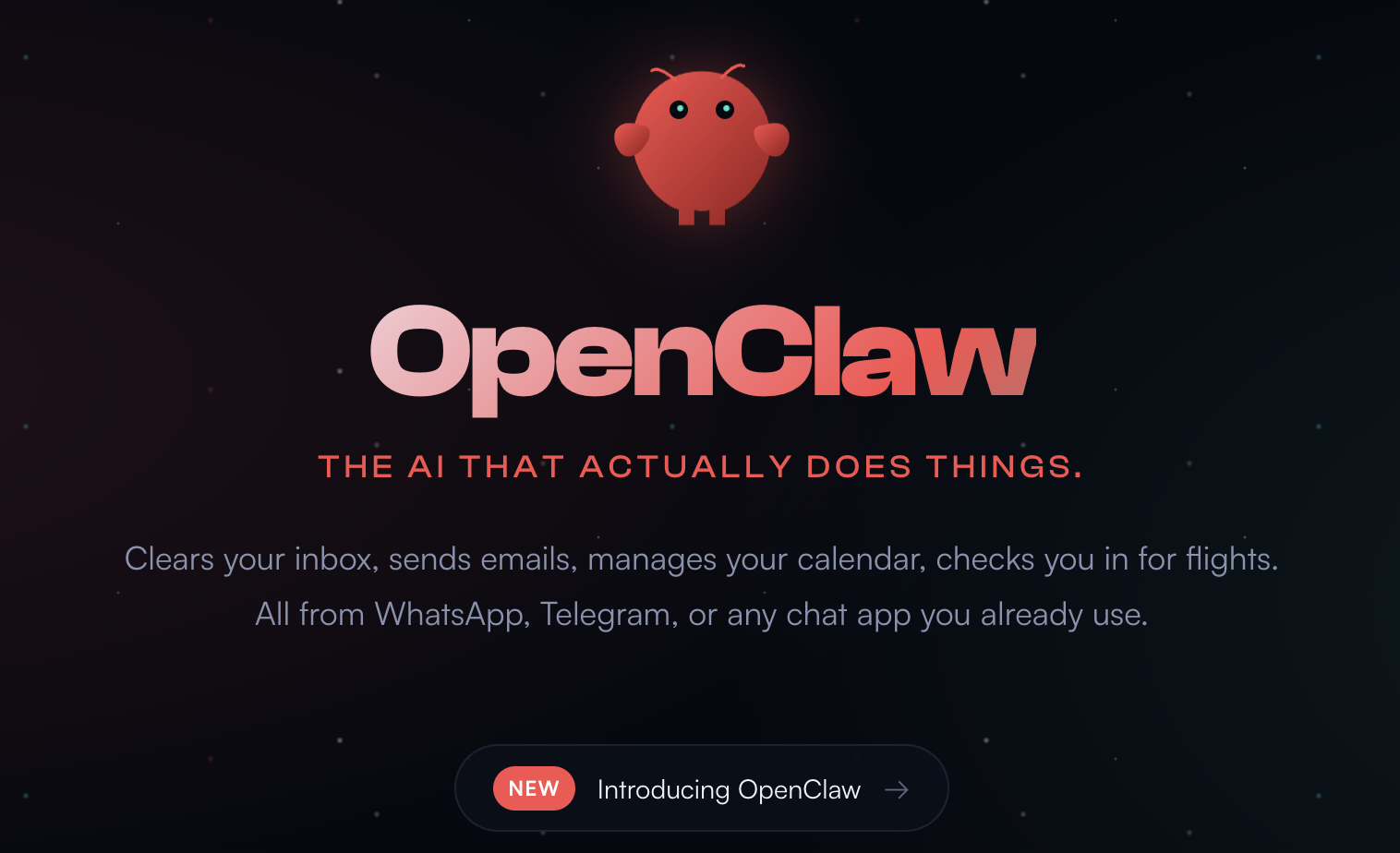
*Image from the internet; all rights belong to the original author, for reference only.
Why OpenClaw Is Trending on GitHub in 2026: The Rise of AI Agent Frameworks
For the past two years, most large language model (LLM) applications have focused on chatbots. Users ask questions, and the AI generates answers. This approach has powered tools for documentation search, customer service, and knowledge assistance.
However, in 2026, developer attention is increasingly shifting toward AI agents. Unlike traditional chat systems, AI agents are designed to plan tasks, call external tools, and execute multi-step workflows.
One open-source project that has recently gained traction on GitHub is OpenClaw, an AI agent framework built to orchestrate large language models and automated actions. Its modular architecture and plugin-based design make it a useful example of how autonomous AI systems can be structured.
At the same time, AI agent frameworks also introduce practical challenges, including higher token consumption, increased system complexity, and potential security risks. Understanding both the opportunities and trade-offs is essential as developers begin experimenting with agent-based architectures.
Q1: What Is the OpenClaw AI Agent Framework?
OpenClaw is an open-source AI agent framework designed to coordinate large language models with external tools and execution environments.
Unlike a standalone AI model, OpenClaw works as an orchestration layer. It manages how different models, tools, and tasks interact inside an automated workflow.
Instead of answering a single prompt, an AI agent typically follows a multi-step process:
Goal → Planning → Tool Execution → Result
Within this workflow, the system may perform tasks such as:
- calling external APIs
- reading or writing files
- executing scripts
- retrieving information from databases
- combining multiple steps to complete a task
In this sense, OpenClaw does not replace large language models. Instead, it helps developers build automated systems powered by LLM reasoning.
Q2: Why Are AI Agent Frameworks Gaining Attention?
The rapid rise of AI agent frameworks is closely related to recent changes in both AI capabilities and developer needs.
Improved reasoning capabilities
Modern large language models have become significantly better at:
- structured tool usage
- code generation
- multi-step reasoning
These capabilities make it possible for AI systems to interact with external tools more reliably.
Increasing demand for automation
Many engineering teams are exploring ways to use AI to automate repetitive processes, including:
- generating and reviewing code
- analyzing system logs
- processing data workflows
- automating operational tasks
Traditional chat interfaces cannot easily manage these workflows. Agent frameworks provide the missing orchestration layer.
A growing open-source ecosystem
Several frameworks are exploring the concept of AI agents, including projects such as LangGraph, AutoGPT, CrewAI, and OpenClaw. Each framework proposes different approaches to building autonomous AI systems.
Together, they signal a broader shift toward AI systems capable of executing tasks, not just generating text.
Q3: How Does the OpenClaw Architecture Work?
One reason OpenClaw has attracted developer interest is its modular system architecture. The framework separates responsibilities into several layers, allowing different components to evolve independently.
Interaction Layer
This layer connects the system to external communication channels such as messaging platforms or web interfaces. Incoming messages are converted into a unified internal format.
Gateway Layer
The gateway coordinates the system by handling:
- message routing
- session management
- task scheduling
- message queues
In distributed environments, the gateway can manage multiple agents simultaneously.
Agent Layer
This layer contains the core reasoning logic. The agent:
- analyzes user requests
- manages conversation context
- determines which tools should be used
Many agent frameworks rely on reasoning loops similar to the ReAct approach, where the model alternates between thinking, acting, and observing results.
Execution Layer
The execution layer performs real system operations, including:
- running scripts
- calling APIs
- querying databases
- processing files
This layered architecture allows OpenClaw to scale from a personal AI assistant to a distributed automation system.
Q4: How Could AI Agents Change Engineering Workflows?
AI agents are still evolving, but they may eventually play a role in several engineering workflows.
Software development
AI agents may assist developers by:
- generating code snippets
- running automated tests
- summarizing code changes
- assisting with debugging tasks
Instead of answering coding questions, the agent can interact directly with development tools.
DevOps automation
In operations environments, AI agents may help automate tasks such as:
- analyzing system logs
- diagnosing service issues
- triggering deployment scripts
- monitoring infrastructure metrics
Data workflows
Engineering teams often handle large volumes of data. Agent systems could help automate repetitive tasks like:
- transforming datasets
- generating reports
- monitoring analytics pipelines
While these use cases are still emerging, they illustrate how AI agents could integrate into engineering automation pipelines.
Q5: What Impact Do AI Agents Have on Computing Hardware?
As AI Agent frameworks evolve, the underlying computing infrastructure must also adapt.
Compared with traditional chatbot applications, AI Agent systems typically involve multiple rounds of reasoning and tool invocation, placing higher demands on computing resources and data processing capabilities.
In practical deployments, AI Agent workflows often run on GPU-accelerated servers or high-performance cloud platforms.
These systems require high-speed memory and storage components to support large-scale model inference and multi-task scheduling.
Typical hardware components used in AI server architectures include:
- GPU accelerator chips
- DDR4 / DDR5 memory
- High-performance NVMe storage
- SPI NOR Flash (for firmware and system boot)
- Power management ICs (PMIC)
These electronic components form the foundation of AI infrastructure, enabling AI Agent systems to reliably execute complex workflows.
Q6: What Are the Token Cost Implications of AI Agent Frameworks?
Although AI agents provide more flexibility than traditional chat applications, they often require significantly more computational resources.
One reason is the multi-step reasoning process. Instead of generating a single response, an agent may call the language model multiple times during a task. Each planning step or tool decision may require additional model queries.
Another factor is prompt expansion. Agent systems often include extra information in their prompts, such as:
- conversation history
- tool execution results
- retrieved knowledge from memory systems
As this context grows, the number of tokens required per request increases.
In practice, agent-based workflows can consume substantially more tokens than standard chatbot interactions, which makes cost management an important consideration for organizations deploying these systems at scale.
Q7: What Risks Do Autonomous AI Agents Introduce?
Autonomous AI systems also introduce operational risks that developers must consider carefully.
Tool misuse
If an agent has broad access to system tools, it may execute unintended actions such as modifying files or triggering incorrect API calls.
Reasoning instability
Large language models may occasionally generate incorrect planning steps or invalid tool instructions, which can disrupt automated workflows.
Security exposure
Some agent frameworks support distributed execution environments. Without proper configuration and access control, these environments could introduce additional security risks.
To reduce these issues, many production systems use safeguards such as:
- sandboxed execution environments
- strict permission control
- monitoring and logging mechanisms
- optional human approval for sensitive tasks
Conclusion
The growing popularity of the OpenClaw AI agent framework reflects a broader shift in how developers approach AI system design. Instead of limiting large language models to conversational interfaces, many teams are exploring architectures that allow AI to plan tasks and interact with software environments directly.
Frameworks like OpenClaw demonstrate how AI agents can combine reasoning, tool integration, and workflow automation into a single platform. At the same time, the technology still faces practical challenges, including higher token costs, greater system complexity, and operational risks.
As AI agent development continues to evolve, engineering teams will need to balance automation potential, reliability, and cost efficiency when integrating these systems into real-world applications.
© 2026 Win Source Electronics. All rights reserved. This content is protected by copyright and may not be reproduced, distributed, transmitted, cached or otherwise used, except with the prior written permission of Win Source Electronics.

COMMENTS