
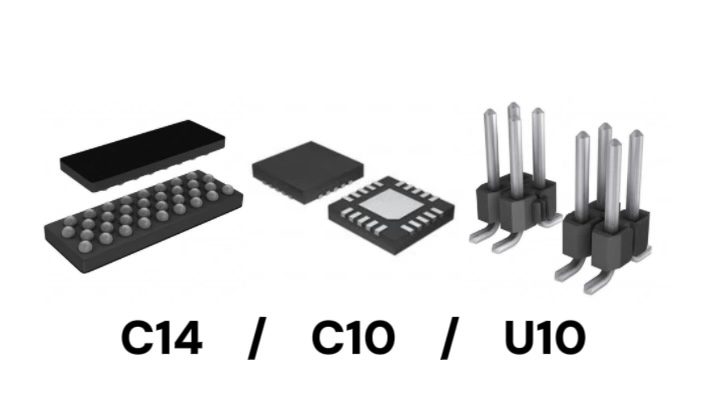
In voice and embedded audio system design, low-power mono audio CODECs are widely adopted due to their high level of integration, simplified external circuitry, and optimized power consumption. These devices are commonly used in smart home products, industrial terminals, automotive voice systems, and consumer electronics.
Within the NAU88 series, although different models share a largely identical core audio architecture, they differ significantly in output driving capability, qualification level, and target application focus.
This guide compares three commonly used models in the NAU88 series — NAU88C14YG, NAU88C10YG, and NAU88U10YG — from both specification and practical engineering perspectives, helping designers make informed device selection decisions during the system design phase.
Parameter Comparison
| NAU88C14YG | NAU88C10YG | NAU88U10YG | |
| Application Grade | Consumer | Consumer | AEC-Q100 Automotive |
| Operating Temperature | -40°C to +85°C | -40°C to +85°C | -40°C to +85°C |
| Audio Channels | Mono ADC / DAC | Mono ADC / DAC | Mono ADC / DAC |
| Max Sampling Rate | 48 kHz | 48 kHz | 48 kHz |
| Digital Interface | I²S / PCM | I²S / PCM | I²S / PCM |
| Analog Input | Differential Mic + AUX In | Differential Mic | Differential Mic |
| Analog Output | BTL Speaker Driver + Headphone | Headphone / Line Out | Headphone / Line Out |
| Package / Size | QFN-24 (4 × 4 mm) | QFN-20 (4 × 4 mm) | QFN-20 (4 × 4 mm) |
Application Analysis
- NAU88C14YG
NAU88C14YG offers the highest level of output integration within the NAU88 series.
- Key Characteristics & Suitability:
Integrated headphone driver and BTL speaker driver, capable of directly driving low-power loads
Eliminates the need for external power amplifiers or op-amps, reducing BOM cost
Ideal for cost- and space-sensitive voice terminals
- Typical Applications:
Smart speakers and smart doorbells
Intercom systems
Voice prompt and announcement terminals
Consumer-grade voice interaction devices
- NAU88C10YG
NAU88C10YG is the most standard and versatile model in the NAU88 series.
- Key Characteristics & Suitability:
Full-featured ADC / DAC with digital audio processing
Line-level output provides high design flexibility
Well suited as an audio front-end paired with external power amplifiers or headphone amplifiers
- Typical Applications:
Embedded voice acquisition modules
Industrial control voice interfaces
Smart home voice front-end systems
Audio systems requiring external amplification
- NAU88U10YG
Functionally, NAU88U10YG is largely identical to NAU88C10YG, but its positioning is clearly different.
- Key Characteristics & Suitability:
Qualified to AEC-Q100 automotive standards
Enhanced reliability for extended operation and harsh environments
Better suited for applications with wide temperature variation and long service life
- Typical Applications:
Automotive voice control systems
Industrial-grade voice terminals
High-reliability embedded systems
Automotive-like, outdoor, or harsh-environment applications
Design Considerations
- Output Drive Capability vs. System Architecture
If the system needs to directly drive headphones or small speakers, NAU88C14YG is the preferred choice, significantly simplifying peripheral circuitry
If higher output power or an existing power amplifier is required, NAU88C10YG or NAU88U10YG provides greater design flexibility
- Qualification Level & Reliability
Consumer and indoor applications: NAU88C10YG / NAU88C14YG are fully sufficient
Automotive or industrial environments: NAU88U10YG should be prioritized due to certification requirements
- Power Consumption & Power Supply Design
Although the NAU88 series is optimized for low-power applications, careful attention should still be paid to:
Separation of analog and digital power supplies
Microphone biasing and front-end layout
Grounding and audio reference ground design
Suboptimal power design can directly degrade SNR performance and increase noise floor.
Common Pitfalls
- Focusing only on audio specifications (SNR / THD) while ignoring output drive capability, resulting in the late addition of external amplifiers.
- Using consumer-grade C10 devices in automotive projects without considering qualification requirements, increasing reliability risk.
- Assuming C14 offers superior audio performance, when its true advantage lies in output-stage integration rather than audio quality itself.
Device Summary
| Model | Manufacturer | Key Takeaway | Buy |
| NAU88C14YG | Nuvoton | Integrated output, direct speaker drive | Buy Now |
| NAU88C10YG | Nuvoton | General-purpose audio front end | Buy Now |
| NAU88U10YG | Nuvoton | Automotive-grade, high reliability | Buy Now |
WIN SOURCE supplies in-production NAU88 series audio CODECs, including NAU88C14YG, NAU88C10YG, and NAU88U10YG. Engineers can quickly complete device selection and sourcing based on project requirements by checking real-time inventory and lead-time information through WIN SOURCE, helping accelerate product development cycles.
©2026 Win Source Electronics. All rights reserved. This content is protected by copyright and may not be reproduced, distributed, transmitted, cached or otherwise used, except with the prior written permission of Win Source Electronics.

COMMENTS