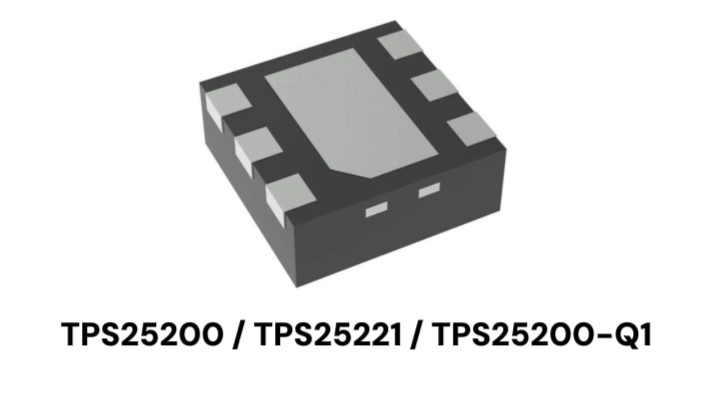
The TPS25200DRVR, TPS25221DRVR, and TPS25200QDRVRQ1 are all adjustable current-limited high-side protection switches from TI, with an integrated N-channel power MOSFET and a single resistor-to-ground that sets the overcurrent threshold. All three are pin-compatible with the TPS2553 and target downstream protection on USB ports, hot-plug interfaces, and adapter-powered rails.
They fall into two classes: the TPS25200 and TPS25200-Q1 are eFuses with input overvoltage protection, while the TPS25221 is a plain current-limited power switch. The first selection question is therefore not current but whether the rail can see overvoltage—whether the device itself must survive a mis-inserted high-voltage adapter or a bus transient. Once settled, the second step is the choice between industrial and automotive grade, and between current and package.
Parameter Comparison
| Parameter | TPS25200DRVR | TPS25221DRVR | TPS25200QDRVRQ1 |
| Class / qualification | 5V eFuse, Catalog | Current-limit switch, Catalog | 5V eFuse, AEC-Q100 auto |
| Input overvoltage protection | 7.6V OVLO + 5.4V OVC | None | 7.6V OVLO + 5.4V OVC |
| IN pin rating (abs. max) | 20V | 6V | 20V |
| VIN operating range | 2.5–6.5V | 2.5–5.5V | 2.5–6.5V |
| Continuous current IOUT max | 2.6A | 2A | 2.4A |
| Adjustable current limit | 85mA–2.9A | 275mA–2.7A | 85mA–2.7A |
| rDS(on) typ | 60mΩ | 70mΩ | 67mΩ |
| Short-circuit response typ | 3.5µs | 1.5µs | 3.5µs |
| Enabled quiescent Iq typ | 143µA | 75µA | 147µA |
Note: the current-limit range is the typical programmable range and rDS(on) is the 25°C typical value. The actual trip point must be verified using the datasheet IOS(min)/IOS(typ)/IOS(max) curves or equations together with the external RILIM resistor tolerance. The −40 to 125°C maximum rDS(on) is roughly 99mΩ (25200), 122mΩ (25221, DRV), and 105mΩ (25200-Q1), so high-temperature design should not rely on 25°C typical values alone.
Application Scenarios
- TPS25200DRVR
The most fully protected of the three. The IN pin withstands 20V; above 7.6V the OVLO disconnects the output, and between 5.4V and 7.6V the OVC clamps the output at 5.4V, protecting the downstream load during a mis-inserted adapter, cable transient, or upstream fault. A roughly 480Ω output discharge resistor bleeds off residual OUT voltage after turn-off, keeping the load from sitting at an undefined level. Under overcurrent the device enters constant-current mode, dropping the full differential across the internal MOSFET and heating up; a sustained overload triggers thermal shutdown with automatic restart. It targets 5V inlets—USB host ports, mobile data cards, SSDs—that need one device covering both overcurrent and overvoltage, with loads up to 2.6A.
- TPS25221DRVR
A plain current-limited switch with every overvoltage feature dropped—no OVLO, no OVC, an IN pin absolute maximum of just 6V, no output discharge resistor. It can only be used on a rail whose voltage is clean and free of overvoltage; if the upstream can mis-insert a high voltage or carry a transient, it cannot protect itself and must rely on front-end clamping.
In return come three benefits: a 1.5µs short-circuit response, under half the 3.5µs of the 25200 series, for faster hot-short isolation; an enabled quiescent current of just 75µA, about half that of the eFuse parts, saving power on always-on light loads; and an extra SOT-23-6 package for easier hand-soldering and rework. The cost is a higher minimum current limit (from 275mA, versus 85mA), unsuitable for low-current ports needing a limit of tens of milliamps. It suits voltage-controlled USB/consumer ports with loads up to 2A that value short-circuit speed and low power.
- TPS25200QDRVRQ1
The automotive twin of the TPS25200, electrically near-identical: rDS(on) 60→67mΩ, continuous current 2.6→2.4A, Iq 143→147µA—differences largely negligible in practice.
Its value is not in the parameters but the qualification: AEC-Q100 certification (CDM ESD raised to ±750V, above the industrial part’s ±500V), plus Functional-Safety-Capable documentation and FIT-rate/failure-mode data that can serve as system-level inputs to a vehicle functional-safety process—though the device itself should not be described as meeting a specific ISO 26262 ASIL level. Any design for automotive USB-port protection or in-vehicle slave-device supply should prefer this part—even when electrical needs match the industrial part—rather than substituting the industrial part.
Design Considerations
- The presence of overvoltage protection is a one-way divide between the 25221 and the eFuse parts
The 25221 is pin-compatible with and looks like the 25200, tempting to treat as a cheaper equivalent—but their protection is not in the same league. Its IN pin absolute maximum is only 6V, with no OVLO and no output clamp; on a rail that can see overvoltage, both device and load have no device-level protection the moment the upstream mis-inserts a 9V/12V adapter or sees a spike. To replace an eFuse part, confirm the rail can never exceed its rating under any condition, or add a front-end TVS/clamp; otherwise stay with the 25200 series.
- All three recover from overcurrent by auto thermal cycling—none latch off
This is easily misread from the parameter tables in some sources. TI’s datasheet body is explicit: under sustained overload all three cycle through current-limit → junction temperature reaching the thermal-shutdown threshold → shutoff → cooling by about 20°C → automatic restart, until the overload clears. During an overcurrent fault FAULT is asserted low after about an 8ms deglitch; FAULT behavior for overtemperature, OVLO, and OVC follows the specific datasheet descriptions. None latches off on a single overcurrent event requiring a power cycle. Two consequences: an uncleared short makes the device thermal-cycle repeatedly, so assess the periodic heating’s effect on device life and neighboring components; and if the logic expects a latch the MCU then clears, none provides it directly—implement the latch yourself using FAULT with external enable logic.
- The nominal current-limit value is not the actual trip point
The table’s current-limit range is the typical programmable range, not the actual trip point. The real minimum/maximum trip points should be verified using the datasheet IOS(min)/IOS(typ)/IOS(max) curves or equations together with the external RILIM resistor tolerance. For ‘must start into full load without false tripping,’ verify against the lower edge (IOS_min); for ‘must not exceed a ceiling to protect the upstream supply,’ verify against the upper edge (IOS_max). Keep RILIM traces short to minimize parasitic effects on the setting.
- Reading rDS(on) as the typical value understates the 25221’s high-temperature heating
The 25°C typical values are close (60/70/67mΩ), but over −40 to 125°C the 25221 (DRV) maximum rises to about 122mΩ, versus roughly 99mΩ and 105mΩ for the two eFuse parts. Conduction loss is proportional to rDS(on), so at full load and high ambient the 25221 runs hotter than its typical figure suggests. Size thermal design using the full-temperature maximum rDS(on), not the 25°C typical.
- Thermal design should rely on the actual PCB, not datasheet thermal resistance
All three WSON (DRV) packages dissipate heat through the vias and copper under the bottom PowerPAD. The datasheet θJA is measured on a standard JEDEC board and can differ greatly from a real multilayer board, so it should not be used directly for junction-temperature estimates. Because the overcurrent protection works by heating up to trigger thermal shutdown, inadequate cooling makes shutdown engage earlier and shortens sustainable delivery time. Leave ample thermal vias and copper for the PowerPAD and verify with full-load temperature rise on real hardware. In the SOT-23 package the 25221’s θJA (about 193°C/W) is far higher than WSON’s (about 83°C/W)—prefer WSON at higher currents.
Product Summary
| Part Number | Mfr. | Key Features | Buy |
| TPS25200DRVR | TI | 5V eFuse, 2.6A, 7.6V OVLO + 5.4V output clamp, fully-protected industrial inlet | Buy Now |
| TPS25221DRVR | TI | Plain current-limit switch, 2A, no overvoltage protection, fastest short-circuit (1.5µs) and lowest Iq (75µA), adds SOT-23 | Buy Now |
| TPS25200QDRVRQ1 | TI | Automotive twin of TPS25200, AEC-Q100 + functional-safety analysis data, electrically close to industrial part | Buy Now |
WIN SOURCE supplies TI current-limit and overvoltage-protection switches and related power-management devices for USB power, hot-plug interfaces, automotive electronics, and consumer power designs. Visit WIN SOURCE to check real-time stock and availability for the TPS25200DRVR, TPS25221DRVR, and TPS25200QDRVRQ1.
©2026 Win Source Electronics. All rights reserved. This content is protected by copyright and may not be reproduced, distributed, transmitted, cached or otherwise used, except with the prior written permission of Win Source Electronics.