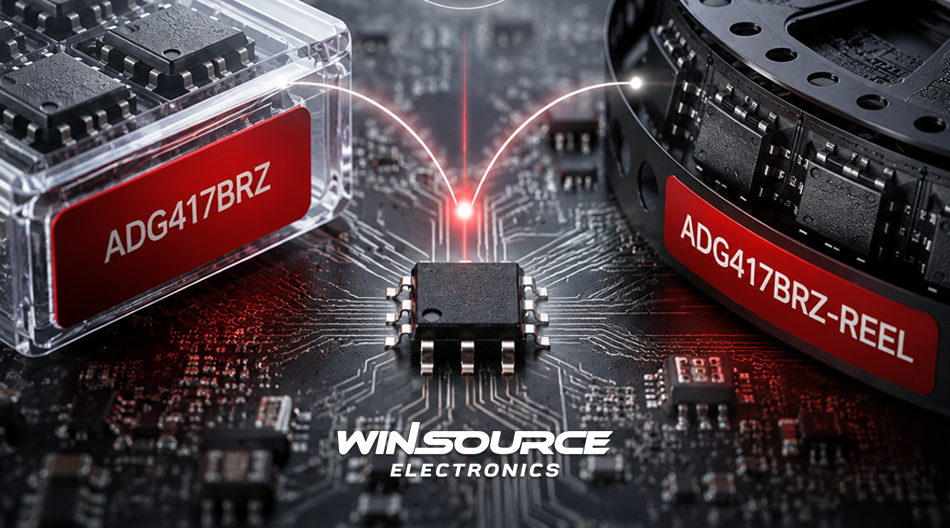
In analog signal-chain design, the same device is often available under multiple suffix-based part numbers. For the ADG417 family, ADG417BRZ and ADG417BRZ-REEL may appear to be two separate devices, but their primary difference lies in ordering and packaging rather than electrical functionality. For engineering design, BOM management, and volume production, understanding the meaning of these suffixes can help reduce duplicate part entries, purchasing discrepancies, and packaging mismatches during manufacturing.
1. Are ADG417BRZ and ADG417BRZ-REEL the Same Core Device?
The ADG417 is a monolithic CMOS single-pole, single-throw (SPST) analog switch from Analog Devices, manufactured using an enhanced LC²MOS process. It features low on-resistance, low leakage current, and low power consumption, with relatively flat on-resistance across the analog input range. Typical applications include precision test equipment, precision instrumentation, battery-powered systems, and sample-and-hold systems. Key specifications include an on-resistance of less than 35 Ω, power consumption below 35 µW, a maximum turn-on time of 160 ns, and a maximum turn-off time of 100 ns.
ADI currently lists both ADG417BRZ and ADG417BRZ-REEL as 8-lead SOIC devices in production. From the perspectives of core device functionality, package type, and circuit design, they belong to the same ADG417 device family. The addition of the “-REEL” suffix should therefore not be interpreted as indicating a different electrical version.
Within ADI’s ordering nomenclature, REEL-related suffixes are used to distinguish Tape-and-Reel packaging options. The suffix primarily affects logistics, packaging, and production feeding methods rather than the functional parameters of the device itself.
2. Why Do Packaging Suffixes Still Matter for BOM Management and Production?
ADI lists both ADG417BRZ and ADG417BRZ-REEL as 8-lead SOIC devices. They share the same core functionality, package type, and circuit application, while the -REEL suffix primarily identifies the Tape-and-Reel packaging option. This difference does not change the main electrical characteristics of the device, but it can affect delivery format, production feeding, and subsequent inventory handling. The two ordering options should therefore remain clearly distinguished during procurement and manufacturing.
For automated assembly, Tape-and-Reel packaging provides components to pick-and-place equipment in a continuous and oriented format, making it well suited to standard SMT production. For prototyping, low-volume builds, or repair applications, a full reel may not be necessary. The actual ordering format should instead be determined based on required quantity, packaging available through the supply channel, and production-line feeding requirements.
In BOM, ERP, AVL, PLM, or procurement systems, electrical attributes and ordering-package attributes should be managed separately. Even though ADG417BRZ and ADG417BRZ-REEL correspond to the same core device from a circuit-design perspective, the complete Manufacturer Part Number should still be retained, or the relevant packaging configuration should be clearly recorded. This helps procurement, inventory, and manufacturing teams identify the actual material format and reduces the risk of production mismatches caused by incomplete packaging or part-number information.
3. How Should ADG417BRZ and ADG417BRZ-REEL Be Selected and Managed in a BOM?
During the design stage, the primary considerations should be the electrical specifications, pin configuration, and package requirements of the ADG417. Since both ADG417BRZ and ADG417BRZ-REEL use an 8-lead SOIC package, the packaging suffix generally does not affect the schematic or PCB layout.
Once the project moves into procurement and volume production, the complete Manufacturer Part Number and packaging configuration should be confirmed. For automated assembly lines, the Tape-and-Reel version can be selected according to feeder and production requirements. Prototype and lower-volume projects should be evaluated based on actual supply format and purchasing quantity. Tape-and-Reel dimensions and packaging specifications should be verified against the manufacturer’s documentation, while minimum order quantities and cut-tape availability should also be confirmed with the relevant supply channel. ADI’s Tape-and-Reel system is designed in accordance with the EIA-481 standard for automated component packaging.
For projects with a locked BOM, packaging suffixes should not be interpreted as performance upgrades or separate functional variants. Any substitution assessment should verify the base device, electrical specifications, package, temperature grade, environmental and compliance status, packaging format, and manufacturing compatibility. This helps prevent electrical compatibility from being confused with procurement-level interchangeability.
Overall, the main difference between ADG417BRZ and ADG417BRZ-REEL lies in the ordering and packaging configuration rather than the functionality of the analog switch itself. During the BOM design stage, the primary focus should be on the core device and package requirements. Once the project moves into volume production, the complete ordering part number should be retained to ensure that the packaging format is compatible with SMT, inventory, and procurement processes. WIN SOURCE’s BOM analysis can support component searches, lifecycle and availability checks, and alternative-part evaluation. For part numbers with packaging suffixes, such as ADG417BRZ-REEL, the complete MPN and packaging configuration should still be verified before procurement.
© 2026 Win Source Electronics. All rights reserved. This content is protected by copyright and may not be reproduced, distributed, transmitted, cached or otherwise used, except with the prior written permission of Win Source Electronics.